
Stop Chasing 7 Hours of Sleep. Your Watch Is Lying to You.
The golden sleep number keeps shrinking. The research is messier than the headlines.
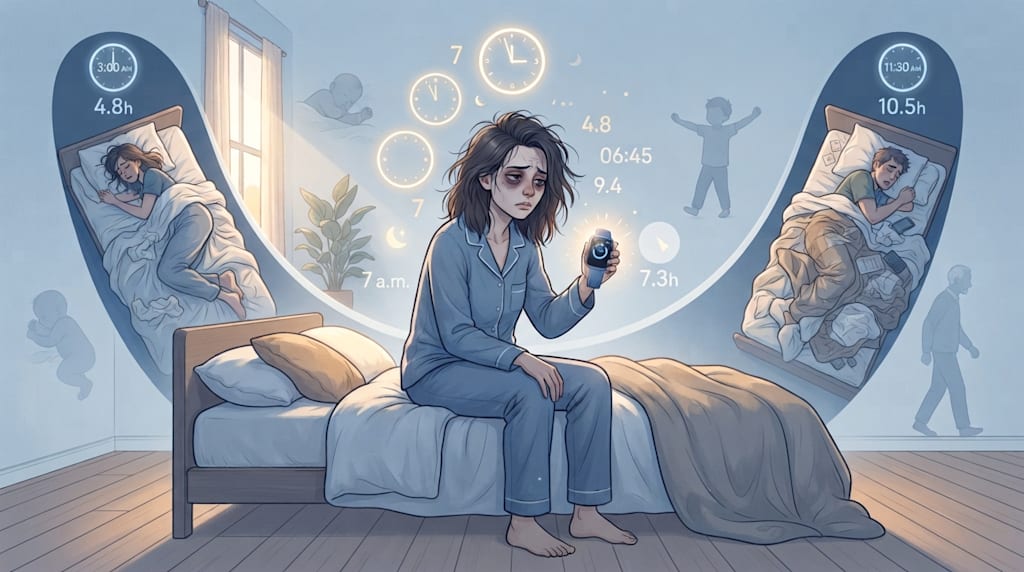
At 7 a.m. your alarm has not gone off. You reach for your phone. Sleep report: 7 hours 12 minutes, deep sleep 1 hour 48 minutes, woke up 3 times. You stare at the 7 hours 12 minutes. How did I miss 8 hours again?
Then the worry starts. Sleepy during the day? Must be sleep debt. Not sleepy? Maybe the watch is wrong. That 8-hour target sits on every night and every morning.
Then the headlines change. Best sleep is not 8 hours. It is 7. Or 7.1. Or 7.32. Or somewhere between 6.4 and 7.8. Now you are more confused. Last year 8. This year 7. Why does the golden number keep shrinking?
Here is what the research says and what it does not say.
Where the 7-hour number comes from
Around 7 hours is a low-risk range in several large population studies. Two words matter: population and range. It is not a personal prescription. It is not a math problem.
In 2026, npj Aging published a study using China Health and Retirement Longitudinal Study data. It followed more than 18,000 middle-aged and older adults for nearly 9 years. Researchers split nighttime sleep into three groups: under 7 hours, 7 to 9 hours, over 9 hours. Sleep duration and frailty risk formed a U-shaped curve. Too little sleep and too much sleep both raised risk. The lowest point sat near 7.1 hours.
Other studies point in the same direction.
A 2026 Nature study of nearly 500,000 people found a U-shaped link between sleep duration and bodily aging. The best range was 6.4 to 7.8 hours. Compared with 6 to 8 hours, sleeping under 6 hours came with a 50% higher death risk. Sleeping over 8 hours came with a 40% higher risk.
A 2026 BMJ subjournal study found an inverted U for weekday sleep and metabolic health. The best point was 7.32 hours. At that duration, insulin sensitivity looked best.
A 2023 BMC Neurology study of 400,000 participants found the lowest cardiovascular risk at 7 to 8 hours. Compared with that range, people who slept 5 hours or less had higher risks of stroke, ischemic stroke, cerebral hemorrhage, and major coronary events: 10%, 7%, 19%, and 23%. People who slept 10 hours or more had risks 12%, 8%, 23%, and 22% higher.
A 2021 JAMA subjournal study of more than 320,000 people found a J-shaped link with all-cause mortality. Seven hours was the low point. Among men, compared with 7 hours, sleeping 8, 9, or 10 hours was linked to 9%, 18%, and 43% higher all-cause mortality. Sleeping under 5 hours was linked to 16% higher risk. Among women, one hour more or less than 7 hours raised all-cause mortality.
A 2022 Nature subjournal study found 7 hours best for cognitive function and mental health. Less or more than 7 hours was linked to cognitive decline and worse mental health.
Put the studies together and the shape repeats. U or J. High at both ends. Low in the middle. The low point often lands near 7 hours.
Why the golden number keeps shrinking
The public standard has changed. Years ago it was 8 hours. Then 7 to 9. Then 7. Now 7.1 and 7.32. It feels like the number shrinks every year. Will someone soon say we need no sleep at all?
That feeling mixes up research findings and headlines.
Research does not hand down a decimal-point standard for every person. 7.1 hours is a statistical low point. It comes from a specific group, a specific health outcome, and a specific model. Change the group, the measurement, or the outcome, and the low point may move to 7.3, 7.5, or 6.8. Papers report confidence intervals. Headlines report decimal points. “7 to 9 hours is low risk” becomes “7 hours is best.” Then it becomes “7.1 hours is golden.”
Sleep research has also changed. Older studies often used questionnaires. “How many hours do you usually sleep?” was enough. Now wrist accelerometers, smartwatches, and fitness trackers estimate sleep onset, awakenings, and regularity at scale. Once the data is collected, researchers can match it against heart disease, diabetes, cognitive decline, and death. One year they study duration. The next year they study efficiency. The year after, a new algorithm finds something else. Better measurement shows that arguing over 7 versus 8 hours is crude.
Media does not like crude. Media likes simple, certain, punchy numbers. So every year brings a new “golden sleep duration.” Last year 8. This year 7. Next year 6.5. If you reset your alarm every time, the headlines run your life.
There is another problem. Reverse causation.
A study finds that people who sleep over 9 hours have higher frailty risk. Does that mean long sleep made them frail? Not necessarily. Middle-aged and older adults are more likely to have chronic disease, depression, reduced mobility, sleep apnea, and neurological disease. Those problems can lengthen sleep and raise frailty risk. The order may be: health declines, then sleep lengthens, then frailty appears. Observational studies cannot wash out all confounding. So “sleeping over 9 hours is linked to higher risk” does not mean “sleeping long harmed you.”
What different ages need
Seven hours is mainly an adult average. Sleep needs change with age. The National Patriotic Health Campaign Committee Office in China published these ranges in 2025:
0 to 3 months: 13 to 18 hours
4 to 11 months: 12 to 16 hours
1 to 2 years: 11 to 14 hours
3 to 5 years: 10 to 13 hours
6 to 17 years: 8 to 10 hours
18 to 64 years: 7 to 8 hours
65 and older: 6 to 7 hours
Use these numbers to see if you are far outside the normal range. Do not use them as a stopwatch.
Some people are short sleepers. Some are long sleepers. Some feel fine after 5 to 6 hours. Some need 9 to 10. That is biology, not willpower. If you sleep 8 hours, wake up clear, and stay awake all day, do not set an alarm for 7 hours 6 minutes because of a headline. If you sleep 9 hours and function well, do not label yourself as sleeping too much because of one study.
Four traps in the 7.1-hour story
Trap one: treating a statistical low point as a personal rule. 7.1 hours is a population low. It does not mean you must sleep 7 hours 6 minutes. The original study said 7 to 8 hours is a reasonable range.
Trap two: ignoring measurement error. Many studies rely on people’s memory of sleep. Change the group or the method, and the low point moves. Your watch’s 7 hours 12 minutes is not the same as a lab’s 7 hours 12 minutes.
Trap three: ignoring age and individual differences. The 7.1-hour study looked at middle-aged and older adults. Their sleep, diseases, and daily lives differ from a young working parent’s. A population result from older adults does not directly guide a 30-year-old.
Trap four: creating new anxiety. You slept 7 hours and felt fine. A headline says 7 is golden. You relax. Two days later another says 7.32 is best. You worry again. Anxiety hurts sleep. Poor sleep raises anxiety.
Trend beats a single number
What is the one sign you slept enough? You wake up refreshed. You can function during the day.
Sleep medicine looks at duration, quality, regularity, and next-day function. One night tells you little. A trend tells you when something changed.
This is where wearables help. Not as a sleep judge. As a tracking tool. Wear the same watch for weeks or months. Learn your baseline. Maybe you used to sleep 7.5 hours. For a month you sleep a little over 5. Maybe the time is the same but your sleep is more broken and you feel sleepy during the day. That change matters more than whether last night was 7 hours 6 minutes or 7 hours 36 minutes.
A 2023 systematic review and meta-analysis pooled 20 randomized controlled trials with 1,608 adults. Wearables used for sleep intervention and feedback improved some sleep outcomes, including sleep disturbances and daytime impairment. The value is seeing your direction.
Do not treat your watch as an examiner. Treat it as a window.
Watch for change, not a number
If you used to sleep 7 hours and now need 9 or 10 and still feel tired, ask why. Anemia, thyroid problems, depression, infection, and sleep apnea can all change sleep need or daytime energy. After long-term sleep loss, waking after 3 or 4 hours is also worth a doctor’s visit.
Sleep is not a check-in task. Your body is not a spreadsheet. You do not owe a number daily homework.
Eight sleep tips
Keep a fixed schedule. Go to bed and wake up at the same time. Keep weekend shifts under 1 hour.
Stay off your phone for 1 hour before bed. Blue light suppresses melatonin. Try a bath, quiet music, or a paper book.
Do not force sleep. If you are awake after 20 minutes, get up. Sit in another room. Return when sleepy.
Do not burden your gut at night. For 1 hour before bed, skip large drinks, snacks, and hard exercise.
Get morning light. Get 10 to 20 minutes of sun early. Dim lights at night.
Keep naps short. 20 to 30 minutes. Over 1 hour can hurt night sleep.
Keep the bedroom dark, cool, and quiet. Use the bed for sleep. Do not scroll or work there.
If insomnia lasts, get help. Do not tough it out. Do not take sleep aids without advice.
Final note
The golden sleep number gets recycled every few years. 8. 7. 7.1. The decimals get sharper. The anxiety gets heavier.
The research does not say you must sleep 7 hours. It says the sleep-health link is not linear. Too little and too much both carry risk. Pay attention to quality, regularity, and how you feel during the day. Do not worship a number.
Papers like confidence intervals. Headlines like decimals. Read the research. Do not let the headline set your alarm.
If you sleep 7 hours and wake up refreshed, keep going. If you sleep 8 and have energy, fine. If your sleep suddenly drops or rises and your days fall apart, look into it.
Sleep is yours. You know your body. Your experience comes before a chart.
Tomorrow morning, do not grab your phone first. Notice how you feel. If you feel clear, that is enough.
About the Creator
Jin
Writer of reamstories
https://reamstories.com/jin
Enjoyed the story? Support the Creator.
Subscribe for free to receive all their stories in your feed. You could also become a paid subscriber, letting them know you appreciate their work.
Comments
There are no comments for this story
Be the first to respond and start the conversation.