
Spare Parts for a Vanished World
The objects still work. It is the small things they depend upon that are disappearing.

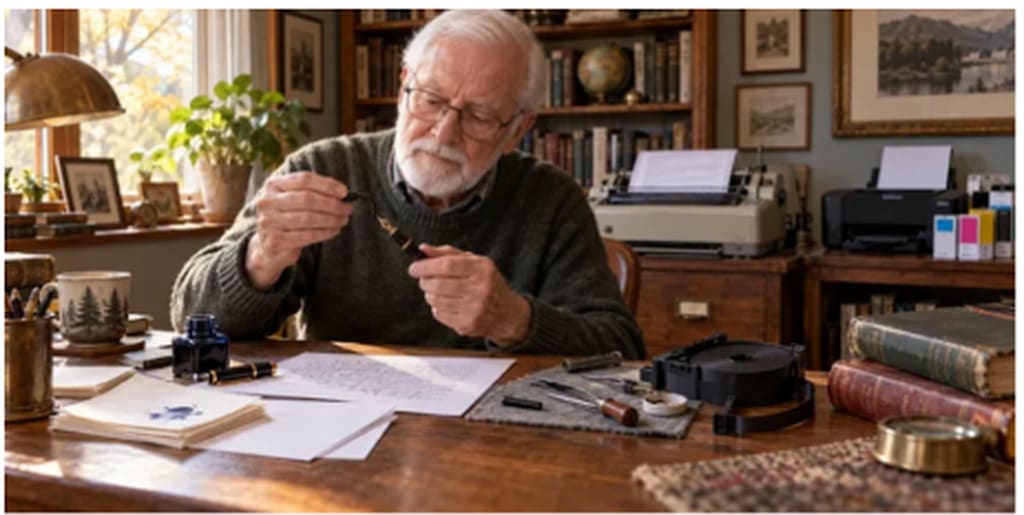
Recently, I decided to buy some blotting paper.
It seemed a simple enough task. Blotting paper was once an ordinary item. Any stationer would have known what it was and probably kept it somewhere near the fountain pens, bottled ink and writing paper.
Today, I searched for it online as though I were trying to locate a replacement component for an extinct machine.
Some results showed facial blotting paper intended to remove oil from the skin. Others showed scientific blotting paper designed for laboratories. Eventually, I found paper made specifically for fountain-pen ink — but then I had to compare dimensions, thicknesses, brands, postage charges and countries of origin.
One packet contained twenty narrow strips. Another offered five full A4 sheets. A recognised French manufacturer sold ten smaller sheets, but one Australian retailer charged almost half the price of the paper again for postage.
I eventually found the same French blotting paper on Amazon, dispatched from Japan and delivered to Australia.
Blotting paper made in France, sold in Japan and sent to Melbourne — all because I wanted to prevent a little wet ink from smudging.
There was a time when I could have bought it by walking into a local stationery shop or even a Milk Bar.
A Fountain Pen That Needed a Rubber Sac
My search for blotting paper was not my first attempt to locate a small item that had once been commonplace.
I own several old fountain pens. Some are reminders of a time when a pen was expected to last for decades. It might become scratched or discoloured, but it was not thrown away merely because it was old.
One of my vintage pens used a lever-filling system. Raising the small lever on the side of the barrel compressed a rubber sac inside the pen. When the lever was released, the sac expanded and drew ink from the bottle.
It was an ingenious system — simple, mechanical and requiring no battery, computer chip or software update.
The pen itself had survived for many decades.
The rubber sac had not.
Rubber deteriorates. It hardens, cracks and eventually loses the flexibility required to draw in ink. The pen can remain attractive and apparently complete, yet be unusable because of a small, invisible component hidden inside its barrel.
Replacing it sounded straightforward: remove the old sac and fit a new one.
I soon discovered that it involved more than simply asking for “a fountain-pen rubber sac.”
What size was required? How wide was the section nipple? How long should the sac be? Did I need shellac to secure it? Should talc be applied so that the new sac would not catch against the pressure bar?
These were once familiar questions to people who repaired pens professionally. A stationer or pen repairer might have opened a drawer containing several sizes and selected the correct one without consulting the other side of the world.
Now the information survives largely among collectors, specialist suppliers and people sharing advice online.
The pen was not obsolete because it could no longer write.
It was becoming obsolete because the small supporting world around it had disappeared.
The Printer That Outlived Its Ribbon
I encountered a similar problem with dot-matrix printer ribbons.
There was a time when the sound of a dot-matrix printer was part of everyday life: the rapid mechanical chatter of the print head moving from side to side while tiny pins struck an inked ribbon against the paper.
The print quality was not elegant, but the machines were remarkably useful. They could print long documents and multipart forms. You could hear them working from another room, and there was never any doubt about whether the printer had begun its task.
Modern printers are quieter, faster and capable of producing images that an old dot-matrix machine could never approach. Yet they have their own ways of becoming unusable. Ink cartridges may be rejected, print heads become blocked, software ceases to support an older model or the printer announces that some internal component has reached the end of its service life.
A dot-matrix printer can continue operating mechanically for years. Its weakness is the ribbon.
Once the ribbon dries out or wears thin, the machine may still faithfully strike every letter onto the page, but the words become increasingly faint. The printer has not forgotten how to print. It has simply run out of the substance that makes its work visible.
Again, the difficulty is not necessarily repairing the main object. It is locating the consumable item that the object requires.
Which ribbon fits the model? Is it an original product or a compatible replacement? Has it been sitting in a warehouse for so many years that its ink has already begun to dry? Is the seller showing the actual item or merely a generic photograph?
The ribbon may cost very little. Finding the correct one may take considerably more time than installing it.
When the Ordinary Becomes Specialised
There is a curious contradiction in all this.
The internet gives us access to more products and sellers than any earlier generation could have imagined. From my desk in Melbourne, I can search shops in Britain, France, Japan, the United States and elsewhere.
In theory, almost nothing is beyond reach.
Yet items that were once available in every local shopping centre have become specialist purchases.
The difficulty is no longer travelling to a shop. The difficulty is identifying the correct item among hundreds of misleading or irrelevant search results.
I can find blotting paper — but is it intended for fountain-pen ink, laboratory experiments, flower pressing or facial oil?
I can find rubber sacs — but will a particular size fit a pen manufactured before the seller was born?
I can find printer ribbons — but are they genuinely suitable for my machine, and is the ribbon itself still fresh enough to use?
We now have access to the entire marketplace of the world, but sometimes I miss the person behind the counter who simply knew what I needed.
Is an Object Obsolete If It Still Works?
We often describe an older object as obsolete when a newer one replaces it.
But perhaps that definition is too simple.
A fountain pen is not obsolete if it still places my thoughts onto paper.
A dot-matrix printer is not obsolete if it still produces the document required of it.
A typewriter is not obsolete if someone still enjoys hearing the keys strike the paper.
A vinyl record is not obsolete if someone lowers the stylus and listens.
These objects may no longer be convenient, but inconvenience and uselessness are not the same thing.
Sometimes a modern replacement performs the task more efficiently. Nevertheless, an older object may offer something the replacement has lost: a physical action, a distinctive sound, a visible mechanism or the satisfaction of understanding how it works.
With a fountain pen, ink travels from a reservoir through a feed and along a slit in the nib until it reaches the paper. I can see the result immediately. There is a direct connection between my hand, the pen and the words.
With a keyboard, the connection is different. It may be faster and easier to correct, but it does not feel the same.
The Advantages of a Disposable Society
We are often described as a disposable society.
The phrase is normally used critically, but disposability is not entirely bad. Mass production has made many products more affordable, reliable and accessible than their predecessors.
Consider the modern motor car. Relative to what it provides, a new car can represent much better value than cars did in earlier generations. It is generally safer, more economical, more comfortable and more reliable, and it may come with a warranty lasting several years.
During that period, the owner has some protection against major mechanical expenses.
In earlier times, a family might keep the same car for many years because replacing it was beyond reach. Considerable amounts of money could then be spent repairing the engine, transmission, cooling system and other components. Eventually, the accumulated repair bills might approach or exceed the value of the car.
Today, when the warranty expires and expensive repairs begin to appear, many owners decide that it makes better financial sense to replace the vehicle. By then, they may be able to purchase another car offering improved safety features, better fuel economy and a fresh warranty.
That is the beneficial side of replacement. We are not obliged to preserve every machine indefinitely simply because it can theoretically be repaired.
Sometimes replacing an ageing object is safer, cheaper and more practical than maintaining it.
When Obsolescence Is Planned
The difficulty begins when replacement is encouraged not by genuine improvement but by poor manufacture, unnecessarily expensive parts or deliberate limitations placed on the useful life of a product.
This is often called planned obsolescence.
Sometimes an item is manufactured so cheaply that repairing it is impossible or uneconomical. Components may be sealed inside cases that cannot be opened. Replacement parts may not be supplied. A small failure can condemn an otherwise functional appliance.
At other times, software support ends while the physical device is still operating perfectly well. The machine has not worn out, but it can no longer communicate with newer systems.
Then there are products that are sold cheaply while the consumable items needed to operate them remain surprisingly expensive.
Printers provide a familiar example.
A new printer may cost less than a complete set of replacement ink cartridges. It can appear that we are buying an inexpensive machine, only to discover that the real cost lies in continually feeding it ink.
The result is absurd. When the cartridges run out, buying another printer may seem more economical than purchasing new ink for the printer we already own.
The old printer then enters the waste stream — not because it is broken, but because the economics of keeping it alive have been made unattractive.
There is an important distinction between an object being obsolete and an object being made inconvenient to retain.
A genuinely improved replacement may save money, increase safety or perform a task far better. That is progress.
But when a useful object is discarded because one small component is unavailable, overpriced or deliberately made impossible to replace, something has gone wrong. We have not necessarily advanced. We have merely become better at replacing things than maintaining them.
The Small Things Supporting the Large Things
We tend to notice the survival of the major object.
The pen remains in a drawer. The printer remains on a desk. The typewriter remains in its case. The record player remains beside a collection of vinyl.
What disappears more quietly are the small things that once surrounded them:
rubber ink sacs;
bottles of suitable ink;
blotting paper;
typewriter and printer ribbons;
replacement needles and styli;
cleaning brushes;
instruction manuals;
and the people who knew how to repair everything.
An object rarely becomes obsolete at one precise moment. It becomes more difficult to use, then more difficult to maintain and finally too troublesome for most people to preserve.
The last replacement part is sold.
The last repairer retires.
The last local shop closes.
Eventually, an object that once served an everyday purpose becomes a curiosity displayed on a shelf.
Keeping Yesterday Working
I recognise that it is not always sensible to preserve everything.
There comes a point when a repair may cost more than an object is worth. Some machines are inefficient, impractical or unsafe. Nostalgia alone cannot justify keeping every outdated device in operation.
Nevertheless, I feel a quiet satisfaction when an old object works again.
A new rubber sac allows a fountain pen to draw ink as it did decades ago. A fresh ribbon gives an old printer a clear voice again. A sheet of blotting paper performs its humble task without electricity, instructions or complaint.
None of these achievements will change the world.
Perhaps that is why I enjoy them.
Modern life frequently encourages us to discard an entire object because one small part has failed. Restoring an older item offers the opposite lesson: sometimes the whole object is still perfectly sound. It merely needs someone willing to search for the missing piece.
I began by looking for blotting paper.
Along the way, I realised that I was looking for more than absorbent sheets, rubber sacs or printer ribbons.
I was searching for the small things that keep the past alive.
And perhaps nothing is truly obsolete while someone still remembers how to use it — and cares enough to keep it working.
About the Creator
George Dimitriadis
Retired mathematics teacher from Melbourne, Australia. I write humorous classroom stories featuring Jimmy, a student who questions mathematical conventions, as well as personal reflections on life, nostalgia and everyday absurdities.
Enjoyed the story? Support the Creator.
Subscribe for free to receive all their stories in your feed.
Comments
There are no comments for this story
Be the first to respond and start the conversation.