
Skipped-Generation Inheritance Is Mostly a Myth. Here’s What Your Grandparents Actually Pass Down
Four grandparents, roughly one quarter each, one tiny mitochondrial tag, and a genetic mosaic that changes from person to person.
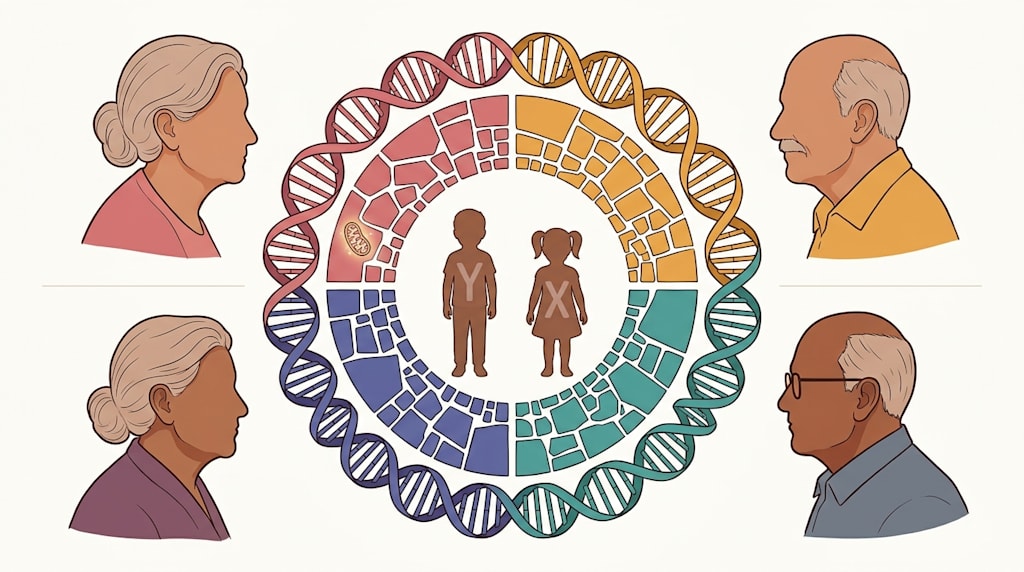
Most people hear “skipped-generation inheritance” and picture a trait jumping over the parents and landing in a grandchild. Genetics can produce that impression through recessive variants, sex-linked inheritance, or several genes acting together. The narrower question here is simpler: how much of a person’s genetic material comes from each biological grandparent?
Across a population, the answer is close to one quarter from each grandparent. Inside one person, the answer is a random mosaic. A few small parts of the genome carry a fixed source. Most of the genome does not.
The one-quarter figure is an average, not a ledger
You inherit about half your nuclear DNA from your mother and about half from your father. Your mother inherited about half from her mother and about half from her father. Your father inherited about half from his mother and about half from his father. Multiply those halves and the expected contribution from each grandparent is about one quarter.
That is a statistical expectation. It does not mean every person carries exactly 25% from each grandparent. Autosomal chromosomes pass as segments. During meiosis, homologous chromosomes pair and exchange pieces. A child receives one chromosome from each parent’s pair, and that chromosome can be a recombinant patchwork of the grandparental copies. The result is a mosaic of segments.
A common simplified model gets this wrong. It says the father has 998 nuclear genes from his parents and randomly passes 499 to the child. Real inheritance does not draw individual genes from a bag. Genes sit on chromosomes. Chromosome segments get passed, and recombination shuffles those segments. The one-quarter figure remains a useful average, but the unit is the segment, not the single gene.
A few parts of the genome carry fixed labels
Most of the genome behaves like a four-color mosaic. A few parts do not. They are small in quantity. They still add a fixed source to the picture.
Mitochondrial DNA comes through the maternal line. A child’s mitochondrial DNA comes from the mother, and her mitochondrial DNA comes from her mother. In the four-grandparent frame, that line points to the maternal grandmother. The human mitochondrial genome is tiny: 37 genes, about 16.6 thousand base pairs. By gene count it is roughly 0.1 to 0.2% of the human gene set. By DNA length it is far less. It gives the maternal grandmother a certain presence. It does not turn her into a majority contributor.
A boy’s Y chromosome comes from his paternal grandfather. A boy inherits an X from his mother and a Y from his father. The father’s Y came from the paternal grandfather. The Y is small and gene-poor compared with the X. This fixed label is real, but limited in gene content.
A girl’s paternal X chromosome comes from her paternal grandmother. A girl inherits one X from her mother and one X from her father. The father has one X, and he received it from his mother. So the paternal X in a girl has a fixed source: the paternal grandmother. The X is larger and carries more genes than the Y. This label is more substantial than a boy’s Y label.
The maternal grandfather has no equivalent chromosome label. He contributes through autosomal segments. His expected share is about one quarter. There is no mitochondrial, Y, or paternal-X tag that necessarily points to him. His contribution is real. It is simply less labeled.
The fixed labels are asymmetric. Maternal grandmother: mitochondrial DNA. Paternal grandfather: a boy’s Y. Paternal grandmother: a girl’s paternal X. Maternal grandfather: autosomal segments, no comparable tag.
Boys and girls differ, but only a little
A common shorthand says everyone gets slightly more from their mother than from their father. That sentence needs a qualifier.
For a boy, nuclear DNA is slightly biased toward the mother. He receives an X from his mother and a Y from his father. The X is larger and gene-rich. The Y is small and gene-poor. Add mitochondrial DNA from the mother, and the maternal bias in total DNA grows a little larger.
For a girl, nuclear DNA is roughly half from each parent. She receives one X from her mother and one X from her father. The two X chromosomes differ in origin, but in quantity the parental nuclear contributions are close to even. Mitochondrial DNA still comes from the mother, so her total DNA has a small maternal bias.
A boy’s nuclear DNA is slightly maternal-biased. A girl’s nuclear DNA is roughly even, with a small maternal bias in total DNA from mitochondria. These are small deviations. One parent does not supply most of the genome.
Individual variation can be large
The one-quarter expectation applies to each grandparent. The variance around that expectation can be substantial. A person may inherit more segments from one grandparent and fewer from another. In an extreme case, a grandparent’s autosomal contribution can be very small. Very small does not mean absolutely zero. It also does not mean every grandparent must leave a detectable segment in every region. Recombination usually happens. It is not a guarantee that every ancestral line appears evenly across the genome.
This is why “looks like” and “genetic share” are different questions. A child may resemble a grandmother because a few genes affecting facial features, hair, or build came from that line. A child may not resemble a grandfather even though his autosomal contribution is near the expected one quarter. Similarity is shaped by a small number of visible traits, gene expression, environment, and chance. It is not a readout of total ancestry proportion.
Population averages depend on what you count
At the population level, the four-grandparent expectation is close to one quarter each. The fixed labels create small deviations. The size and even the ranking of those deviations depend on what you count.
By gene count, the maternal grandmother has a fixed mitochondrial contribution to all grandchildren. The paternal grandmother has a fixed paternal-X contribution to granddaughters. The paternal grandfather has a fixed Y contribution to grandsons. The maternal grandfather has no comparable fixed chromosome tag. Because the X is much larger than the Y, the paternal grandmother’s fixed addition is usually larger than the paternal grandfather’s. The mitochondrial addition is certain but numerically tiny. The maternal grandfather’s contribution is carried by autosomal segments and stays close to the one-quarter expectation.
The shorthand “the maternal grandmother is slightly ahead” is not a universal ranking. It depends on whether you count genes, DNA length, fixed chromosome labels, or detectable segments. Across these methods, one point holds. The deviations are small. The baseline remains roughly one quarter from each grandparent.
What to keep in mind
“Skipped-generation inheritance” is useful in conversation. It should not be read as a grandparent’s genome jumping over a generation intact. The more accurate picture is a four-color mosaic. On average, each grandparent contributes about one quarter of the autosomal ancestry. In any one person, the proportions are a random patchwork of chromosome segments.
Mitochondrial DNA gives the maternal grandmother a small fixed tag. A boy’s Y gives the paternal grandfather a fixed tag. A girl’s paternal X gives the paternal grandmother a fixed tag. The maternal grandfather contributes through autosomal segments without an equivalent tag. Boys have a slight maternal bias in nuclear DNA. Girls are roughly even in nuclear DNA, with a small maternal bias in total DNA.
Resemblance is not a percentage. It is a few visible traits meeting chance.
About the Creator
Jin
Writer of reamstories
https://reamstories.com/jin
Enjoyed the story? Support the Creator.
Subscribe for free to receive all their stories in your feed. You could also become a paid subscriber, letting them know you appreciate their work.
Comments
There are no comments for this story
Be the first to respond and start the conversation.