
Refined Russian Propaganda
New manifesto of the Russian government

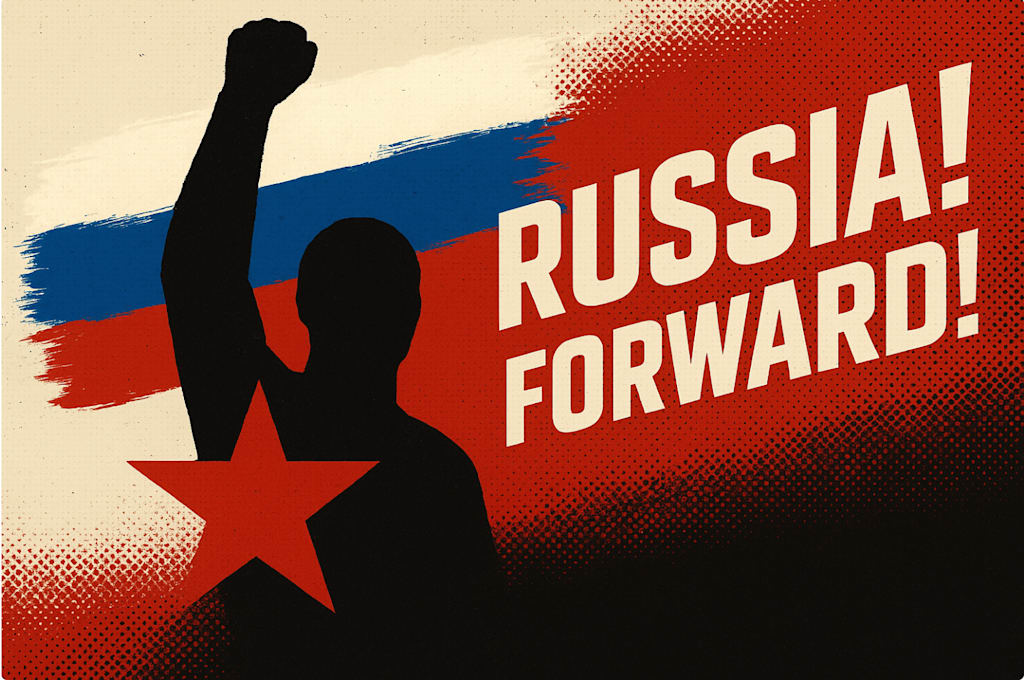
Author's note: I came across this document accidentally on Facebook when a colleague published it as an example of new effort to develop modern ideology for Russia. Despite the fact that the country is still at war with Ukraine (it is never mentioned in the document), the Russian ideologues feel that they need a new program for keeping the country from falling apart. It is a long marvelous document that I could summarize as "Something old, something new, but nothing true." I do not expect anyone to read it in its entirety, as it is probably extremely boring for people who are not specialists in propaganda and rhetoric. But I'll just leave it here for public reference. The original publication in Russian starts on p.18 at this link
Who Are We?
Author: A.D. Kharichev (Head of the Presidential Office of the Russian Federation for Monitoring and Analysis of Social Processes since 2024)
Until recently, education was defined as the formation of certain professional qualities in graduates — the acquisition of a body of knowledge necessary for work after completing their studies. Now, however, we are witnessing a return to the dictates of the past century — directly linked to strengthening the sovereignty of the state. The country needs specialists who are not simply users of foreign technologies but people capable of developing such technologies themselves. It’s not enough to copy a functioning system — we must create our own.
As MIFI rector Vladimir Shevchenko said back in 2018: “A person cannot become an engineer if he doesn’t know Leo Tolstoy. You cannot manage production — and this is the essence and mission of an engineer — if you do not understand how the world works.” Within this logic, a socio-humanitarian core has reappeared in higher education. We can now speak of newly established disciplines such as Foundations of Russian Statehood and History of Russia. Yet much remains to be done — for instance, introducing courses on Russian law, social psychology, the fundamentals of cultural policy, economics, and especially philosophy. In Russia, the dogmatic teaching of Marxism-Leninism left a certain bias in this field. The creation of a new philosophy textbook — free from that bias — is a pressing task. This philosophy textbook should answer the main question: What is a human being, and what is the meaning of existence?
Today, many discussions on this topic are taking place — and they matter. There is much debate over the idea that if Russia claims the status of a civilization, it must have its own distinct values. There are various opinions about this. But if we set aside subjective preferences, one particularly interesting study is that of E.V. Bagdasaryan. Using an expert-assessment method, he found clear differences between our civilization and the Western world (see Figure 1). According to his chart, the main distinctions lie in the opposition between collectivism and individualism, idealism and rationalism, patriotism and cosmopolitanism. In general, the leading values in Russia and in the West show a clear correlation with the spiritual values emphasized in Presidential Decree No. 809. For Russia, the top three values are patriotism, collectivism, and prioritizing the spiritual over the material — that is, idealism. These are what we traditionally call conservative values. For the liberal West, the top priorities are individualism, humanism, and personal freedom.
There is no point arguing which is “better” — civilizations have formed their own value systems over centuries. Personally, I think collectivism, when understood not as conformity, but as solidarity, is a remarkable competitive advantage. The future belongs not to isolated individuals but to true, cohesive teams. Bagdasaryan’s study also attempted to map the world’s civilizations along a scale of values, like a rheostat, and though some results are debatable, they provide a broad picture. For example, collectivism and mercy are so deeply rooted in us that removing them would be impossible; they are part of how we live our entire history. At the same time, there are clear differences within professional groups between individualists and collectivists. As for patriotism, in Western Europe national boundaries of this concept practically no longer exist.
p.2 (17)
Figure 1 Spider chart. Russia and the West: Digitizing Traditional Values
Legend:
- 🔴 Red line – Russia
- 🔵 Blue line – West
Value categories and scores: Russia vs. West
- Life (58 vs 89)
- Dignity (34 vs 54)
- Rights and Freedoms of the Individual (28 vs 94)
- Patriotism (93 vs 63)
- Citizenship (40 vs 75)
- Service to the Motherland and Responsibility for One’s Destiny (81 vs 52)
- High Moral Ideals (85 vs 33)
- Strong Family (55 vs 40)
- Creative Labor (75 vs 64)
- Priority of the Spiritual over the Material (82 vs 35)
- Humanism (66 vs 86)
- Justice (81 vs 38)
- Mutual Aid and Mutual Respect (75 vs 50)
- Historical Memory and Continuity of Generations (69 vs 52)
- Unity of Nations (84 vs 22)
- Collectivism (91 vs 11)
- Mercy (84 vs 27)
p.3 (18)
That’s their particular nature. And consequently, they (Westerners) are, by definition, cosmopolitans. We, on the other hand, are more patriotic. Living across vast territories, though within strictly defined borders, throughout its history Russia has been compelled to defend them. Our state has been built this way for centuries. There is no antagonism in these differences — only distinct priorities. Therefore, within the global civilizational framework, we can clearly define a Russian civilizational code.
We attempted, through several iterations, to formulate our own interpretation of this code. Ultimately, we identified 56 values which, in our view, constitute a complete collection of our civilizational identity.
For us, life itself matters far less than it does for a Western person. We believe there are things more sacred than the mere fact of life. This, in essence, is the foundation of all faith. Therefore, one of the essential elements of our civilizational code is faith itself.
Based on these 56 values, various authors build different models; the most commonly referenced is the vector model (see Figure 3), which, though simplified, best reflects the core structure of the Russian civilizational code.
The first vector consists of rationalism and idealism. We tend to think more in images and ideals. This doesn’t mean we lack analytical ability, of course not. But throughout our history it has been natural for us to imagine, to picture ideal visions of the future, often irrational ones. Hence the constant efforts to build a national or supra-national idea, and the feeling that we’ve always fallen short of it. We are the only ones who have a national ideal. We are the ones who need to build communism, or the Kingdom of God on Earth, or at least one Europe from Lisbon from Vladivostok. We strive toward the ideal, the all-embracing, the universal. Happiness for everyone, lest no one feels left out. No one else in the world has this idea. And if it does, it is first for themselves only.
We have grown accustomed to needing a luminous ideal to strive toward — one we may never fully reach. Thus, on the civilizational “rheostat,” our position lies closer to idealism than to rationalism. And not only because this imperative is often best expressed in poetry: "Russia cannot be known by the mind// Nor measured by the common mile:// Her status is unique, without kind// Russia can only be believed in." [translation of Fedor Tyutchev's 1866 poem by Alex Cigale] But also because to explain our tendency toward emotional devotion, self-sacrifice, heroism otherwise would be extremely difficult.
For us, life itself is worth less than it is for a Westerner. We believe that there are things more sacred than life itself. That, in essence, is the basis of any faith. Therefore, we define one of the core elements of our civilizational code as faith. And if we speak of faith, we immediately touch upon the question of worldview, of whether we are mortal or immortal. And what kind of immortality we mean: religious or civic? We are closer to the idea of civic immortality. We can become immortal in our children, in our deeds, in our actions. And if we believe that we live as long as we are remembered and our actions are remembered, then the answer to the question “Do we, as mortals, believe in the existence of immortality?” becomes: yes. This is indeed a philosophical question, and for us, faith is a sufficiently precise definition of the first vector—rationalism and idealism.
The second vector is individualism and collectivism. I have already mentioned that we see the collective as our competitive advantage. In Russia, the word world ("mir") means both community and togetherness, and a geographic, shared space. At various stages of our history, we have called it faith-based conciliarity, kinship, and communal life. Later we used the terms collectivism, community. Today we call it “teamwork.” The ability to work together in teams, one for one, remains a topic of both tradition and the future. It is evident that development today is driven less by competition and more by partnership. And that too is part of the collectivity, family and kinship.
p.4 (19)
Figure 2. World Scales of Civilizational and Value Reostat
[Graph description: A comparative chart of civilizations ranking values such as life, dignity, human rights, patriotism, family, creativity, mercy, collectivism, etc. Russia appears highest for values like service to the Fatherland, spirituality, mercy, collectivism, historical memory, and unity of peoples.]
Family and kinship — that is one of our essential traits, for we live not as isolated individuals but in small groups, gathering together even for leisure, at the dacha. We are used to this. For us, family means something more than just relatives. A family may include close friends and even colleagues. That is how our world is structured. So when the President says that “Russia is a family of families,” he refers not only to our multinational unity and diversity. He means that Russia is composed of these small groups of friends, colleagues, and kin, which together form a single whole under the name the Great Country. Hence comes our polyphony, our ability to live in such a world where there exist many ethnicities and nationalities. We have learned to coexist, without suppressing or denying one another, without destroying cultural differences. And in this diversity lies yet another of our competitive advantages, a source of development. Therefore, we called this vector “the family as a family of seven 'Is',” [in Russian, the word family - semya can be broken down into sem' and ya, which means 'seven' 'Is,' individual people in the family], or “the team.” To me, this is an even more accurate term than the usual “we.”
The next vector — formal and moral normativity. For a Russian person, the spirit of the law matters far more than its letter. We are less concerned with regulations and procedures, and more with justice and truth. We are guided more by the Ten Commandments than by the 282 laws of Hammurabi. When we violate something, the discomfort we feel is not from being punished, but from our conscience telling us we acted wrongly. We are not tormented if we break a minor rule that no one noticed; but if we violate the truth, fairness, or moral duty, we feel genuine guilt.
We are closer to moral than formal normativity. It is not in our nature to stand obediently at a red light when no cars are around. We do not have a passion for regulations and instructions. But we do have the concept of conscience. From this arises our striving for justice, honesty, and respect. That is why, in many sociological surveys, Russians consistently rank justice as one of their highest values. Nothing else rivals it. We have called this moral imperative in a somewhat populist manner – “the truth,” and it includes all the above values. And the competitive advantage of truth for us is undoubted. Like the famous movie quote goes: “So, tell me, you American, where’s the strength? Is it the money? Here the bro says it’s in the money. But you have lots of money, and so what? I personally believe that the strength is in the truth. Whoever has the truth is stronger.” [this quote is from the Russian 2000 movie "Brother", which is available in full with English subtitles at this link]
p.5 (20)
Figure 3. The Civilizational Code of Russia
Chart shows paired vectors:
Rationalism ↔ Idealism (Imperative: Faith. Service, sacrifice, heroism),
Individualism ↔ Collectivism (Imperative: Family/We. Teamwork, kinship, multiethnicity),
Formal Normativity ↔ Moral Normativity (Imperative: Truth. Honesty, justice, conscious),
Dependent Development ↔ Independent Development (Imperative: Motherland. Patriotism, sovereignty, messianism),
Negative Freedom FROM ↔ Positive Freedom FOR (Imperative: Will. Creativity, endurance).
***
The next pair of vectors is more complex; it is called dependent and independent development. This pair has a distinctly historical contour. For example, Moldova has almost always existed in a state of dependency — first on Turkey, then Romania, then Russia, and today the EU. It has grown so accustomed to subordination that it may no longer see the possibility of independent existence. But there are countries whose history has taught them self-reliance, nations accustomed to their own sovereignty and the defense of their independence — especially those with vast borders. Throughout its history, Russia has constantly fought for sovereignty. In our civilizational code, this striving for independence has entered deeply. To be independent means to be a country with its own Self. You have Catholicism, we have Orthodox Christianity; you have capitalism, we'll build socialism. This very sovereignty is the foundation that we understand as patriotism. Love for the Motherland, responsibility for its fate — these are deeply ingrained feelings in a person, often realized consciously. Therefore, we are not cosmopolitans but patriots, primarily because we are used to possessing a sense of “I” — and to defending the independence of our country. Whether this constitutes a competitive advantage or not, I cannot say. History, perhaps, will judge. But the Motherland is, of course, a key concept bearing the main meaning in our system of identity. The President put it precisely: “Patriotism is our national idea.”
And the next vector concerns freedom. Freedom from or freedom for? Freedom from something (obviously, something oppressing, constraining, limiting) or freedom of will? We, of course, are closer to the latter. Everything that concerns us is more about freedom of will. Historically, freedom of will has higher value for us. Daniil Danilevsky explained that our civilization’s climatic and geographical factors shaped us this way. We can endure, persist in hardship, withstand harsh winter and uncertainty — and then suddenly (mobilize when necessary) accomplish heroic deeds. But we are not used to systemic, grinding work. Perhaps this extreme oscillation is the source of our many troubles. For us, the problem is not to design a unique device, but to put it into mass production and make it affordable. I don’t think this is our unconditional competitive advantage, but our ability to step outside the comfort zone, to show will, certainly is a valuable quality.
p.6 (21)
Figure 4. Structure of Russian Civilization
(Diagram description: Center — “Human Being: Preservation and Development.”
Connected to: Society (Ethical Norms and Values), Family (Reproduction – Biological and Social), State (Security and Governance), and Country (Opportunities and Resources for Development)
***
Now, let us speak about the challenges facing our civilization, if we view it through the five-element model above (Figure 5).
The first challenge is the challenge before society. Much has been written about division and contradiction. Essentially, the most serious challenge facing society is what can be called a civil war — the division of people, the fragmentation of the country, the loss of the ability to unite in the struggle for self-preservation and development. We have experienced this in our history at least twice: in the 17th and the 20th centuries. And who can say that it cannot happen again? Such a challenge could arise under many conditions: conflicts on national or religious grounds, generational, or property-based contradictions. But this is the risk, or more precisely, a challenge and a threat, that is always present in any social system.
The challenge before the country is the loss of sovereignty of any kind: military, territorial, political, or cultural. If the Special Military Operation (СВО) had not happened, then perhaps we could already state the fact that Russia, over a certain — though not very long — period, would have lost its political sovereignty. The Russian elite was, in essence, oriented toward sending its children to study abroad, to secure its own retirement structure. Those who were richer sent their children to the south of France, those who had less money - to Montenegro. That is, we simply were losing the elites. Almost 70% of graduates of elite physics and math high schools went to study abroad and never returned. After some time, this would have meant the loss of our country’s potential — economic, technological, and political alike.
The challenge before the country is the loss of sovereignty of any kind: military, territorial, political, or cultural. If the Special Military Operation (СВО) had not happened, then perhaps we could already state the fact that Russia, over a certain — though not very long — period, would have lost its political sovereignty.
For Russia, the Special Military Operation became a form of purification. To repeat: the loss of sovereignty is the main challenge the country faces.
p.7 (22)
Figure 5. The Civilizational Formula of Russia
(Five key concepts in the ascending order: Motherland — Faith — Family — Truth — Will)
***
There is no other like it. The feat of our soldiers is not only in defending our borders but also in having saved our collective consciousness. Because every person who speaks of globalization or traveling to Europe must also think of those at that same moment who, under the attack of enemy drones, are defending the Motherland, while others hold parties in the Maldives. If only for that reason alone, their sacrifice is for our very ability to rest, to celebrate, and to be happy.
The challenge before the family is, of course, what is now called depopulation—the refusal to form families, to have a husband and children. This is a globalized phenomenon, the result of long-term globalist social experiments. Today, even China’s Communist Party is seriously studying the causes of falling birth rates, explaining it simply: women in large cities no longer want to form families. They live for themselves, satisfy their own needs, and focus on their career. At around thirty, they might have a single child— from a data-driven match or as a “solo choice.” A single mother family has become the norm. Women have one child and say that's enough. And the husband becomes an additional burden, someone to wash the socks for and to cook. So, if even recently China was fighting skyrocketing birthrate, now they are seriously concerned about its decline. And in the context of progressing infantilism, youth’s desire to “lie on a couch” and to do “remote work,” this pattern is becoming something that is not too far removed from us either.
Depopulation can be a fashionable, beautifully wrapped intervention into consciousness, a virus infecting thought with inadequate and ill-conceived constructs. Today's Europe is infected with growing movements rejecting procreation and the family that are sadly known as “child-free.” Russia opposes the LGBTQ+ culture not because we consider it immoral. We have long eliminated the criminal prosecution for it. However, the propaganda of this lifestyle and pulling the youngsters into it will simply result into a demographic collapse and destruction of our people, our culture, the country. Therefore we will always inevitably stand against it. Because otherwise, we will perish. Our nation will die otherwise.
As for the state, the main challenge is the loss of trust in authority and the collapse of the political system. This is a well-known story. We already mentioned revolutions and uprisings. In the Western tradition—and among our own so-called “humanitarians”— state power is often seen as monstrous oppressor exerting violence. An impersonal soulless golem. But we need to understand that power is an institution of collective action and shared responsibility, historically formed within the framework of a particular culture and language.
p. 8 (23)
Figure 6. Key Ideological Lines of State Policy
(Diagram: The five sectors and their challenges and responses)
• Society
Challenge: Conflicts on social, economic, national, cultural, and political grounds.
Response: Formation of a solidary and unified society.
• Country
Challenge: Loss of political, economic, and technological sovereignty.
Response: Forming patriotic attitudes in society and among the younger generation.
• Human Being
Challenge: Dehumanization and virtualization of life —human as a digitalized commodity.
Response: Upbringing of the human being of the future.
• Family
Challenge: Refusal to form families and have children; depopulation.
Response: Popularization of family values and a modern multi-child family model.
• State
Challenge: Loss of trust in authority and the destruction of political institutions.
Response: Meritocracy and improvement of efficiency and manageability of state institutions.
***
Power, of course, can be usurped and detached from the citizens. But such systems do not live long. Power, always and in all times, has been based on trust, the trust of some people in others. Power entrusts the executive branch with duties and authority that exist precisely for the fulfillment of these responsibilities. Therefore, the institutions of power (governance) are an essential and effective mechanism securing nation's preservation and development.
Depopulation can be a fashionable, beautifully wrapped intervention into consciousness, a virus infecting thought with inadequate and ill-conceived constructs.
It is no coincidence that people speak of multiple powers. There is the “fourth power” — journalists. And even of the “fifth power” — educators. This list can be continued. The problem of lost trust between people, trust in those who hold authority and those who follow it, is a fundamental and timeless issue for any state. And, to think of it, the loss of trust in the state means the loss of the citizens’ sovereignty and agency. This is a double-edged and most dangerous threat. Those who, having destroyed their own country over the past decades, have built their financial empires on its ruins, know these laws well. However, for us, these efforts mean that we can and must solve real problems of trust and resist the artificial narratives that destroy our world.
For the individual, the challenge is even more complex, dehumanization. Here I will refer to Emmanuel Todd (decidedly not a Russian author), who provided convincing examples of how unlimited freedom leads not to growth, but to disintegration. It is believed in the West that boundless freedom expands and elevates the individual. But, as Todd’s research shows, quite the opposite occurs: the individual becomes fragmented, detached from the team, from collective action and no longer finds meaning in cooperation or shared effort. The individual can grow only in a social network. In isolation, the individual fragments and atomizes, becomes smaller, shrinks. And that, Todd argues, is the main malady of liberal civilization, i.e. destruction of an individual against the backdrop of mass desocialization.
The atomization and dehumanization of individuals can manifest in different ways. A person may turn into a consumer of products and services, or, as happens now, into a product. In essence, the market has absorbed even human agency and today, sales and advertising have become its highest forms of manipulation. In such a society of consumption the human becomes the subject of consumption.
p.9 (24)
The second story is the virtualization of the human being, wherein, due to the development of information and communication systems, it becomes more comfortable for a person to exist in the virtual world than in the real one.
We must put our effort not only into the military patriotism, but rather into civic-patriotic and spiritual-patriotic upbringing which is inconceivable without broader worldview aspects.
And entering this virtual world, one ceases to be human, becoming instead a virtual avatar. This is dehumanization — subtle, yet extremely dangerous. It may not be fully realized today, but tomorrow it will be. And we will have to face this problem and learn to overcome it.
Responses to the Challenges
When it comes to responses, they must be not instrumental but ideological. They can be based only on our own civilizational code. If responses rely on something alien, they cannot oppose these challenges effectively. And if we are speaking about society, then we must begin with the concept of “We.”
It is necessary to form a solidary, unified, and cohesive society. That is why we are promoting the volunteer movement “We Are Together.” From this initiative emerges the ideology of “We do not abandon our own” — an orientation toward cohesion, solidarity, and the creation of unifying values. Such values make it harder to impose conflict and division from outside.
When it comes to the country, it is obvious that the formation of patriotic consciousness and patriotic education are essential. I believe the time is near when the Russian Federation will adopt federal laws on patriotic education, defining the goals and objectives for schools, universities, and government institutions — along with measurable indicators of effectiveness for fostering patriotic attitudes.
The main point on this path is not to chase events or numbers, as that leads only to superficiality and burnout. On the eve of 1917, the Russian Empire had around 2.5 million people involved in patriotic associations; the 300th anniversary of the Romanov dynasty was celebrated with great enthusiasm. Churches were full, and people participated in religious processions. We can also recall the patriotic rise at the beginning of the First World War… But within a few months, the system collapsed, and the country descended into chaos. The same happened later in the Soviet Union: we celebrated Soviet holidays, honored Lenin’s anniversaries, held the grand 1980 Summer Olympics. We were building communism, rejecting God, the Communist Party had 18 million rifles on the ready but everything nonetheless fell apart quickly and tragically.
That is why we must place the emphasis not only on military patriotism, but also on civic and spiritual-patriotic education, which is unthinkable without worldview dimensions.
As for the state, we inevitably come to the question of meritocracy. Positions and influence must be distributed based on achievement, merit, and talent — not on nepotism or connections. Using meritocracy as a guiding principle, the President [Putin] launched an open competition for the new generation of leaders — the “Leaders of Russia” program, and that's why are now in the seventh year of the “School of Governors.” Our interviewees, selected through open competition, go through a process akin to natural selection, but with moral foundations. Because what the country needs most are people with moral authority.
And finally, regarding the human being... We must raise a person of the future, not a virtual avatar or a biorobot, but a human being capable of preserving and developing the values of our civilization. We have sketched out seven most important and essential pillars that make up this code (see Fig. 7). We need patriots, not couch potatoes, who are sovereign, self-reliant, and ready to answer for themselves, their family, and their country.
Multi-ethnicity is, in fact, our true competitive advantage.
p.10 (25)
Figure 7. The Person of the Future and the Value Orientations They Subscribe To
1. Active Patriotism
The value of personal involvement in Russia’s fate; love for the Motherland; pride in one’s country; responsibility for its destiny.
2. Creative Labor and Service
Service as the highest form of self-realization in creative work.
3. Teamwork and “We”
Mutual assistance and cooperation. Cohesion and solidarity.
4. Unity of Peoples
Our strength lies in our diversity, our uniqueness — a source of pride and development. Russia is a family of families.
5. Family Values and Traditional Moral Norms
The importance of family and children (three or more). Reliance on conscientiousness and moral-ethical principles.
***
In this diversity — of cultures, traditions, and identities — lies our strength. When we are different, we enrich one another. If we do not focus on what divides us, but instead look for what makes each of us unique and valuable to others, then that becomes our strength.
The prioritization of specific moral norms — this might sound counterintuitive, but must develop intolerance to all forms of religious radicalism, sectarianism, and extremism.
Family values are the only true answer to depopulation. We must promote traditional family values. This is a complex effort that includes education, motivation, and public outreach — even down to banning advertising images that portray families with only one or two children. And not to release movies that center on families with 1-2 children, but rather with three or more. This must become a systemic, propagandistic effort to normalize large families. Of course, motivation is essential. There must be incentives: mortgage support, family capital, and other meaningful financial benefits that make having children truly worthwhile. And paradoxically, although it may sound outdated, it is the right and necessary thing: Medical consultations are needed not only for women but also for men, because male health — as shown by practice — is a powerful limiting factor in birth rates. Doctors and psychologists working in this area confirm it.
Finally, there is another aspect no less important — or perhaps even more so: service. We have spoken of the ideal that every person should have a higher purpose. Recent research studies have shown that in over 70% of various professions and organizations service is possible and viable. A soldier serves the Motherland; a government official — the people; an actor — the art; a scientist — science; a doctor — health and life; a teacher — children. That is, service can exist in all professions, and it turns out that many of us are already serving without realizing it.
Perhaps the time has come to recognize this — that medical and educational professions should not be treated as mere careers, but as forms of service. There are no transactions in medicine or education, but there is service. When that understanding takes hold, when we turn from the language of profit and fees toward the language of duty and service, it will be a great step forward — toward the formation of the human being of the future.
About the Creator
Lana V Lynx
Avid reader and occasional writer of satire and short fiction. For my own sanity and security, I write under a pen name. My books: Moscow Calling - 2017 and President & Psychiatrist
@lanalynx.bsky.social
Enjoyed the story? Support the Creator.
Subscribe for free to receive all their stories in your feed. You could also become a paid subscriber, letting them know you appreciate their work.
Comments
There are no comments for this story
Be the first to respond and start the conversation.