
Punjab Skills Revolution Could Change the Future of Work
How Punjab Is Building a Workforce for the Global Economy
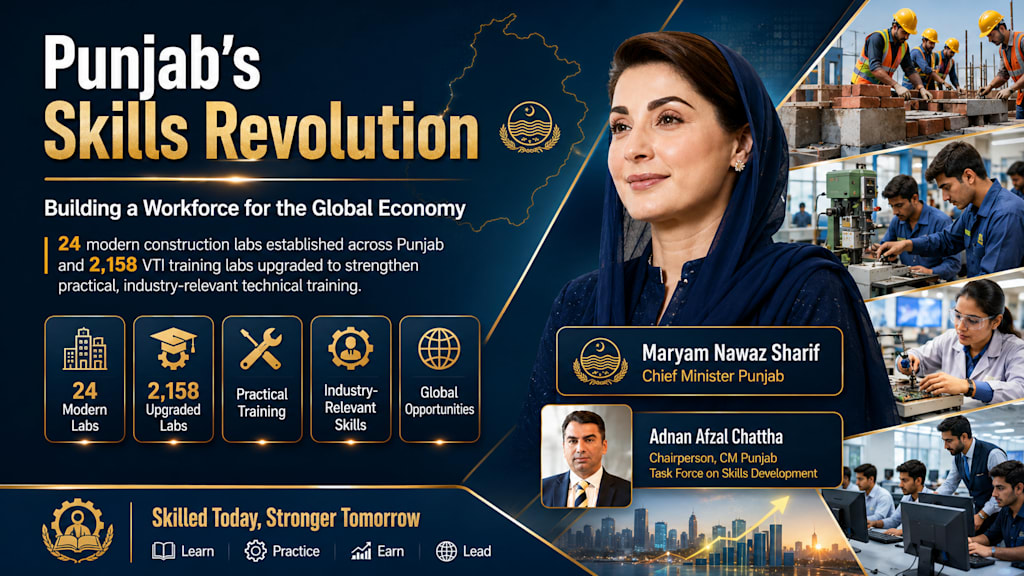
Across the world, economic competition is no longer defined only by roads, factories, technology parks, or investment figures. Increasingly, the real measure of a region’s future strength lies in the quality of its people: how well they are trained, how quickly they can adapt, and whether their skills match the demands of a changing labour market.
Punjab appears to be moving in that direction with a renewed focus on technical and vocational education. Under the leadership of Chief Minister Maryam Nawaz, and with strategic input from Task Force Chairperson Adnan Afzal Chattha, the province is attempting to reshape its skills development framework around a more practical question: are young people being trained for certificates, or are they being prepared for real jobs?
That distinction matters.
For many years, vocational education systems in developing economies have often been judged by the number of trainees enrolled, the number of certificates issued, or the expansion of training centres. These indicators are important, but they do not always tell the full story. A certificate has limited value if it does not lead to employability. A training programme has limited impact if employers still need to retrain graduates from the beginning.
Punjab’s current reform direction suggests a shift from activity-based training toward outcome-based workforce development. In simple terms, the focus is gradually moving from “how many people were trained” to “how many people became employable.”
Why Governance Matters
One of the most important parts of any skills reform is governance. When multiple institutions work separately, with overlapping mandates and different priorities, implementation often becomes slow and inconsistent. Training bodies may duplicate work, policies may lack coordination, and employers may struggle to understand where to engage.
Punjab’s move toward a more unified and coordinated model is therefore significant. A “one-window” style approach can help reduce fragmentation and allow faster decision-making. It can also create clearer accountability, which is essential when reforms are expected to deliver measurable results.
This kind of coordination is not merely administrative. It directly affects the quality of training. When policy, curriculum, industry consultation, certification, and placement efforts are aligned, the overall system becomes more responsive. It becomes easier to adjust programmes when labour market needs change.
In a fast-moving economy, that responsiveness can become a competitive advantage.
From Training Rooms to Workplaces
A skills system should not operate in isolation from the industries it is meant to serve. The strongest workforce models in the world are usually those where employers are not treated as outsiders. They are involved in shaping the curriculum, identifying skill gaps, offering apprenticeships, and supporting job placement.
Punjab’s reform model appears to recognize this point. By giving greater importance to industry consultation and public-private collaboration, the province can make training more relevant to real workplace needs.
This is especially important in sectors such as information technology, construction, healthcare support, hospitality, manufacturing, and technical trades. These sectors do not remain static. Tools change, standards change, customer expectations change, and international requirements change. If training programmes are not regularly updated, graduates can fall behind before they even enter the job market.
A practical workforce strategy must therefore be built around continuous feedback from employers. It should ask: what skills are needed today, what skills will be needed tomorrow, and how quickly can training institutions respond?
Preparing for the Global Labour Market
Punjab’s skills development agenda also has a broader economic dimension. The global labour market is facing shortages in many skilled and semi-skilled occupations. Countries in the Gulf, Europe, and East Asia continue to need trained workers in several sectors, including technical services, healthcare support, construction, hospitality, and digital work.
For Punjab, this creates an opportunity. If training programmes are aligned with international standards, language requirements, workplace discipline, and recognized certification pathways, young people can access better employment opportunities beyond local markets.
This is not only beneficial for individual workers and their families. It can also support the wider economy through remittances, professional exposure, and the development of a more globally competitive workforce.
However, export-oriented skills development must be handled carefully. It should not be limited to sending workers abroad in low-paid categories. The stronger goal should be to prepare people for higher-skilled, better-paid, and more secure employment. That requires quality training, credible certification, career counselling, and partnerships with responsible employers and overseas placement channels.
Inclusion Should Remain Central
A modern skills strategy cannot succeed if it only benefits those who already have access to opportunity. Punjab’s long-term progress will depend on how effectively skills development reaches women, rural youth, low-income communities, and people who have traditionally been excluded from formal training systems.
Inclusive access is not simply a social slogan. It is an economic necessity. When large parts of the population remain undertrained or economically inactive, the province loses talent, productivity, and household income potential.
Expanding access for women is particularly important. With the right training models, safe learning environments, digital access, flexible schedules, and market-linked programmes, more women can enter formal and semi-formal income streams. This can improve household resilience and create wider social benefits.
Similarly, rural training initiatives should be connected to real employment and enterprise opportunities. Skills development should not force every young person to migrate to a major city. It should also support local economies by preparing people for work, services, entrepreneurship, and digital earning within their own regions.
The Challenge Ahead
Punjab’s reform agenda carries promise, but its success will depend on execution. Strong announcements can create momentum, but lasting impact requires consistency, monitoring, and honest measurement.
The key questions will be practical ones
Are training centres delivering quality instruction? Are instructors being upgraded? Are curricula aligned with actual market needs? Are graduates finding jobs? Are employers satisfied with the skills of trainees? Are women and rural communities gaining meaningful access? Are international placement pathways transparent and safe?
These questions should remain at the centre of the reform process
Another challenge is continuity. Workforce development does not produce results overnight. Countries known for strong skills systems built them through years of institutional commitment, employer participation, and constant improvement. Punjab will need the same discipline if it wants these reforms to become more than a short-term initiative.
A Chance to Build a Stronger Future
Punjab’s skills transformation should be seen as more than a technical education reform. At its best, it can become an economic development strategy, a youth empowerment strategy, and a social mobility strategy at the same time.
By focusing on coordinated governance, employability, industry alignment, export-oriented training, and inclusive access, the province has an opportunity to build a workforce system that is more relevant to the modern economy.
The real test will not be how many programmes are launched. The real test will be how many lives are improved, how many young people find dignified work, and how effectively Punjab’s workforce can compete in local and international markets.
If the current reform direction is sustained with quality, transparency, and measurable outcomes, Punjab could become an important example for other developing regions looking to turn human capital into long-term economic strength.
Read Punjab’s Skills Transformation Model Emerges as a Competitive Force in Global Workforce Development
About the Creator
Muddasar Rasheed
https://vocal.media/journal/my-worst-experience-with-simon-leigh-of-pure-reputation
https://www.glassdoor.co.uk/Reviews/Employee-Review-Pure-Reputation-E2198292-RVW70391103.htm
https://simonleigh.weebly.com/
Enjoyed the story? Support the Creator.
Subscribe for free to receive all their stories in your feed.
Comments
There are no comments for this story
Be the first to respond and start the conversation.