
Moonen Yachts and the Appeal of Long-Range Expedition Vessels for the Modern Owner
The expedition yacht has moved from maritime fringe to mainstream aspiration — and Dutch shipbuilder Moonen illuminates exactly why.

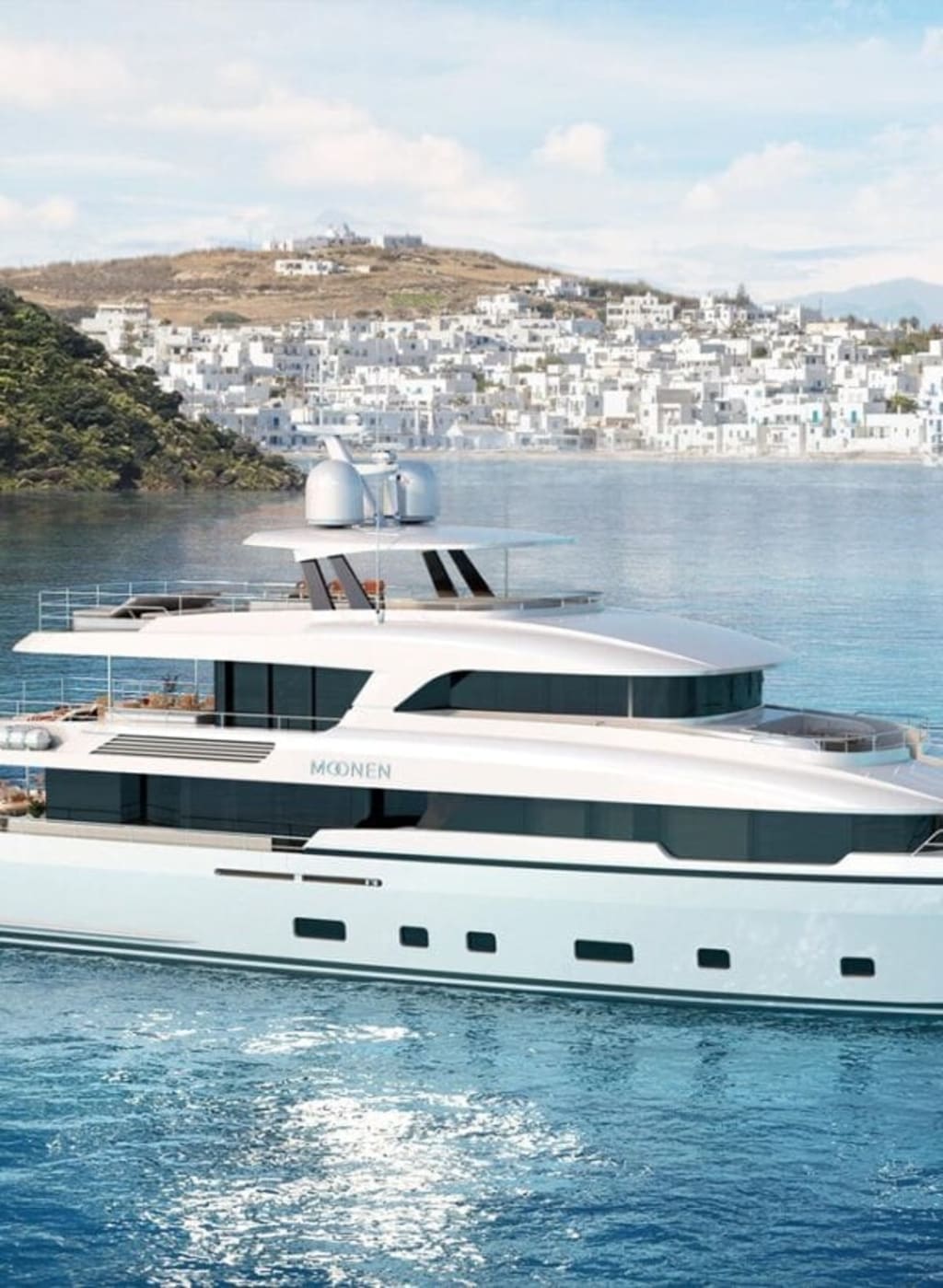
There is a particular kind of ambition that drives someone to buy an expedition yacht rather than a conventional motor yacht. It has nothing to do with the size of the vessel, the brand name above the transom, or the optics of arriving somewhere fashionable. It is, at its core, a decision rooted in what the owner actually wants to do on the water — and increasingly, what serious maritime buyers want is to go places that other vessels simply cannot reach. That desire has turned the long-range expedition segment into one of the superyacht industry's most compelling growth stories, and it has elevated builders like Moonen Yachts to a level of industry esteem that the yard's modest production volume might not immediately suggest.
Moonen Yachts are steel-and-aluminum semi-custom displacement vessels produced in the Netherlands, ranging from approximately 24 to 50 meters. They are built for blue-water endurance: extended range, serious seakeeping, and an interior finish standard that reflects the Dutch shipbuilding tradition at its most considered. Typical cruising range across the Moonen catalog exceeds 3,000 nautical miles at economical speeds, making transatlantic and long-haul passage-making a practical reality rather than an engineering aspiration.
A Market That Has Outgrown Its Own Definition
The expedition yacht category resists clean boundaries, and that definitional looseness has worked in its favor commercially. A decade ago, the segment was reasonably well understood: robust, ocean-capable motor yachts with ice-class or near-ice-class hull construction, extended range, and interiors that leaned functional rather than opulent. Buyers were a specific type — experienced mariners, conservationists, the occasional research-oriented owner. The market was small enough that most superyacht brokers could enumerate the available inventory without consulting a database.
That picture has changed substantially. The expedition and explorer category now encompasses a spectrum running from purpose-built polar vessels to refined long-range cruisers that would look entirely at home in a Mediterranean anchorage, with every variation in between. What has remained consistent is the underlying premise: these are vessels designed to operate far from the infrastructure that conventional motor yachts depend on, for extended periods, in conditions that would test a lesser hull.
The growth in buyer interest has been measured and real. Brokerage houses that specialize in the sector have reported consistent year-on-year increases in inquiry volume for expedition-type platforms, both new-build and pre-owned. In markets like Miami — where the brokerage community serves buyers planning Caribbean circuits, Bahamas passages, and transatlantic repositioning in roughly equal measure — demand for capable long-range vessels has grown faster than available inventory in certain size ranges. That supply-demand dynamic is not accidental. It reflects a structural shift in what a meaningful subset of the wealth-holding population defines as the purpose of yacht ownership.
What Moonen Actually Builds, and Why It Matters
The temptation when writing about any respected niche manufacturer is to traffic in superlatives — to describe the product as the finest, the most rigorous, the uncompromised exemplar of the type. Moonen's reputation does not require that treatment. What the yard produces is more precisely characterized as a specific and consistent expression of Dutch maritime values: the primacy of engineering soundness, the belief that a vessel should perform as well in year fifteen as it did at delivery, and an unwillingness to sacrifice structural integrity for weight savings or visual drama.
Moonen has been building yachts in 's-Hertogenbosch since 1964. The yard's output has never been high by volume — this is not a production facility cranking out vessels to meet a quota — and the semi-custom model it operates means that each build involves genuine dialogue between the yard's naval architects and the owner about how the vessel will actually be used. Hull series provide the structural framework; everything above and within is subject to meaningful customization. The result is a fleet of vessels that share engineering DNA but differ markedly in character, depending on what their original owners prioritized.
The choice of steel-and-aluminum construction is the foundational decision from which everything else follows. Steel hulls are heavier than fiberglass or composite alternatives, and they require appropriate maintenance to prevent corrosion in the marine environment. In exchange, they offer a damage tolerance and repairability that becomes critically important the further a vessel operates from major refit centers. A steel-hulled yacht that grounds on an uncharted shoal in a remote archipelago can potentially be floated, assessed, and repaired by local welders with basic equipment. A composite vessel in the same situation faces a far more complicated recovery scenario. For owners who take the expedition concept seriously — who intend to use their vessels in genuinely remote waters rather than well-charted coastal routes — this is not an abstract engineering preference. It is a practical decision with real consequences.
The interior standards at Moonen have historically been executed by craftsmen with roots in furniture-making and architectural joinery. This matters more than it might initially seem. The marine interior industry has its own conventions, its own materials palette, and its own ceiling of quality — and that ceiling is sometimes lower than what an experienced owner accustomed to fine residential or commercial interiors might expect. Moonen's approach to sourcing and executing interior work has, over decades, produced vessels whose interior quality holds up under close inspection and extended use in a way that distinguishes them from peers built to similar price points but with different priorities.
The Buyer Who Has Moved Beyond the Marina
Understanding expedition yacht demand requires understanding who is actually driving it — and the answer has evolved considerably over the past fifteen years. The early adopter profile was fairly narrow: blue-water sailors converting to motor power, former commercial mariners, a handful of genuinely adventurous owners with the seamanship credentials to back their ambitions. These buyers understood ocean passages from experience and chose expedition vessels because the alternative — a conventional motor yacht optimized for sheltered coastal cruising — was simply inadequate for the itineraries they had in mind.
The contemporary expedition yacht buyer is a broader and more varied figure. Entrepreneurs who have spent careers building companies and have finally reached a point where discretionary time is available, but whose relationship with risk has been shaped by decades of high-stakes decision-making, often gravitate toward the expedition category for reasons that are partly philosophical. These owners tend to research their purchases with unusual thoroughness. They consult surveyors, interview delivery captains, read technical specifications with genuine comprehension, and demonstrate a healthy skepticism toward the marketing language that permeates the superyacht industry. They want capability because they intend to use it.
Family ownership is another significant driver. The aspiration to bring children and grandchildren to places that cannot be reached any other way — to anchor in uninhabited bays, to observe wildlife in undisturbed natural habitats, to conduct a voyage whose geography genuinely surprises people — has become a meaningful motivator for buyers in the 35-to-60 age range who have the resources for serious vessel ownership and want to use those resources to create experiences that outlast any transaction. An expedition-capable yacht makes those experiences structurally possible rather than logistically complicated.
The Miami market reflects this demographic mix with particular clarity. South Florida functions as a genuine crossroads for international yacht buyers — Latin American ownership is significant, as is European buyer interest in vessels positioned for Caribbean deployment — and the itinerary appetite that characterizes many Miami-based owners runs well beyond day trips and weekend anchorages. Vessels listed with brokerage houses serving the South Florida market are evaluated against a usage expectation that frequently includes extended Bahamas passages, Lesser Antilles circuits, and occasionally transatlantic repositioning. In that context, the engineering seriousness of an expedition platform like a Moonen is not a premium feature — it is a baseline requirement.
Range, Endurance, and What the Numbers Actually Mean
The marketing of range figures in the superyacht industry deserves some scrutiny, because the headline number and the operational reality are not always the same thing. A vessel quoted at 3,000 nautical miles of range achieves that figure under specific conditions: a particular speed, a defined sea state, a calculated fuel load, and an assumption about auxiliary power consumption that may or may not reflect how the vessel is actually used. Understanding what a range specification means in practice requires understanding the assumptions behind it.
Moonen's range figures are generally quoted at economical cruising speeds in the 10-to-12-knot range, which reflects how displacement hull forms actually perform most efficiently. The key insight is that the displacement hull is not trying to climb over its bow wave the way a planing or semi-planing hull does — it is optimized to move through water with minimum resistance at a speed-to-length ratio that keeps fuel consumption predictable and manageable. The practical consequence for a Moonen owner is that a transatlantic passage — roughly 3,000 nautical miles from the Canaries to Barbados, or 2,700 miles from Lisbon to the Azores and onward — falls within operational reach without the logistical complexity of tanker-truck fuel deliveries at intermediate stops.
Watermaking capacity is the systems specification that experienced passage-makers pay attention to almost as closely as fuel range. A vessel capable of extended blue-water operation needs to produce its own fresh water in sufficient volume for crew and guests without dependence on marina connections that may not exist along the intended route. High-capacity watermakers, combined with adequate holding and provision storage, are what transform a long-range vessel from a coastal cruiser with a big fuel tank into a genuinely self-sufficient passage-making platform. Moonen's builds have consistently incorporated these systems with the same engineering rigor applied to the hull and propulsion.
Stabilization technology has changed the passenger experience on displacement vessels more than almost any other single development of the past two decades. Gyroscopic stabilizers — operating both at anchor and underway — have addressed what was historically one of the most significant deterrents to extended passage-making: the fatigue and discomfort of rolling motion in open water. A well-stabilized expedition vessel in moderate Atlantic swells offers a qualitatively different experience from an unstabilized one, and that difference is not trivial when passages measure in days rather than hours.
Value, Longevity, and the Economics of Expedition Ownership
The financial case for expedition yacht ownership is more nuanced than either its advocates or its critics typically acknowledge. These vessels are expensive to build and meaningful to maintain, and anyone who approaches an expedition yacht purchase expecting low carrying costs will be disappointed. What the category offers instead is a combination of value retention, operational capability, and longevity that compares favorably to many alternatives in the superyacht market.
Pre-owned expedition vessels from quality yards have demonstrated stronger resale performance than many conventional motor yachts of comparable age, a pattern that reflects both the durability of properly maintained steel-and-aluminum construction and the growing demand base for capable long-range platforms. A Moonen built fifteen years ago, well maintained by an engaged owner, will typically present to a prospective buyer as a vessel with meaningful remaining service life and systems that, while possibly due for updating, are fundamentally sound. That is a different proposition from a composite motor yacht of the same vintage, where hull condition and systems integrity are both more variable and more difficult to assess.
The broader expedition market shows no structural signs of demand moderation. Environmental and geographic curiosity about remote destinations — the high-latitude cruising grounds of Norway and Iceland, the isolated archipelagos of the South Pacific, the wildlife-rich coastal waters of Patagonia — has accelerated rather than diminished among the demographic that can afford serious yacht ownership. New-build yards producing expedition-capable vessels are operating with forward order books that reflect genuine demand, and the pre-owned market has correspondingly tightened in certain size ranges. For buyers and their advisors evaluating expedition platforms — whether approaching the search through European brokerage networks or assessing the yacht for sale Miami inventories that serve the western Atlantic market — the supply picture argues for decisiveness rather than patience when the right vessel becomes available.
Moonen Yachts sits within this market as a manufacturer whose reputation has been built slowly and protected carefully. The yard does not produce vessels at a pace that compromises quality, does not pursue volume at the expense of the engineering standards that define its identity, and does not allow commercial pressure to erode the finish and construction consistency that has made its vessels reference points in the expedition category. In a market full of claims and comparisons, that consistency — across decades, across owners, across the full range of conditions these vessels actually encounter — is ultimately what the Moonen name means.
About the Creator
Robert Lama
Robert Lama is a seasoned yacht broker with Miami International Yacht Sales, a reputable yacht brokerage company specializing in both used and new yachts. https://www.miamiinternationalyachtsales.com/
Enjoyed the story? Support the Creator.
Subscribe for free to receive all their stories in your feed.
Comments
There are no comments for this story
Be the first to respond and start the conversation.