
Memory Is a Mirage: The Past You Remember Is a Story Your Present Rewrites
A personal essay on the Mandela Effect, false memories, and why I stopped treating my recollections as verdicts.
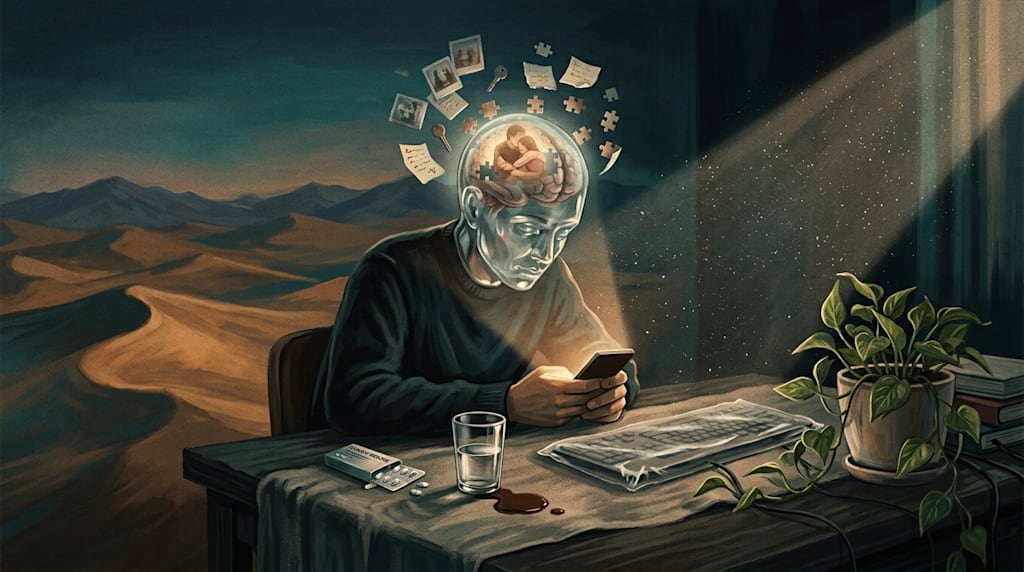
At 3 a.m. I searched "Mandela effect." The phone screen lit the half-empty packet of stomach medicine on my desk. I remembered Mandela dying in prison. A television news report. Black and white. Someone crying. Then I found out he became president of South Africa in 1994 and died in 2013. I typed "parallel universe" into the search bar. Then I deleted it.
A friend once told me, "You can't prove I'm not a time traveler." I pushed a glass of water toward him. Some of it spilled. He didn't wipe it. He said, "You also can't prove my memory is wrong." I said, "No." Then we were quiet. He played with a lighter. I stared at the water stain on the tablecloth. It spread slowly into a small, round period that admitted nothing.
After that night, I started asking what memory is.
The brain does not keep a video library. It is more like a messy warehouse. The hippocampus indexes. The neocortex stores fragments. The prefrontal cortex builds a story. When you remember, you do not open a file. You gather pieces according to your current cues, your current mood, your current goal. Then you assemble them into something that feels like a scene.
There is a step called reconsolidation. After you recall something, the memory becomes unstable for a while. Then it is stored again. Every act of remembering is like opening a document, changing a little, and saving it under the same name. Sometimes the new version overwrites the old one. The more you remember, the more you may mix in later information, other people's words, and your own imagination.
I remember my ex-girlfriend throwing her keys on the table. In a photo, the keys are on the shoe cabinet. I do not know which version is the original. Maybe there was no original. Maybe I was looking at her fingers and not at the keys. Memory has no tape. It has a reconstruction site.
Cognitive biases live inside that reconstruction. Source-monitoring error: you remember a dream as reality, a film as your own experience, a friend's story as your own memory. Misinformation effect: a friend says you wore a red shirt that day. Later you feel certain you wore red. Then you find a photo. The shirt was blue. Flashbulb memory: you are sure you remember where you were on 9/11, but you may have the weather wrong, or your clothes, or who was with you. Hindsight bias: once you know the result, you feel you always knew, and you rewrite the past to fit. Self-serving bias: you edit the past so you look kinder or more correct. You make yourself more wronged or more heroic. Mood-congruent memory: when you are depressed, negative memories surface faster. When you are anxious, danger memories surface faster. Social contagion: after a group talks, memories converge. The Mandela effect often forms this way. Shared false memory spreads through social transmission. Source confusion and confirmation bias do the rest. Images get mixed in.
The parallel-universe explanation is possible in principle. The brain in a vat, the Boltzmann brain, the five-minute world. These ideas can be logically coherent. They also cannot be proved or disproved. But the ordinary assumption, that because something happened in the past I now have this memory, has no absolute proof either. We choose the ordinary assumption because it is useful and testable. Unfalsifiability does not make an idea equally credible. If we go far enough, we would have to doubt the parallel-universe believer's own reasoning and memory too.
In the Khandha Samyutta, the Buddha says perception is like a mirage. Perception includes memory. A mirage looks like water from far away. Up close, it is light and hot air. I read that line one afternoon. Sunlight fell on the keyboard cover. Dust floated in the light. A mirage looks like water. Close up, it is light. A memory is a mental event. It is not a verdict.
I used to treat memory as a verdict. I would replay one sentence. My stomach would hurt. The stomach medicine would run out. Rumination. The brain finds an old scrap of a person or an event and starts chewing. "He said something bad about me months ago." "I should have chosen a different major." "Why was I so stupid that day?" These memories may be partly true, partly reconstructed, or completely misunderstood. Their accuracy is not the main issue. Their effect on me now is.
The Buddha's approach was simple. Since the origin of memory cannot be known, watch it. Take what is useful. Put down what is not. Someone knocks on the door with a delivery. A memory appears: "I bought a water cup yesterday." I open the door, sign, unpack it, fill it, drink. If a memory appears, such as "He insulted me years ago," and it only makes me suffer and unable to act, I label it: this is a memory, not an order. If it points to a problem I can act on, I turn it into action: talk, set a boundary, ask for help, write it down, make a plan. If it is only rumination, I let it go. Not suppress it. Not follow it.
I put the stomach medicine back in the drawer. I watered the pothos. I set the cup on the table. The phone screen went dark. The news about Mandela was still in the search results. I did not search for parallel universes again. There was water in the cup. I drank.
About the Creator
Jin
Writer of reamstories
https://reamstories.com/jin
Enjoyed the story? Support the Creator.
Subscribe for free to receive all their stories in your feed. You could also become a paid subscriber, letting them know you appreciate their work.
Comments
There are no comments for this story
Be the first to respond and start the conversation.