

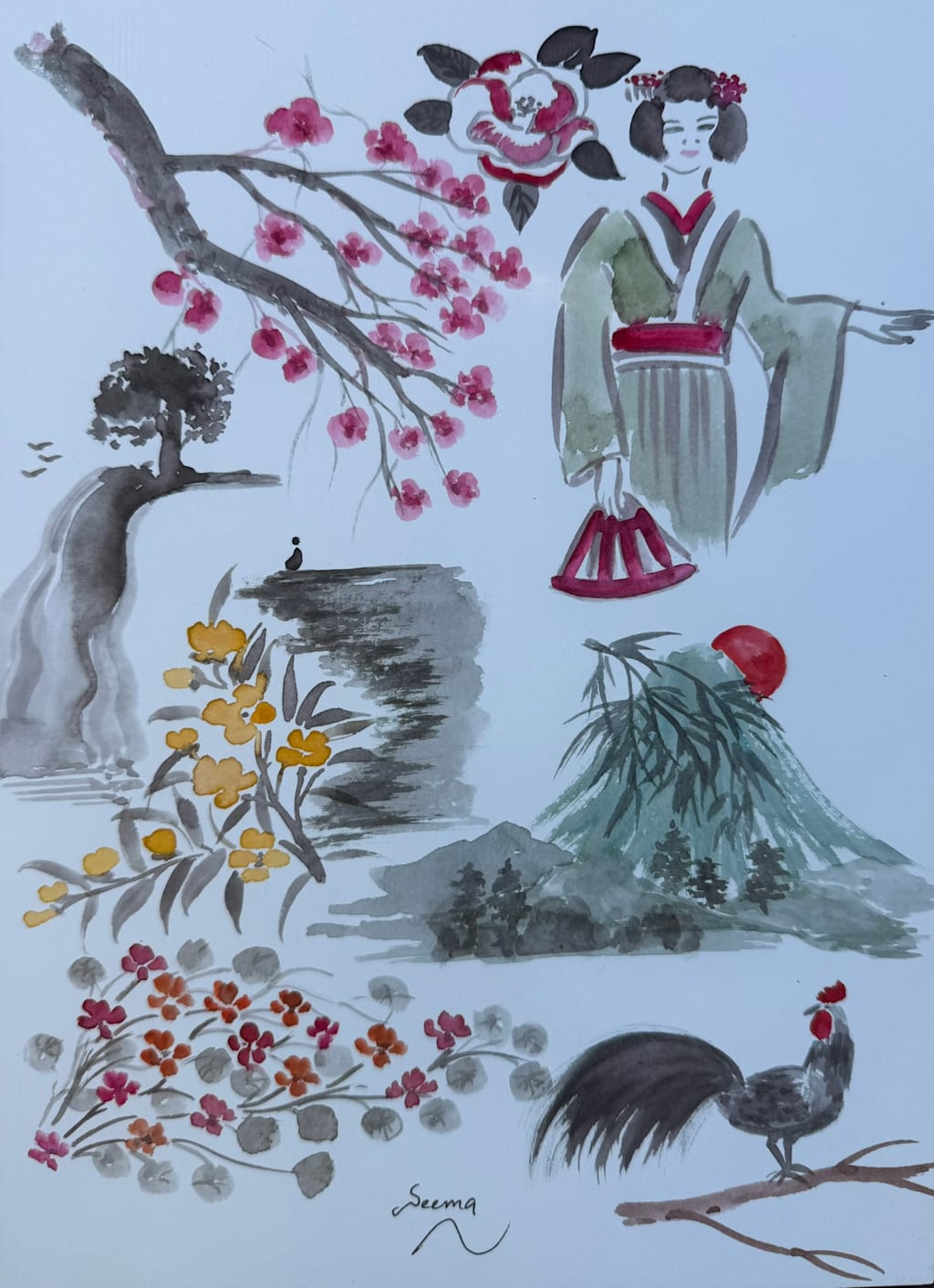
I am very much fascinated by Japanese words. Why? They respect nature and their life philosophies are very helpful
So, let's learn some Japanese words.
Wind is kaze. (so kamikaze in World war II was name for suicide pilots, which meant divine wind.)
Water is mizu. Mountain is yama. Sky is sora. Snow is yuki, and melting snow is called yukidoke.
Dream is yume.
Cherry blossom is sakura, and night cherry blossom viewing is called yozakura.
Earth is tsuchi.
Moon is tsuki. Moon viewing or moonlight appreciation is called tsukimi. Flower is hana, and flower viewing is hanami.
Spring is haru, and summer is natsu.
Lantern is tōrō. That’s a Japanese Garden in Washington State.
I learned a word: Tsukikage. It means the reflection of moonlight on water. Tsuki is moon, and kage is reflection.
Komorebi is the sunlight filtering through the leaves of trees. I see this often. The spectrum of colors bursting through the canopy. Even my kids know this word.
Yūgen is the subtle beauty that cannot be fully explained. Shizuka is quiet, calm, and stillness.
Nagi is the calm of the sea when there is no wind.
Asayake is soft dawn light and Yūyake is evening glow at sunset.
Kogarashi is the first cold wind of winter. Kasumi is mist or haze, often in spring.
Madoromi is a light, pleasant drowsiness.
Since the main cause of depression in modern times is estrangement from nature, value the essence behind these words. They can help us enrich life.
Heart is kokoro. Journey is angya.
Cloud is kumo. Grass is kusa.
Lotus is hasu, a flower of high religious significance in many Asian cultures.
Ice is kōri and mist is kiri — similar sounding and equally poetic.
Pine is matsu, which is also the root of matsutake, a prized edible mushroom from the genus Tricholoma.
Maple leaves are momiji, and the beautiful act of “autumn leaf hunting” in Japan is called momijigari.
The land of the dead is meido. The Pure Land (Western Paradise) is Jōdo.
The floating world is ukiyo. I learned these terms while reading a Japanese book titled Death Poems.
Festival is matsuri. As a child, I had heard of Hinamatsuri, also known as Doll’s Day — celebrated in March to honor girls and wish for their happiness and health.
Let's learn some creatures name in Japanese.
At the zoo, we saw a tora (tiger), raion (lion), kuma (bear), zo (elephant), and kirin (giraffe). Ōkami (wolves) live in the jungle.
Saru (monkeys) were our ancestors. Gorira (gorillas) are very similar to us, genetically.
Kyōryū (dinosaurs) are long extinct.
Our backyard barn had ushi (cow) and yagi (goat). We also had niwatori (chickens).
In the USA, inu (dogs) and neko (cats) are very popular pets.
Hebi (snakes) are dangerous — their poison can kill. But ka (mosquitoes) can kill even more people. I have lost relatives to dengue.
Mitsubachi (honeybees) are very helpful creatures.
We love watching chō (butterflies) flutter.
The pond has a variety of sakana (fish).
I learned that many Japanese surnames are related to rice fields or rice plants. Let me share.
Tanaka: central rice field (there is a popular farm near my house, in Irvine)
Yamada: mountain rice field
Kawada: river rice field
Inada: rice plant field
Honda: original rice field (see the origin of this famous company!)
Ueda: upper rice field
Shimada: island rice field
Okuda: inner rice field
Takeda: warrior’s rice field (a big pharmaceutical company)
Ina/ Yone, meaning rice. There are also surnames related to rice plants.
Inagaki: rice plant fence; Inamura: rice plant village; Inaba: rice plant leaf; Inoue: above the rice plant; Yoneda: rice field; Yonekura: rice warehouse; Yonehara: rice field; plain; Yonebayashi: rice forest; Inehara: rice plant plain.
So many Japanese philosophies are popular globally. They are powerful self-improvement principles.
Ikigai
It’s about finding purpose in life.
Oubaitori
It’s about growing at your own pace and not ruining the joy by comparing yourself to others.
Shinrin-yoku
It’s about the importance of living in alignment with nature.
Uketamo
It’s about the virtue of accepting fate.
Mono no aware
A gentle sadness at the impermanence of things.
Kaizen
Gradual progress.
I hope that you enjoyed the post.
About the Creator
Seema Patel
I am Seema. I contribute to PubMed, Blogger, Medium, LinkedIn, Substack, Amazon KDP, Vocal Media.
I write on nature, health, parenting, creativity, gardening, social issues.
My art shop: https://artsforhealinggifts.etsy.com
Enjoyed the story? Support the Creator.
Subscribe for free to receive all their stories in your feed. You could also become a paid subscriber, letting them know you appreciate their work.
Comments
There are no comments for this story
Be the first to respond and start the conversation.