Latest Stories
Most recently published stories in FYI.
GUARDING YOUR PEARLS
GUARDING YOUR PEARLS "The Art of Discernment in Sharing Your Valuables and Trust" Introduction: "Guarding Your Pearls: In a world where valuables and trust hold great significance, exercising discernment in sharing is crucial. This brief exploration will dig deeper into the art of preserving what's precious, be it material possessions, personal information, advice, or emotional vulnerability. Join us as we navigate the path to fostering meaningful relationships and safeguarding what truly matters."
By JOHN U. ORDILLO3 years ago in FYI
5 Inventions That Are Changing Lives Of The Poverty
We, most of us reading this are fortunate enough to have access to our basic needs but not all are so fortunate. The rural areas of developing countries and 3rd world countries are still struggling to meet their basic needs like access to safe drinking water, food, shelter or basic health care. However, in this modern century, well-established people from 1st and 2nd world countries are trying to help those in need, to improve the quality of lives of poverty. From scientists to ordinary, creative people, they are all using their field expertise to invent products to help those in poverty in whatever ways they can. Nowadays, even businesses and new organizations are popping up to solely help the ones in need or donate a percentage of their revenue to specific causes to help the ones in poverty.
By Raihana H.3 years ago in FYI
why oceans are scarier than space
Did you know that there exist black holes in the ocean, also known as Eddies? These black holes bear similarities to the ones we observe in space and function as powerful whirlpools with an irresistible pull, preventing anything from escaping. What adds to their menacing nature is their massive size, with some spanning up to 150 kilometers in diameter. These Eddies are formed through a combination of water at different temperatures, wind, and the Earth's rotation, and once generated, they can persist for months or even years.
By Michael Owolabi3 years ago in FYI
Benefits of iOS App Development With iPhone 15 Launch?
With iPhone 15 set to launch this fall (Date TBD), businesses are jumping on the idea of getting iOS apps developed to reach more audience. Every year, the launch of an iPhone brings in a great number of users to iOS. This is why the launch of an iPhone is a monumental event for businesses around the world. iOS is a great haven for businesses that wish to multiply their growth through a mobile app. If you are still unsure about the popularity of iOS, read this blog and find out the benefits of iOS app development for businesses amid the iPhone 15 launch.
By Mobile App Experts3 years ago in FYI
REALISM IN KENYA
Theories are constantly emerging and competing with one another. For that reason it can be disorientating to learn about theoretical approaches. Thomas Kuhn’s The Structure of Scientific Revolutions (1962) set the stage for understanding how and why certain theories are legitimized and widely accepted. He also identified the process that takes place when theories are no longer relevant and new theories emerge. For example, human beings were once convinced the earth was flat and accepted this as fact. With the advancement of science and technology, humans discarded this previously accepted belief. Once such a discovery takes place, a ‘paradigm shift’ results and the former way of thinking is replaced with a new one. Although changes in IR theory are not as dramatic as the example above, there have been significant evolutions in the discipline. This is important to keep in mind when we consider how theories of IR play a role in explaining the world politics and how, based upon different time periods and our personal contexts, one approach may speak to us more than another. This paper comprehensively shows that realism is the best IR theory to useful in making sense of world politics because it best applies to our daily individual lives and, therefore, dominates how we shape international relations.
By Hempstone Onyalo3 years ago in FYI
Remote hard to reach places in the world
There are some shockingly difficult and remote places to get to in the world, and there are some places that nobody in all of human history has ever been to yet! The question is, Where is the most difficult place that you can possibly get to in the world?. Back then, most of Europe could be reached in under 5 days of travel time, while more remote parts of Scandinavia and Russia would take 5–10 days. Getting to San Francisco could have taken 10–20 days; getting to Sydney would have taken up to 40 days; and there were parts on every continent except for Europe that would have still taken months to actually get to. Today, however, the travel times are absurdly lower, where all of Europe can be reached in under half a day's journey, as well as large parts of North America, Africa, and Asia. The journey to San Francisco that would have taken 20 days 100 years ago now takes only half a day. The journey to Sydney, which would have taken 40 days, now takes just about one day. Much of the world has been open to rapid transportation thanks to modern air travel. But there are still a few places that haven't kept up with the rest of the world. Take Pitcairn Island, for example. A UK overseas island in the middle of the Pacific Ocean that is home to a mere 49 people and is hundreds of kilometers away from the nearest other inhabited island. If you want to move here, they'll actually give you a free plot of land to build your house on, And temperatures remain tropical year-round. But there's no airport on the island, so transportation to the outside world is done only by boat, and they rarely visit. So the best way I found to get there From London, it is as follows: You would first have to get a flight from London to Los Angeles. And then take a connecting flight from there to Tahiti; that journey would take about 24 hours. But then you would need to take a flight from Tahiti to another island, Monica Raiva. Which only happens once every week. And it would take another five hours and 30 minutes, and It's the closest airport to Pitcairn, and it's still 531 kilometers away. The only boat that regularly travels to Pitcairn with supplies is located here, but it only leaves once every three months to visit. If you're lucky enough to get on the boat, it'll be another 32 hours of sailing before you finally arrive at Pitcairn. or a total trip time of about two and a Half days from London. At the bare minimum, that's difficult. But there are these islands named the Kurguelen Islands, also known by their ominous name of "The Desolation Islands". Located in the remote Indian Ocean, they're three thousand, Three hundred Kilometers away. From the closest other population center in Madagascar. There are around 50 to 100 French scientists on duty at all times. Like Pitcairn, there is no airport. So Transportation is done only by ships. They are visited by only one supply and transport ship every three months. The least is from Reunion Island, near Madagascar. So first, you need to somehow arrive on that island. and then get on the six-day boat journey to "The Desolation Islands." It would take a minimum of about one full week to get to the island from London, but there's an even greater challenge once you're there. The tallest mountain on the island is 1850 meters high, and the first guy who flew on top of it was some guy who flew up in a helicopter in 1960. Hardly anyone has ever been there since. It's one of the most remote mountain summits in the world, which means that it's likely one of the most difficult places to get to on earth. But there are some others that are significantly more difficult to reach than this. Take Mount Sidley, for example. Which is the tallest volcano in Antarctica. Antartica is already difficult enough to get to, with no regularly scheduled flights from anywhere in the world. The volcano is located in the most remote part of Antartica, known as Mary Birdland, a place so vast and remote that no sovereign nation in the world currently claims it. It's basically like being on the Moon here. and the volcano is 428 meters high. It wasn't even discovered until 1934, and nobody had ever climbed to the top of it until 1990. and ever since then, only two expeditions have ever successfully made it to the top. Most recently in twenty-ten. Which makes the summit of Mount Sidley an elusive place that very few people have ever been to. The summit of Mount Everest on the Nepal-China border is the highest summit on earth. And is obviously very difficult to get to. It's 8,848m tall and has been successfully reached by only around 4,000 people through history. Which is fewer people than have ever won a Grammy, but 223 have died while attempting to climb as well, which means out of everybody who has ever tried climbing to the top, About 1 out of every 20 of them has died trying, which sounds very dangerous and difficult, of course. But then we move on to another mountain named K2, which is the second tallest mountain in the world and is far more difficult to climb; only around 300 people have ever successfully made it to the top. While seventy-seven have died trying, Which means about one in every five people who has ever tried getting there has died while trying. Nobody has ever successfully gotten there in the winter, and K2 is nicknamed "the Savage Mountain". because of its extreme difficulty. contender for its difficulty in climbing. The summit here is good for the most difficult place to get to, but another mountain in the Himalayas, Annapurna, is even more dangerous; it's the tenth highest mountain in the world but has only ever been successfully climbed by 191 people. While 61 other people have died while trying, that means about one out of every four people who have ever tried reaching the summit has died while trying to do so. In terms of your odds of survival doing so, getting somewhere on this mountain may truly be the most difficult place on earth for you to get to, but there are still other summits on other mountains that have never been reached by anybody. This is the Gangkhar Puensum, the tallest unclimbed mountain in the world at seven thousand five hundred and seventy meters tall. Nobody in history has even been at this point right here, and nobody probably will be for a very long time. The mountain is located in Bhutan, which has banned any climbing of it for religious reasons, so getting to the top is not only physically challenging. But it's also legally impossible. So what about a mountain that is legally okay to climb but has never been reached? The tallest summit in this category would be Mucha Chhih at seven thousand four hundred and fifty-three meters tall, an incredibly demanding mountain that has only ever been attempted to be climbed twice. And If you are looking for the most difficult place on earth to get to that is legal for you to try, the answer is probably this summit right here that no human has ever set foot on. Humans have been to the deepest part of the ocean, but there are still several dozen mountains around the world whose summits have never yet been reached by anybody, making them possibly the most difficult places to get to on our entire planet.
By Hamza Kanyike3 years ago in FYI
Token Vesting Platforms: Streamlining Token Distribution for Entrepreneurs
In recent years, the world of cryptocurrencies and blockchain technology has witnessed exponential growth, leading to the creation of various innovative solutions that revolutionize traditional practices. One such advancement is the emergence of token vesting platforms, which have gained popularity among entrepreneurs and startups as a streamlined method for distributing tokens and managing token allocations. Token vesting platforms provide a secure and efficient way to safeguard the interests of stakeholders while encouraging long-term commitment and dedication from team members and investors.
By StreamFlow Finance3 years ago in FYI
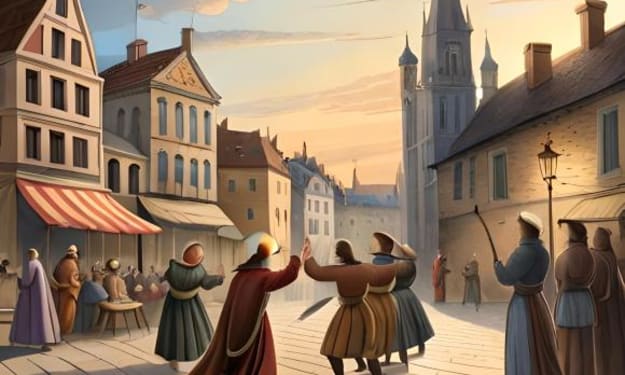
The Strange Mystery of the Dancing Plague
In the annals of history, there have been numerous bizarre and unexplained phenomena, but few are as perplexing as the Dancing Plague. Also known as the Dancing Epidemic or Dance Mania, this strange event occurred during the medieval period in Europe, captivating communities with its enigmatic nature. For reasons still unknown, groups of people would start dancing uncontrollably, often for days on end, leading to exhaustion, injuries, and, in some cases, even death. This article delves into the curious events surrounding the Dancing Plague, exploring the theories that attempt to explain this peculiar occurrence.
By Sagar Karn3 years ago in FYI