
I'm Blind. The Raised Dots on the Floor Walked Me Back to Class.
Tactile paving does the job it was built for. It can't do the job that keeps most blind people home.
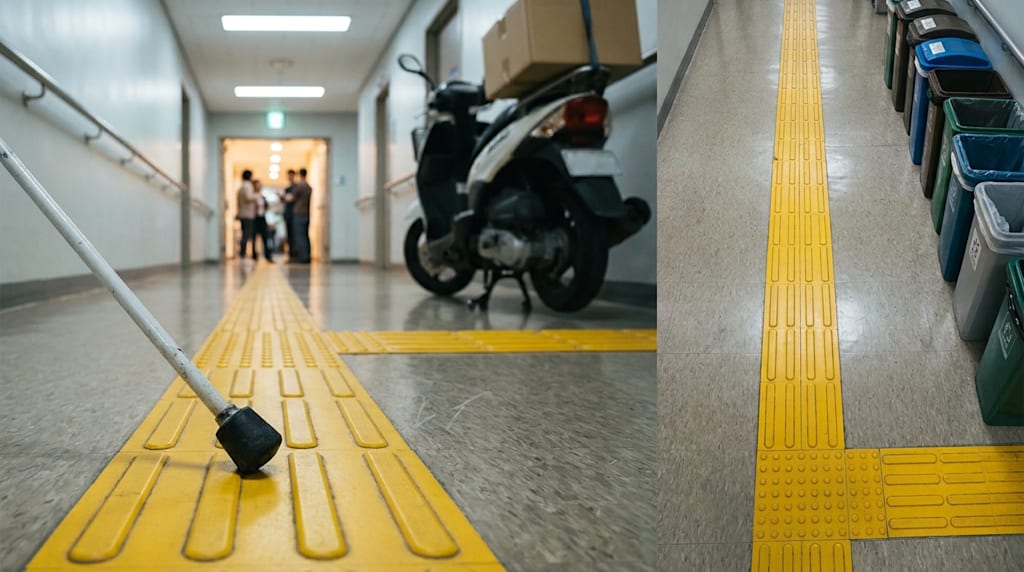
When I took a class at the Chaoyang District Disabled Persons' Federation, everyone went to the restroom during the break. I came back last. The voices moved ahead of me, shoes on tile getting quieter, and my cane tip hit the base of the wall, then a metal doorframe. I had never walked that corridor. The floor was polished, and the tip slid, the tap coming back hollow.
I stopped, pulled the cane closer, and rubbed the sole of my foot across the ground. Raised bars. One, then the next. I followed them to the corner, where they turned into raised dots. Turn here. Past the corner the bars came back. Water ran somewhere on my left. A door hinge creaked on my right. I went on, cane tapping ahead of me, foot reading the bars. At a doorway the bars stopped at the edge. Inside, people were talking, including the teacher whose class I had just left. I went in, found the corner of the front-row desk, folded the cane short, and sat down.
Not a long walk. But without that strip of dots, I would have been trying the corridor in both directions, or standing outside the restroom waiting for someone to walk past.
What proper tactile paving gave me was small and specific: a line I could stand on, a dot pattern that meant turn, and a doorway where the line ended. It didn't know the route. It made "which way now" a question my feet could answer.
Tactile paving works. Laid straight, running without a break, kept clear of scooters and delivery boxes, it earns its space on the sidewalk. When the strip stops halfway, or a scooter is parked across it and my cane finds the footboard while my foot finds a delivery crate, I start over, hunting for the line.
The man who parks there thinks he moved a scooter a few feet. For me the line is gone.
It still won't get most blind people out of the house.
Half the problem is the pavement. The other half is whether the person on it knows how to walk.
Someone who lost their sight at forty spent forty years reading distance with their eyes. Then the lights went out, and the floor plan in their head stopped working. You have to work out whether the slab under you is loose, whether the noise ahead is a car or a crowd, whether the wind is on your left cheek or your right, whether the corridor echoes short and means a wall or long and means open floor. None of that arrives by closing your eyes. You learn it by tapping, dragging, listening, and walking the same block until your body remembers it.
I once watched a man get handed a cane and pushed out the door by his family. "Follow the tactile paving," they told him. He stood on the front step, swept the cane forward, found a bicycle, turned left, found a trash can. He did not know which direction the paving ran, and he did not know how to retrace his steps. The strip was three meters away. He couldn't reach it. I have also watched people led by the hand for twenty years freeze the second the hand lets go. Not because they don't want to walk. Because the body never got the training.
That training has a name. Orientation and mobility. Echo reading, wind direction, pacing, memorizing intersections, probing for steps and low branches, finding the line again where the paving breaks off at a driveway. It takes a teacher and months of practice on real streets. Tactile paving is the hardware outside. This is the software inside. You can pour a perfect sidewalk and still leave the person standing on the step unable to use it.
Which is why I flinch when the whole conversation is about how many kilometers of tactile paving got laid. Lay it. Lay it straight, keep it continuous, clear the parked scooters, fix the corners where the dots point the wrong way. Then spend the next dollar on the thing that makes the paving usable: orientation and mobility classes people can actually enroll in, cane instruction, intersection practice, and family members taught to walk beside a blind person without seizing their arm.
The strip on the floor is the easy half. Teaching a person to read a street with their ears and feet is the slow half, and it is the half that decides whether anyone goes outside at all.
That corridor still comes back to me. Cane finds the doorframe, foot finds the last row of dots, traffic noise comes in from the street, and I turn the right way. The dots are under me. The judgment is in me. I need both before I leave the building.
About the Creator
Jin
Writer of reamstories
https://reamstories.com/jin
Enjoyed the story? Support the Creator.
Subscribe for free to receive all their stories in your feed. You could also become a paid subscriber, letting them know you appreciate their work.
Comments
There are no comments for this story
Be the first to respond and start the conversation.