
Human Waste Makes Concrete Stronger. That Is the Easy Part.
A study from India found that fecal sludge biochar can replace 10% of cement and raise flexural strength by 42%. The hard part is building a supply chain that can compete with portland cement.
The Black Powder
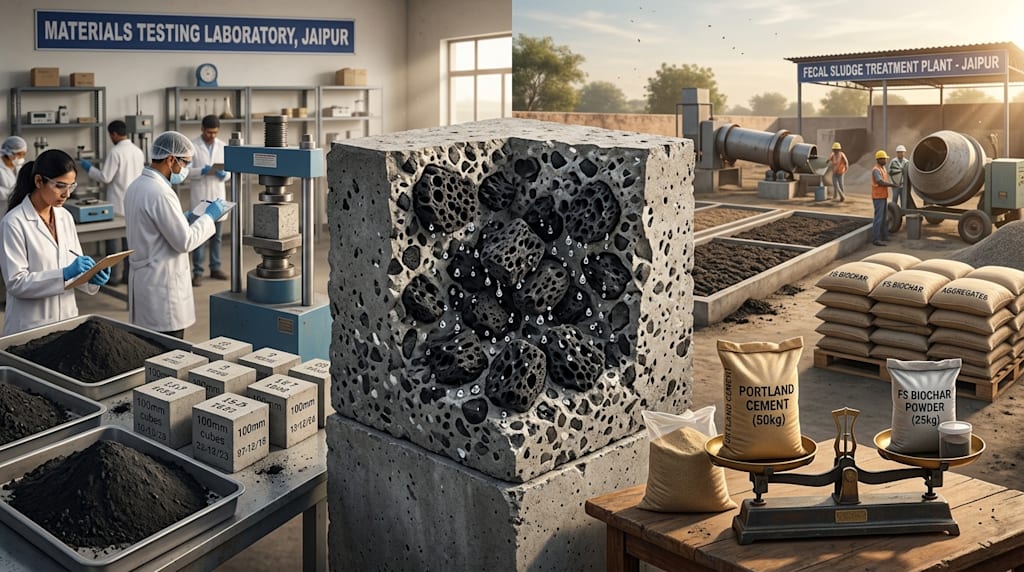
JAIPUR, India. In a materials lab at Manipal University Jaipur, a tray of black powder sits beside a concrete mixer. It looks like charcoal dust. It smells like nothing. The powder began as fecal sludge, collected from septic tanks and pit latrines, dried, and heated in a low-oxygen kiln until the organic matter carbonized. What came out is a porous, carbon-rich material the researchers call fecal sludge-derived biochar.
The team, working with Louisiana Tech University, mixed that powder into concrete. They replaced 5%, 10%, and 15% of the cement by mass. Then they cured the samples and tested them at 91 days. The results appeared in Scientific Reports. At 10% replacement, compressive strength rose 21%. Flexural strength, the resistance to bending, rose 42%. At 5%, the gains were 20% and 36%. At 15%, the numbers fell below the control.
The headline is simple: human waste makes concrete stronger. The details are narrower and stranger.
What cement does, and what it costs
Concrete is water, sand, gravel, and cement. The cement is the glue. When cement powder meets water, tricalcium silicate and dicalcium silicate react to form calcium silicate hydrate, or C-S-H. That gel binds the aggregates together. The reaction needs water. Not just water for workability, but water that stays available as the material hardens. In thick pours, or in mixes with a low water-to-cement ratio, the interior can dry out before the reaction finishes. The outside gets cured with hoses and wet burlap. The inside does not.
Cement also has a carbon problem. Making it means heating limestone to about 1,500°C, usually with coal or petroleum coke. The process releases carbon dioxide from the fuel and from the limestone itself. Cement production accounts for roughly 8% of global CO₂ emissions. Concrete is the second most consumed material on Earth after water. About 30 billion tonnes of it are poured every year.
The industry has known this for decades. Fly ash, slag, and silica fume, byproducts of coal plants and steel mills, have replaced part of the cement in concrete for years. They work because they contain amorphous silica that reacts with calcium hydroxide, a byproduct of cement hydration, to form more C-S-H. The search for new supplementary cementitious materials is a search for things that are cheap, abundant, and chemically useful.
Fecal sludge is abundant. In India, it is also a problem.
The sludge that has nowhere to go
India has built more than 800 fecal sludge treatment plants in the past six years. The count has passed 1,000. The plants collect sludge from septic tanks and pit latrines, dewater it, and dry it on beds. The liquid fraction is treated. The solid fraction, called biosolids, is supposed to be reused. In practice, it often is not.
In Uttar Pradesh, the state government built 59 fecal sludge and septage treatment projects. A 2025 assessment found that between May and July, the plants ran at about 40% of their designed capacity. Even at that rate, they produced roughly 71,000 quintals of biosolids and nearly 200 million liters of treated wastewater per year. At full capacity, the biosolids would reach 190,000 quintals annually. A survey of urban local bodies found that nearly 60% had never reused a single kilogram of biosolids. Drying beds filled up. Operators stacked the material by the wall, bagged it without labels, and waited for a taker who rarely came.
That is the context for the Jaipur study. The researchers wanted an outlet, not a novelty.
The powder and the three mechanisms
The biochar is made by pyrolysis. Fecal sludge is dried and heated in a low-oxygen environment. Pathogens are destroyed. Odor disappears. The carbon that remains is fixed in a stable form. The material is then ground and sieved into a fine powder. In the concrete mix, it replaces a fraction of the cement.
Three things happen.
First, internal curing. Biochar is highly porous. During mixing, those pores fill with water. As the concrete hardens and the internal relative humidity drops, the biochar releases the water slowly. The hydration reaction continues in places it would otherwise stall. Each particle acts as a tiny reservoir.
Second, filler effect. The ground biochar fills voids between cement grains. A denser matrix has fewer pathways for cracks to start and propagate.
Third, pozzolanic activity. The biochar contains amorphous silica. That silica reacts with calcium hydroxide, also called portlandite, to form additional C-S-H. The study measured a strength activity index to confirm this.
The combination explains the gains at 5% and 10%. It also explains the drop at 15%. Biochar pores are not selective. At high replacement levels, the biochar competes with the cement for mix water. Less water reaches the cement grains. Hydration slows. Porosity increases. Strength falls. The optimum is a balance, not a maximum.
The study also reported lower heavy metal concentrations in the biochar-modified concrete. The alkaline environment and the high surface area of the biochar appear to immobilize metals like copper and zinc. For a waste stream that could otherwise leach into soil or water, that matters.
The cost and the standard
The technical case is clear. The economic case is not.
Biochar from fecal sludge is expensive to make. Collection, transport, drying, pyrolysis, and grinding each add cost. One study estimated a minimum selling price of $700 to $1,000 per tonne. Portland cement trades at roughly $100 to $150 per tonne in most markets. Even if the biochar improves performance, the price gap is wide. The concrete industry runs on thin margins and standardized inputs. A supplementary material that costs five to seven times more than cement will not be adopted at scale without a carbon price, a subsidy, or a regulatory mandate.
Standardization is another barrier. Biochar is not a commodity. Its properties depend on the feedstock (septic tank sludge, pit latrine sludge, mixed sludge) and on the pyrolysis temperature, residence time, and cooling method. A plant in one city may produce a material with a different surface area, ash content, and silica reactivity than a plant in another. Concrete mix designs require predictable inputs. There is no industry standard for biochar in concrete. No specification. No test method. No design code.
Then there is durability. The 91-day data are encouraging. Concrete structures are designed to last 50 to 100 years. How does biochar behave under freeze-thaw cycles? Under chloride attack? Under carbonation? Freeze-thaw tests on biochar concrete have produced mixed results. Some mixes resist damage better. Others deteriorate faster when pores fill with water and crack. The long-term data do not exist yet. They will take years to collect.
What the lab does not answer
The Jaipur study is a proof of concept. It shows that fecal sludge-derived biochar can replace part of the cement in concrete and improve certain mechanical properties at specific replacement levels. It does not show that the material can be produced at scale, sold at a competitive price, certified for structural use, or trusted by engineers who have spent their careers specifying portland cement and fly ash.
The study is early. That is different from useless.
The researchers wanted to find a use for a waste stream that is growing faster than the infrastructure to manage it. India’s sanitation push has built treatment plants. Those plants produce biosolids. The biosolids have to go somewhere. Concrete is a vast, distributed, permanent destination. If the economics can be fixed and the standards can be written, the material could absorb some of the sludge that currently piles up behind treatment plants.
That is a long chain of ifs.
In the lab in Jaipur, the black powder sits in its tray. The concrete cubes have been tested. The numbers are in the paper. The next step belongs to plant operators, regulators, contractors, and accountants. The powder works. The system does not exist yet.
The drying beds in Uttar Pradesh are still full. The bags are still stacked by the wall. The concrete mixer is still running.
About the Creator
Jin
Writer of reamstories
https://reamstories.com/jin
Enjoyed the story? Support the Creator.
Subscribe for free to receive all their stories in your feed. You could also become a paid subscriber, letting them know you appreciate their work.
Comments
There are no comments for this story
Be the first to respond and start the conversation.