
How to Maintain Your Car During Summer in UAE 2026: A Complete Survival Guide
If you live in the UAE, you already know summer is not just a season — it is a test.

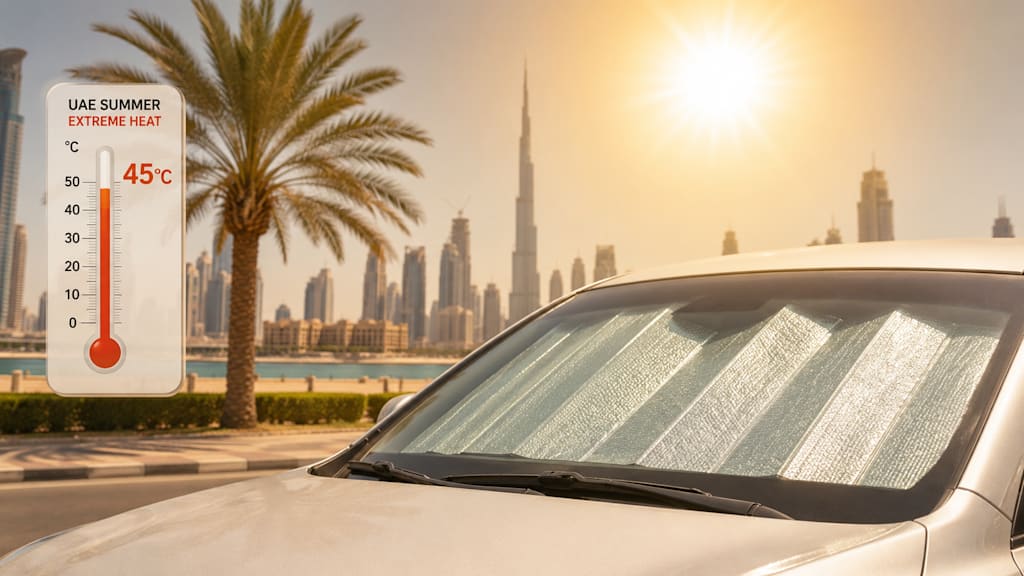
Temperatures regularly climb past 45°C (113°F) across Dubai, Abu Dhabi, and Sharjah, and in 2026, meteorologists recorded inland readings exceeding 50°C in parts of the Arabian Peninsula. Hot asphalt can reach 70–80°C on a summer afternoon, and the interior of a parked car can cook at over 60°C within minutes.
Your car was not designed to be idle in a furnace. The UAE summer is the single biggest threat to vehicle health in the region — and most breakdowns happen not on long road trips, but in city traffic, on Sheikh Zayed Road, or in a parking lot that offered no shade.
This guide covers everything you need to know to keep your car running safely, efficiently, and reliably through the UAE summer of 2026.
What Does UAE Summer Heat Actually Do to Your Car?
Before jumping into the checklist, it is worth understanding why heat is so destructive.
Heat degrades rubber, accelerates chemical reactions in your battery, thins engine oil, expands tire pressure, and bleaches your paint. Every single system in your car — mechanical, electrical, and cosmetic — is affected by sustained exposure to extreme temperatures. The UAE summer does not give these systems a break. For three to four months straight, your car battles heat every single day.
The good news: most summer breakdowns are preventable with basic maintenance habits.
1. Check Your Cooling System First — It Is Your Engine's Lifeline
Why it matters: The cooling system is the most critical component during UAE summer. If it fails, your engine can overheat within minutes, causing catastrophic damage that can cost AED 10,000–30,000 or more to repair.
What to do:
Check coolant (antifreeze) levels monthly. The reservoir should sit between the MIN and MAX markers.
Inspect radiator hoses for cracks, soft spots, or bulging — rubber degrades fast in extreme heat.
Have a mechanic pressure-test the cooling system before June if possible.
Never open a hot radiator cap. Let the engine cool for at least 30 minutes first.
If your temperature gauge rises toward the red zone, pull over immediately and turn off the engine.
Quick fact: A burst radiator hose causes immediate engine overheating. A cracked serpentine belt simultaneously kills your AC, power steering, and alternator. Both failures spike sharply during UAE summers.
2. Change Your Engine Oil More Frequently in UAE Summer
Why it matters: Heat thins engine oil, reducing its ability to lubricate and protect metal parts. In extreme climates like the UAE, standard European oil-change intervals are not sufficient.
What to do:
Reduce your oil change interval by 20% during summer months.
If you normally change oil every 10,000 km, switch to every 7,500–8,000 km from June through September.
Use the oil grade recommended by your manufacturer for high-temperature climates. Check your owner's manual for the "hot climate" viscosity specification.
Check oil levels monthly — heat also accelerates oil consumption.
3. Test Your Car Battery — UAE Heat Kills Batteries Fast
Why it matters: Cold winters kill batteries in Europe. Extreme heat kills batteries in the UAE. Heat accelerates the internal chemical reactions in your battery, causing fluid evaporation and faster degradation. Most UAE car batteries last only 2–3 years, compared to 4–5 years in cooler climates.
What to do:
Get your battery tested at a garage before summer starts (April–May is ideal).
If your battery is over two years old, test it again in July–August.
Watch for warning signs: slow engine cranking, flickering dashboard lights, or the battery warning light.
Keep battery terminals clean and free of white corrosion buildup.
Pro tip: Many petrol stations and auto garages in the UAE offer free battery checks. Take advantage of them before the heat peaks in July.
4. Inspect Your Tires — Blowouts Are a Summer Danger
Why it matters: UAE road surfaces can reach 70–80°C in summer. The air inside your tires expands as temperatures rise, causing over-inflation. Combined with worn tread or an aging tire compound, this significantly raises the risk of a blowout — especially at high highway speeds.
What to do:
Check tire pressure every two weeks during summer (early morning, before driving).
Follow the manufacturer's recommended pressure — do not over-inflate or under-inflate.
Inspect tread depth. Replace any tire below 1.6mm tread depth immediately.
Replace tires older than four years, even if tread looks acceptable. Heat degrades the rubber compound internally.
Consider nitrogen inflation: nitrogen maintains more stable pressure in extreme temperature swings compared to regular air.
RTA Advisory (2026): Dubai's Roads and Transport Authority has urged all UAE motorists to inspect tires and AC systems ahead of summer, citing a spike in summer breakdown incidents linked to tire failure and overheating.
5. Service Your Air Conditioning Before It Fails
Why it matters: In UAE summer, your car's AC is not a luxury — it is safety equipment. Interior temperatures can reach 60°C in a parked car. A failed AC system can cause heat stress, especially for children, elderly passengers, or anyone with a medical condition.
What to do:
Book an AC service in April or May, before demand peaks and garages get overwhelmed.
Common problems to check: refrigerant levels, cabin air filter, compressor belt, condenser cleanliness.
Replace the cabin air filter every 15,000–20,000 km (or annually). A clogged filter reduces airflow and strains the compressor.
If your AC blows warm air, makes clicking or squealing sounds, or has unusual odors, get it checked immediately.
Run your AC on recirculation mode in traffic to reduce the load on the system and cool the cabin faster.
6. Protect Your Car's Interior and Exterior
Why it matters: UV radiation in the UAE is intense year-round, and peaks in summer. Dashboard plastics warp, leather cracks, and paint fades under sustained UV exposure. Prevention costs far less than replacement.
What to do:
Use a windshield sunshade every time you park outside. This alone can reduce cabin temperature by 10–15°C.
Apply a quality car wax or ceramic coating before summer to protect paint from UV damage.
Use UV-protective leather conditioner on seats every 2–3 months.
Park in shaded or covered areas whenever possible — DEWA-approved carports, mall parking, or covered garages are best.
Tint your windows to the UAE legal limit (30% VLT for rear windows). Legal window tint blocks significant UV and heat.
7. Special Considerations for Electric and Hybrid Vehicles in UAE Summer
Why it matters: EV and hybrid battery packs are sensitive to temperature extremes. Sustained UAE summer heat can accelerate battery aging, reduce driving range, and slow charging speeds.
What to do:
Park your EV in covered or shaded parking whenever possible.
Avoid charging to 100% and letting the battery sit in the heat — keep charge between 20–80% for daily use.
Use pre-conditioning features (available on most EVs) to cool the cabin while the car is still plugged in, reducing battery drain on the road.
Have the battery thermal management system inspected annually.
8. Keep an Emergency Kit in Your Car All Summer
Even with perfect maintenance, breakdowns happen. In UAE summer, being stranded on a hot road is not just inconvenient — it is dangerous.
Your UAE summer emergency kit should include:
- A reflective warning triangle (mandatory under UAE traffic law)
- A small fire extinguisher
- A bottle of emergency coolant
- Jumper cables or a portable jump starter
- Bottled water (at least 2 liters per person)
- A basic first-aid kit
- A phone charger or power bank
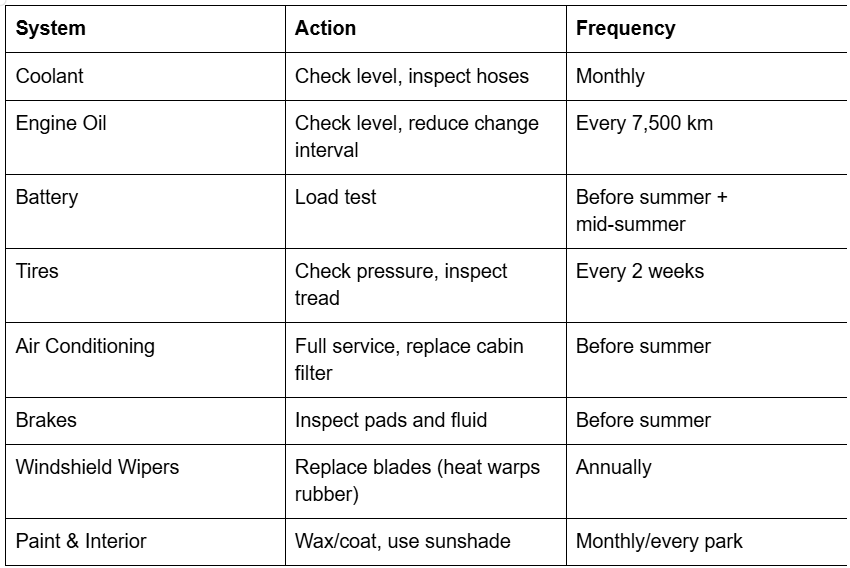
How Often Should You Service Your Car in UAE Summer?
In the UAE, automotive experts recommend a full vehicle inspection every 3 months during summer (June–September), rather than the standard 6-month interval used in cooler climates. This is because the thermal stress the UAE puts on vehicle components is equivalent to double the aging rate of vehicles in temperate regions.
At minimum, check coolant, oil, tire pressure, and battery monthly during peak heat months.
Final Word: Prevention Costs Less Than Repair
The UAE summer is predictable. It arrives every year, it is severe every year, and it causes the same types of vehicle failures every year. The drivers who avoid breakdowns are not lucky — they are prepared.
A proper pre-summer service at a reputable garage in Dubai or Abu Dhabi typically costs AED 300–800, depending on what is needed. Compare that to the cost of an engine overheat repair, a tow on Sheikh Zayed Road, or a tyre blowout at 120 km/h on the Abu Dhabi highway.
The math is simple. Maintain your car before summer, not after it breaks.
About the Creator
Sarath Menon
Hi I am Sarath Menon working proffesional Insurance consultant, covering insurance latest trend especially in the middle east regions.
Enjoyed the story? Support the Creator.
Subscribe for free to receive all their stories in your feed.
Comments