
From Baghdad to return of the Gilgamesh Dream Tablet
Tall tales buried by the Smithsonian: PART FIVE

Widely considered as the worst acts of cultural vandalism since World War II, the looting following the United States’ incursions into Iraq beginning in the 1990s has seen the disappearance of thousands of priceless artefacts from the National Museum in Baghdad... many have since found their way back to the Iraqi capital but far more have been lost to a lucrative black market in historical relics where provenance is a particularly dirty word.
Amidst the chaos following the US’ 2003 invasion of Iraq, staff at the National Museum were believed to have secured more than 8,000 artefacts before evacuating the premises but, as invading forces advanced, the museum was stormed by looters who allegedly made off with as many as 15,000 priceless artefacts, chronicling millennia of Mesopotamian civilisation.
In response to this US soldiers were stationed at the museum to "prevent further thefts", with efforts over subsequent years believed to have secured the recovery of about 7,000 pieces, but the majority – more than 8,000 artefacts – are still missing.
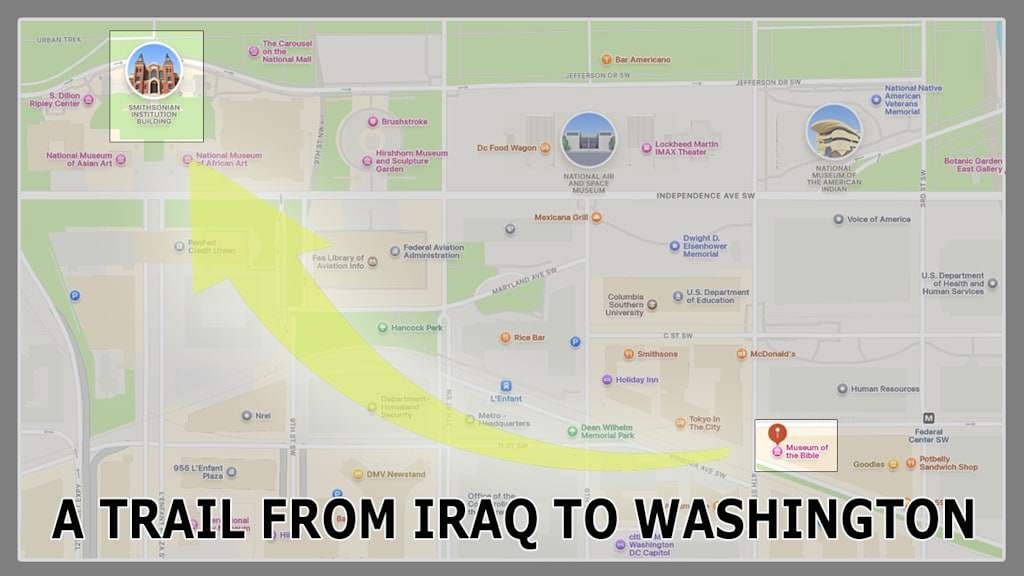
So where did these plundered artefacts end up, well surprisingly thousands made their way across the ocean through Turkey and Israel to the US and perhaps the Museum Of The Bible in Washington, which Wikipedia describes as a “non-profit Christian missionary organisation established in 2010 by the Green family”.
The Green family? Well, they’re the owners of Hobby Lobby, a chain of more than 1,000 stores operating across 48 US states that has apparently grown from a US$600 loan to David Green, and his wife Barbara, in 1970 to become the world's largest privately held arts-and-crafts retailer with annual sales of US$470 million in 2025.
The company’s leadership is dominated by the family, with David serving as chief executive officer, his son Steve as president and his other son, Mart, holding the title ministry investment officer. Their daughter Darsee Lett is vice-president of art/creative and her husband Stan is executive vice-president.
The Museum Of The Bible opened on 17 November 2017 at a cost of about US$500m but a year earlier the Green family were questioned extensively about the acquisition of Iraqi antiquities that included a federal case against Hobby Lobby over smuggled artefacts, with their provenance closely scrutinised.
The artefacts, numbering more than 5,500 in total, included more than 3,000 cuneiform tablets, 144 cylinder seals and about 3,000 clay bullae, that had been acquired by Hobby Lobby through dealers in the United Arab Emirates and Israel from 2010-14 for inclusion in the planned museum and were shipped to the US through intermediaries with falsified customs declarations that labelled the cuneiform tablets as “tile samples”.
A 2017 civil action filed by the US Department of Justice against Hobby Lobby and its affiliates stipulated the forfeiture of all contested items and settlement of a US$3m civil penalty to the US government without admission of liability... the purchases being accepted as inadvertent errors due to reliance on dealers’ representations concerning provenance.
A related 2020 forfeiture case involved a specific cuneiform relic containing portions of the Epic Of Gilgamesh purchased by Hobby Lobby for US$1.67m and loaned to the museum, which was also judged to have been illegally exported from Iraq and returned accordingly.
According to a BBC report from 7 December 2021 the “Dream Tablet” had been looted during the 1991 Gulf War and was smuggled through many countries before ending up at the Museum Of The Bible, where it was seized in 2019 and handed over to the Iraqi embassy in September 2021.
Following its disappearance in 1991 the tablet was bought by an antiques dealer in London in 2003 and shipped to the US by international post without a declaration of formal entry. In 2007 the dealer sold the tablet on with a false letter stating it had been inside a box of ancient bronze fragments purchased in 1981. It was sold again several times at auction in different countries before being bought in 2014 in a private sale by Hobby Lobby.
Prosecutors didn’t name the auction house handling the sale in their public statement, but Hobby Lobby filed a lawsuit later against Christie’s in relation to the tablet, with a statement from the British auction house claiming the lawsuit was linked to alleged illegal conduct “predating Christie’s involvement” with the artefact. "Any suggestion that Christie's had knowledge of the original fraud or illegal importation is unsubstantiated," it said.
The Epic Of Gilgamesh is one of the oldest surviving works of literature and dates back about 4,000 years to ancient Mesopotamia, offering a rare glimpse into the beliefs and values of early human civilisation. But whether it is based on fact – about a real Sumerian deity – or a fictional account that weaves together myth, history and a philosophical exploration of universal human themes is a subject of much debate... although what is not in dispute is that it represents a timeless reflection on life, death and the human condition.
It begins with Gilgamesh as a young and arrogant king, unmatched in strength and power, yet known for his tyranny over the people of Uruk. Concerned about his unchecked ambition, the gods create Enkidu, a wild man who lives in harmony with nature, to challenge Gilgamesh and, after a fierce battle, the two become close friends... with the friendship forming one of the central relationships of the epic.
Historians now widely accept Gilgamesh as being an actual historical ruler of the Sumerian city-state of Uruk, who probably lived about 2,500 BC. Listed as one of the Uruk rulers in the Sumerian king list, he is widely accepted as being the fifth monarch with later Mesopotamian figureheads invoking his name and associating his lineage with their own.
And, returning to the subject of giants, Gilgamesh was by all accounts an extremely tall individual... standing 11 cubits high, which equates to about 18 feet tall. And, according to the king list, he ruled for 126 years, with one of the poems, “The Death Of Gilgamesh”, claiming his resting place to be beneath the Euphrates River, with workmen temporarily diverting its flow for his tomb to be buried there.
Today the Euphrates is a long-dried up riverbed which a German-led archaeological team surveyed in 2003, claiming to have found the tomb. Using magnetometer surveys – a non-invasive technique that reads subtle variations in the Earth’s magnetic field caused by buried structures – Jorg Fassbinder of the Bavarian State Department for Historical Monuments in Munich told the BBC: “I don’t want to say it definitely was the grave of King Gilgamesh, but it looks very similar to that described in the epic.”
But before the team could think about excavation work their expedition was interrupted by the Iraq War and obstacles have stood in their way ever since, with southern Iraq remaining off-limits to foreign archaeological teams for most of the period since. The site remains a sealed chapter of Mesopotamian archaeology, with approval from the State Board of Antiquities and Heritage in Baghdad needed for an excavation of such importance to take place... and digging up the supposed tomb of one of the most famous kings of the Iraqi cultural pantheon wouldn’t be a trivial decision.
But at least the Dream Tablet is back where it belongs, although the same cannot be said for the “Baghdad Battery” discovered in 1938 during excavations by German archaeologist Wilhelm Koniga a few miles from the Iraqi capital. The clay jar, which is believed to be 2,200 years old, seems to have consisted of a copper cylinder with a vertical iron rod inside.
And while archaeologists have proposed various theories about what it was used for, those who’ve examined it closely regard it to be a “wet cell”... or battery. A little more than five inches high and three inches across, the opening was sealed with an asphalt plug holding a copper sheet rolled into a tube, which was capped at the bottom with a copper disc held in place by more asphalt.
This combination – according to an online report from “Popular Mechanics”, dated 3 March this year – suggests the makers had a sound understanding of voltage thousands of years before Alessandro Volta would be considered the progenitor of modern electrical research.
Undoubtedly an incredibly important historical artefact, the battery was on display in the National Museum of Iraq until the US-led invasion in 2003 when, wouldn’t you just know it, looters spirited it away. But, unlike the Dream Tablet it has not surfaced since... disappearing from the world just like the giant skeletons sent to the Smithsonian from the mounds across North America.
It’s a pretty safe bet that any museum worth its salt would give a lot of money to have that in their collection, especially one that’s an integral part of the US federal government that has a history of spiriting away important artefacts that contradict the establishments sanitised version of history. I wonder who appropriated the Baghdad Battery in 2003 and where it is now?
About the Creator
Steve Harrison
From Covid to Gaza and Ukraine... nothing is as it seems in the world. Don't just accept the mainstream brainwashing, open your eyes to the bigger picture at the heart of these globalist agendas.
JOIN THE DOTS: https://not.wildaboutit.com
Enjoyed the story? Support the Creator.
Subscribe for free to receive all their stories in your feed.
Comments
There are no comments for this story
Be the first to respond and start the conversation.