
CRN Yachts and What Full Custom Steel Construction Offers That Production Builds Cannot
Why the Ancona shipyard's half-century of bespoke steel and aluminum construction remains a benchmark in a market crowded with near-custom alternatives.

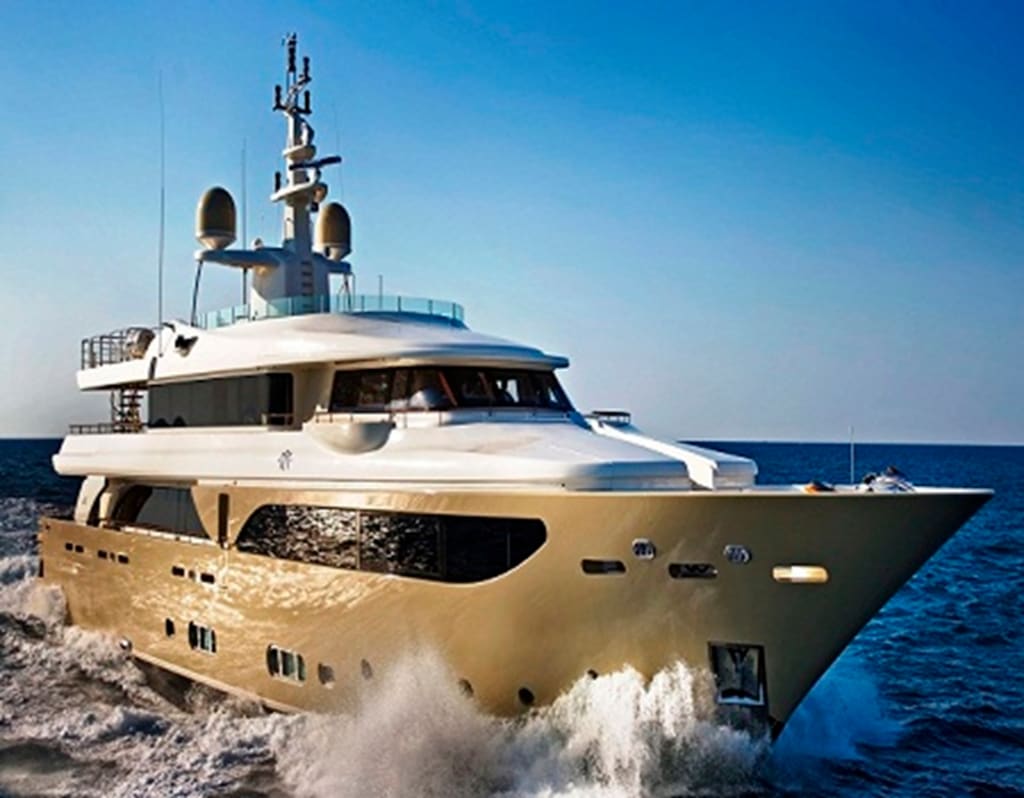
In the superyacht industry, the word "custom" has been diluted to the point of near-meaninglessness. Builders across Europe and Asia apply it to vessels that offer client choices within a fixed menu — hull form, layout zones, interior finish packages — while the structural and engineering decisions have already been made. Against that backdrop, CRN Yachts occupies a genuinely distinct position. The Ancona-based shipyard, operating under the Ferretti Group since 1999, builds entirely from first principles on each commission, with no standard platform, no shared tooling, and no repeat hull form unless a client explicitly requests it.
CRN yachts are fully custom superyachts constructed in steel and aluminum, built to individual owner specifications at the CRN shipyard in Ancona, Italy. Each vessel is engineered from a blank brief, with the hull form, structural specification, naval architecture, interior volume, and technical systems designed specifically for that commission. The shipyard produces a small number of vessels per year, typically ranging from approximately 40 to over 80 meters in length.
Understanding what that actually means — structurally, operationally, and financially — requires moving past the marketing language that surrounds the upper end of the yacht market and examining what the construction methodology produces that alternative approaches cannot.
Steel and Aluminum: The Material Case
The choice of steel for hull construction and aluminum for superstructure is not incidental to CRN's identity — it is central to what the shipyard offers and why the vessels perform the way they do at sea. Steel is heavier than the fiberglass composites used in production yachts, but at the lengths CRN works with, that weight comparison becomes structurally irrelevant and the advantages of steel become pronounced.
Steel hulls absorb impact, flex without catastrophic failure, and resist the kind of fatigue cracking that can affect composite structures under sustained open-ocean conditions. For owners who intend to use their vessels as expedition platforms — transiting to Svalbard, navigating the Northwest Passage, or spending extended time in the Southern Ocean — the structural margin that steel provides is not a luxury consideration but a practical one. A composite hull optimized for Mediterranean day sailing carries different structural assumptions than a steel vessel designed for bluewater passage-making, and those assumptions become meaningful when conditions deteriorate far from a shipyard.
The aluminum superstructure that CRN pairs with the steel hull addresses the weight-above-the-waterline penalty that an all-steel build would carry. Aluminum is roughly one-third the density of steel, which allows the upper decks — where mass has the greatest effect on stability — to remain light while the hull retains its structural integrity. This combination is standard practice in serious oceangoing vessel construction, applied by naval architects who prioritize seakeeping over the simplified manufacturing economics that favor single-material production.
The welding quality and structural inspection process at Ancona reflects the shipyard's history in commercial and military vessel construction — a background that shaped the engineering culture before CRN transitioned fully to luxury work. That industrial heritage is visible in how the yard approaches structural tolerances, weld inspection, and long-term corrosion protection, standards that have no direct equivalent in a fiberglass production environment.
What Full Custom Commissioning Actually Involves
The distinction between a genuinely custom build and a semi-custom production vessel becomes clearest at the brief stage. When a client commissions a vessel from a production-platform builder, the conversation begins with an existing hull — the center of gravity, stability curve, engine room volume, and internal layout zones are already determined. Client input shapes what sits inside those constraints, not the constraints themselves.
A CRN commission begins with a brief that has no preset boundaries. The naval architect works from the owner's intended use profile — passage-making range, expected cruising grounds, guest capacity, tender and toy requirements, crew complement — to develop a hull form and structural specification appropriate to those parameters. An owner who intends to cruise the Pacific Northwest and Alaska has different range, fuel capacity, and seakeeping requirements than one whose primary use is the Mediterranean and Caribbean, and those differences should produce different vessels. At CRN, they do.
This methodology has consequences that extend through every system on the vessel. Because the engine room volume is sized for the actual machinery the owner specifies rather than for a standard package selected at the design phase, the engineering spaces on CRN vessels tend to be proportioned correctly for the installed systems — a detail that matters considerably for crew working in those spaces during extended passages. Retrofit accommodation, where machinery installed after the fact must compete for space with whatever the original design left over, is a persistent operational problem on vessels where the engine room was designed around a different specification.
Interior volume allocation follows the same logic. The relationship between hull beam, deck height, and interior layout is determined by the owner's actual program — the number of guest cabins required, the desired volume of the owner's suite, the preference for an observation lounge or a large sundeck — rather than by what a standard platform happens to provide. Owners who have previously operated production vessels frequently note that custom builds at comparable overall length can offer substantially different volume distribution, because the hull form itself was shaped around the interior program rather than the other way around.
Naval Architecture and the CRN Engineering Approach
CRN's in-house technical team works alongside external naval architecture firms — Omega Architects, Zuccon International Project, and others have collaborated on Ancona commissions — but the engineering integration at the shipyard level is unusually close for the luxury sector. The design process and the build process are not separated by a handoff; the yard's engineers are involved in design decisions that affect fabrication, and the fabrication team's practical experience feeds back into design choices.
This integration matters most in the systems engineering dimension, which tends to be where custom vessels either fulfill their potential or fall short of it. A superyacht is essentially a complex mobile infrastructure — power generation, stabilization, climate control, propulsion, navigation, and safety systems that must function reliably across wildly varying conditions and far from shore-based support. Getting those systems to work together efficiently, and to be maintainable by a crew without specialized shoreside backup, requires engineering decisions that are specific to each vessel's actual parameters.
CRN's history of building to MCA (Maritime and Coastguard Agency) Large Yacht Code and comparable flag state standards reflects the practical demands that serious offshore voyaging places on vessel systems. These are not certification requirements pursued for marketing purposes — they reflect construction and outfitting standards that experienced owners and crew recognize as meaningful differentiators when planning extended passages.
Stabilization is one area where the custom approach produces measurable operational differences. A vessel designed from the outset with active fin stabilizers or gyroscopic stabilizer units integrated into the structural design — with the appropriate hull volume allocated and the structural reinforcement specified from the keel up — performs differently at sea than a vessel where stabilizers were added to an existing platform as a later specification choice. The difference is felt most clearly at anchor in a beam swell, which is precisely when a vessel's occupants most notice it.
The decision to commission a fully custom vessel at the CRN scale is not made in the same context as selecting a production yacht from a dealer's available inventory. It involves a multi-year relationship with a shipyard, a substantial capital commitment that begins well before delivery, and a level of engagement with technical decisions that many owners in the production segment never encounter.
The owners who pursue this path tend to share certain characteristics regardless of industry background. They typically have prior yacht ownership experience and specific performance or operational requirements that available production vessels cannot satisfy. They have often chartered extensively and identified the gaps between what charter vessels offer and what an ownership program tailored to their use patterns would provide. And they treat the vessel as an asset with a long operational life — often fifteen to twenty-five years for a well-maintained steel superyacht — rather than as a consumer product with a short ownership cycle.
This long-horizon perspective changes how the financial analysis of custom construction compares to production alternatives. A production vessel purchased at a lower initial cost may face higher depreciation through its first decade of ownership, particularly if the market for that specific model softens or if the platform becomes dated relative to newer production releases. A well-specified custom vessel with a distinctive design and proven construction quality tends to hold value more steadily, partly because there is no comparable new build competing directly with it at resale and partly because the original construction cost establishes a quality baseline that the market recognizes.
Maintenance economics over a long ownership period also favor custom construction in steel and aluminum for owners who intend to use their vessels actively. Steel hulls are easier to repair in ports around the world than composite structures requiring specialized materials, and the structural documentation that accompanies a custom build from a shipyard like CRN provides surveyors and refit yards with precise information about original specifications — information that frequently does not exist for production vessels in equivalent detail.
CRN in the Context of the Current Superyacht Market
The superyacht sector has grown significantly in terms of new build orders and delivery volume over the past decade, with backlogs at major European shipyards extending several years out following the demand surge of the early 2020s. Within that broader expansion, the fully custom segment — where CRN operates — has maintained a distinct market position rather than being absorbed into the near-custom production mainstream.
The reasons are structural. Production-platform builders have become more sophisticated in how they present customization options, and the quality of the best near-custom builders has improved measurably. But the underlying constraint remains: a platform that has been engineered for manufacturing efficiency carries compromises that cannot be fully resolved by client-facing customization, however extensive. The hull form is what it is; the engine room volume is what it was designed to be; the structural weight distribution reflects decisions made before the first client specification was written.
For the owner whose requirements sit comfortably within what a well-chosen production platform provides, that constraint may be acceptable or even invisible. For the owner whose use case is more specific — whether defined by intended cruising grounds, range requirements, guest program, or aesthetic ambition — the fully custom approach remains the only path to a vessel that actually matches the brief rather than approximating it.
Miami, which functions as one of the most active centers for superyacht brokerage and charter management in the Western Hemisphere, reflects this market segmentation clearly. The city's concentration of vessel transactions, survey activity, and experienced brokers means that buyers evaluating yachts for sale in Miami encounter the full spectrum of production, semi-custom, and fully custom vessels — and the informed comparisons that experienced brokers draw between them illustrate precisely why the CRN methodology commands the respect and the price points that it does within that landscape.
About the Creator
Robert Lama
Robert Lama is a seasoned yacht broker with Miami International Yacht Sales, a reputable yacht brokerage company specializing in both used and new yachts. https://www.miamiinternationalyachtsales.com/
Enjoyed the story? Support the Creator.
Subscribe for free to receive all their stories in your feed.
Comments
There are no comments for this story
Be the first to respond and start the conversation.