
Before Antibiotics, Surgeons Had One Rule: Let the Pus Out
Modern surgery was not built by penicillin. It was built by cutting, draining, and cleaning.
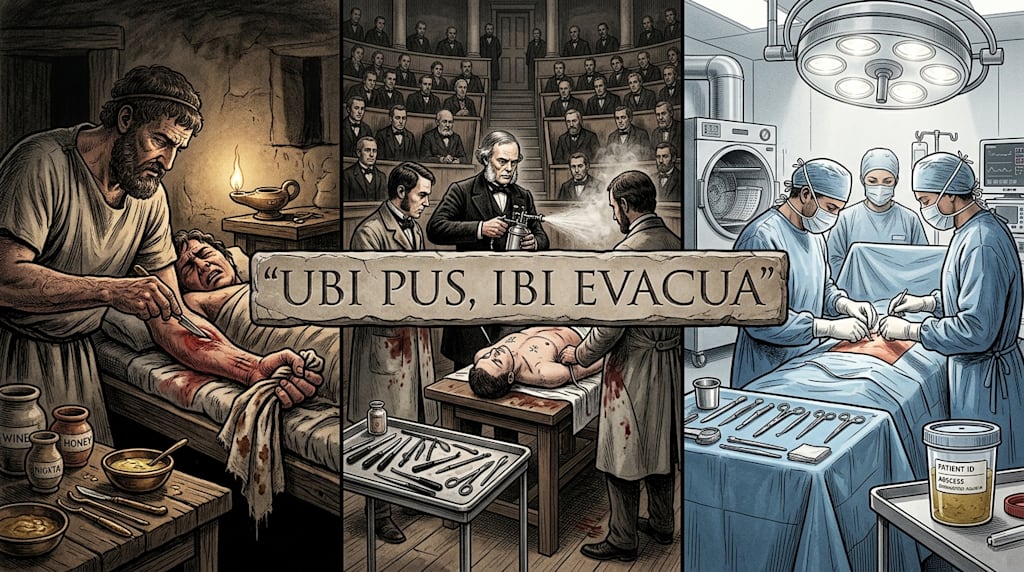
This may sound like a strange piece of trivia: doctors did not originally prevent or control wound infection with antibiotics.
Modern surgical infection control rests on several principles: debridement, drainage, sterile technique, disinfection, and isolation. Most of these were established before antibiotics existed.
The most important is debridement and drainage. Ancient doctors in both East and West did not know what bacteria were. But experience taught them that dead tissue, foreign objects, and pus left inside a wound could kill the patient.
Across cultures, the core treatment for surgical infection was basically the same. Remove dirt, cloth fragments, dead tissue, and other contaminants. Cut away necrotic tissue early. Open abscesses and let pus drain. Keep wounds open. Do not force closed a badly contaminated wound. If necessary, amputate a severely infected limb.
Even today, with powerful antibiotics, an abscess that is not drained properly often will not heal on antibiotics alone.
Surgical history has an old rule: Ubi pus, ibi evacua. Where there is pus, evacuate it. The fact that it is written in Latin tells you how old the rule is.
During my rotation in emergency surgery, a family once complained because we would not suture a wound that had been contaminated for more than eight hours. We would rather take the complaint than violate the principle. Closing that wound would have raised the risk of infection and gangrene.
The turning point in surgical infection prevention did not come from antibiotics. It came when doctors began to understand that wound infection came from unseen microorganisms, not from inevitable putrefaction in the wound itself.
In the 19th century, the idea of asepsis was born. Before that, postoperative infection was treated as part of surgery. A doctor might wear a coat stained with blood and pus from the previous operation, examine a patient with bare hands, use unsterilized instruments, and then operate on the next patient. Operating rooms even treated the accumulated blood on a surgeon's coat as a sign of experience.
If that happened today, it would be unimaginable. At minimum, the doctor and the head nurse would face criminal liability.
British surgeon Joseph Lister argued in the 1860s that if putrefaction was caused by microorganisms, then wound suppuration might be caused by microorganisms too. Lister began using carbolic acid, or phenol, to clean wounds, treat dressings, and disinfect instruments. He even sprayed carbolic acid into the operating area.
The point was not to wait for infection and then treat it. The point was to reduce microorganisms during surgery.
By the late 19th century, modern operating rooms had the system we recognize: high-temperature sterilization, steam sterilization, surgical gowns, gloves, caps, sterile dressings, hand washing by the surgeon, and skin disinfection at the surgical site.
As surgery advanced, doctors realized that surgical technique itself was an infection-control measure.
Rough clamping of tissue, damaged blood supply, large hematomas, dead space, and leftover necrotic tissue all give bacteria an excellent place to grow. A doctor named Halsted proposed gentle tissue handling, precise hemostasis, and protection of blood supply. These principles mattered even more in the era before antibiotics.
By the early 20th century, even without antibiotics, surgeons could effectively reduce infection through preoperative skin preparation, surgical hand washing, instrument sterilization, sterile gloves and gowns, a sterile field, minimal tissue damage, complete hemostasis, removal of necrotic tissue and foreign bodies, cautious primary closure of contaminated wounds, and drainage when necessary.
Antibiotics had not yet been born. What changed surgery was never antibiotics by itself.
Antibiotics do not solve the infection problem of surgery itself. They solve what happens after bacteria break through the defense line. And antibiotics are not the only things that can inhibit bacterial growth. Hippocrates used wine and vinegar on wounds. Ancient China used honey, alcoholic liquids, and plant extracts. These had limited antibacterial power. Antibiotics added a powerful systemic defense, but they did not replace any of the layers before them.
That is why surgical infection control still emphasizes source control. For an established abscess, the key treatment is usually still incision, debridement, and drainage, combined with appropriate antibiotics. Not simply switching to a stronger antibiotic.
About the Creator
Jin
Writer of reamstories
https://reamstories.com/jin
Enjoyed the story? Support the Creator.
Subscribe for free to receive all their stories in your feed. You could also become a paid subscriber, letting them know you appreciate their work.
Comments
There are no comments for this story
Be the first to respond and start the conversation.