
An Unheard But Incredible Voyage To Where?
New genetics work is rewriting the story of one of humanity's greatest voyages.

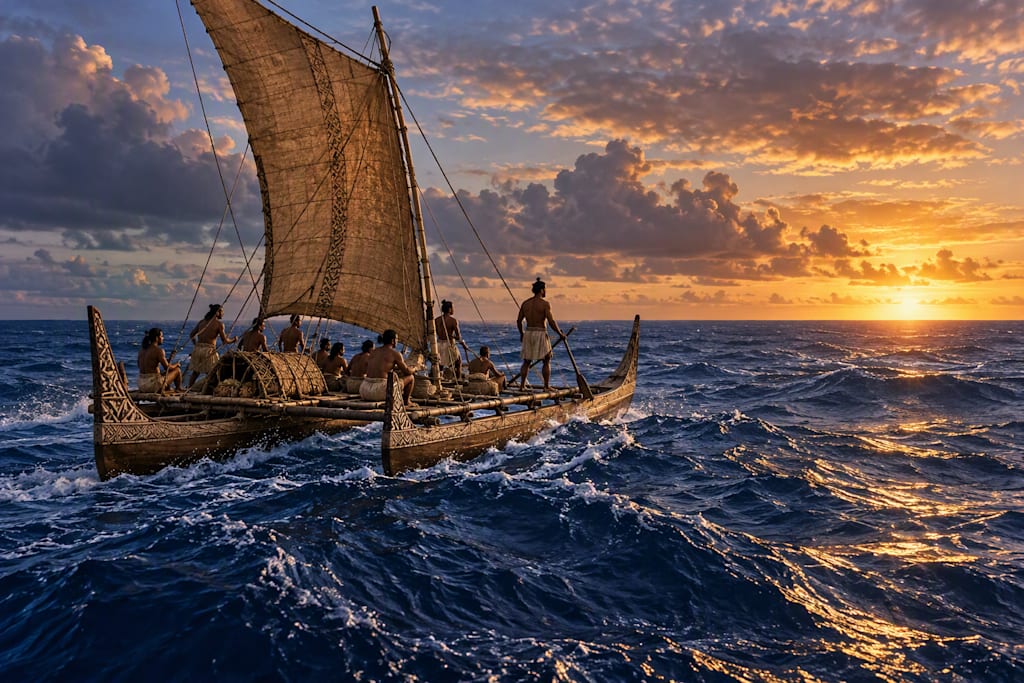
The discovery may prove who settled the Hawaiian Islands originally. It definitely tells you who some of the best seafarers once were.
Over 4400 miles of ocean couldn't stop them!
Imagine climbing aboard a wooden sailing canoe and setting out across Earth’s largest ocean. No GPS, compass, radio, or satellite navigation. Just the wind, the stars, the moving ocean, and generations of knowledge passed down by people who understood the sea in ways most of us never will.
Somewhere beyond the horizon, thousands of miles away, lies another island. You cannot see it, and you cannot know precisely when you will reach it. And turning around may eventually become just as dangerous as continuing.
Now imagine accomplishing that journey more than 700 years ago.
It sounds almost impossible, yet scientists recently revealed new genetic evidence pointing to an extraordinary chapter of human exploration. A connection between the ancient settlers of Hawaii and the people of Rapa Nui, better known internationally as Easter Island.
The two island groups are separated by approximately 4,400 miles of open Pacific Ocean. And the discovery is challenging what researchers thought they knew about how one of the most isolated island chains was populated. And it’s fascinating for more than just the distance they traveled, but also for what they left behind.
An Amazing Discovery Hidden In Human DNA
On October 8th, 2026, researchers published a study in the journal Science that examined the genetic history of Polynesian populations. The international team analyzed whole-genome data from more than 1,000 Polynesian people, including Native Hawaiians and individuals from Rapa Nui, Mangareva, Tahiti, and other Pacific islands.
They were trying to reconstruct something that happened centuries before written records could document it. Who settled these islands? Where did they come from? And how were these seemingly isolated populations connected? The results appear to have surprised even those involved in the research.
Their analysis revealed that Native Hawaiians share their closest Polynesian genetic relationship with the people of Rapa Nui. The researchers found that 61% of the thousands of reconstructed family trees paired Hawaii and Rapa Nui together. They checked the findings using four different approaches.
The evidence pointed to an unexpected sequence of ancient migrations, with voyagers reaching Rapa Nui from Mangareva around the 1200s and a related population subsequently making the extraordinary journey to Hawaii.
The study points toward Rapa Nui as a likely source of Hawaii’s founding population, although genetic reconstruction cannot establish every detail of an individual voyage. What does that mean?
People living on opposite ends of an enormous ocean carry genetic evidence of a shared history that unfolded more than seven centuries ago. Their ancestors accomplished something remarkable enough to leave a detectable signature in human DNA. Until now, that connection had remained hidden.
The Greatest Explorers You’ve Probably Never Heard About
When most of us think about the great age of exploration, certain names almost always come to mind. Christopher Columbus, Ferdinand Magellan, and Captain James Cook, for example. But centuries before their celebrated voyages, Polynesian navigators were already accomplishing amazing feats across the Pacific.
They traveled in sophisticated sailing vessels, including double-hulled canoes capable of undertaking long ocean journeys. Their navigation relied on detailed environmental knowledge, including the movement of stars, prevailing winds, ocean swells, birds, and other natural indicators.
They weren’t people accidentally drifting from island to island. They were accomplished navigators who developed and transmitted an extraordinary body of maritime knowledge. Their voyages also required planning.
Settling an uninhabited island meant bringing more than enough food to survive the journey. They needed the resources to establish an entirely new community. So they transported plants such as taro, bananas, and sweet potatoes, along with animals including chickens.
Imagine the confidence, or bravery, to prepare not merely for a voyage, but for an entirely new life somewhere across the ocean.
The newly identified genetic relationships reinforce the remarkable scale of Polynesian exploration. Researchers have proposed the name Holomoana Nui. Hawaiian for “great ocean voyaging, to describe the amazing tradition of voyaging revealed by their findings. It seems like a fitting description.
A Journey that Changed the Map of Human History
The Pacific Ocean covers nearly one-third of Earth’s surface. Across the immense expanse, Polynesian communities established settlements on islands separated by distances that remain intimidating even with modern technology.
The latest information provides new evidence about how the expansion unfolded. Rather than suggesting one enormous migration involving thousands of people moving at the same time, the genetic findings reveal a succession of smaller founding populations.
A community would be established on one island. Generations later, some of its descendants would go farther, founding another settlement. Over the centuries, these journeys created an extraordinary network of communities across the Pacific.
The researchers traced a migratory sequence involving Tahiti, Mangareva, Rapa Nui, and ultimately Hawaii. Their analysis estimated that Tahiti’s founding generation included around 800 people sometime close to the year 1070.
The evidence also suggests that Hawaii’s founding population may have been smaller, but here’s where the discovery becomes even more remarkable. Each new settlement left a genetic signature.
As smaller groups separated from larger populations, they carried only part of the genetic diversity of their ancestral homes. This is called a founder effect. And those effects accumulated across generations of ocean exploration.
The Second Chapter And How It Affects People Alive Today
This made an amazing discovery, something far more personal. The same genetic patterns that helped scientists reconstruct ancient Polynesian voyages may also explain certain inherited health risks among modern Pacific populations. When a relatively small group establishes a new population, rare genetic variants can become more common among its descendants.
If this happens repeatedly, those effects can become especially pronounced. The researchers found that founder effects among Eastern Polynesian populations were more than ten times stronger than those documented in several well-studied European-descended populations.
They also identified rare genetic variants linked to inherited conditions affecting vision and kidney function. Some of these variants are poorly represented in existing international genetic databases. Understanding a population's genetic characteristics can help researchers develop more appropriate screening programs and identify inherited health risks.
The scientists argue that Native Hawaiian and other Polynesian communities deserve greater attention in genomic research. So this discovery isn’t only helping to reconstruct the ancient journey. It could also contribute to better medical care for descendants of those extraordinary voyagers.
It’s amazing, but a voyage undertaken centuries before we were born is still influencing scientific understanding today.
What To Reconsider Based On This Discovery
The way we remember human achievement is interesting. We celebrate the invention of increasingly sophisticated technology, and we admire people who accomplish things once thought impossible. Yet some of the most remarkable achievements in human history occurred without the technology we now consider mandatory.
The ancient Polynesians navigated immense distances across the Pacific using knowledge accumulated through generations of experience. They crossed open ocean, established communities, transported the resources necessary for survival, and created lasting cultural connections across one of the most geographically challenging environments on Earth.
And they did it all centuries before many of the famed European voyagers that we remember in history.
What the new research reveals about Pacific voyaging is another powerful line of evidence: a surprising genetic tie that adds detail to an already remarkable history.
In this case, it’s an example of how sometimes the evidence to understand the past is carried quietly through generations, hidden in the DNA of people living thousands of miles apart.
Takeaways
When I went looking for something about the islands to write about, I didn’t imagine I’d find this. And it makes one wonder, after reading it, have we been celebrating the wrong explorers?
We don’t know them like we do Columbus or Magellan. We can only imagine what they experienced during these long voyages.
But we now have compelling evidence of the voyages, through the extraordinary connections made with DNA.
Perhaps the greatest lesson from this discovery isn’t that ancient people accomplished something we once struggled to understand. It’s that human ingenuity has always been greater than the historical recognition it receives.
I would say that Polynesian exploration may be one of the most underappreciated achievements in human history. What about you? I’d love to hear your perspective.
About the Creator
Jason Morton
From fiction to reality there’s tons to share about this crazy life. From being a single father, an officer, and having had many insane adventures while I learned about the world, my imagination runs wild with ideas.
Enjoyed the story? Support the Creator.
Subscribe for free to receive all their stories in your feed. You could also become a paid subscriber, letting them know you appreciate their work.
Comments
There are no comments for this story
Be the first to respond and start the conversation.