
Airless Spray Painting vs. Brush and Roller: What Hobart Painting Contractors Use and Why
How professional technique selection shapes finish quality, durability and cost across Tasmania's coastal climate
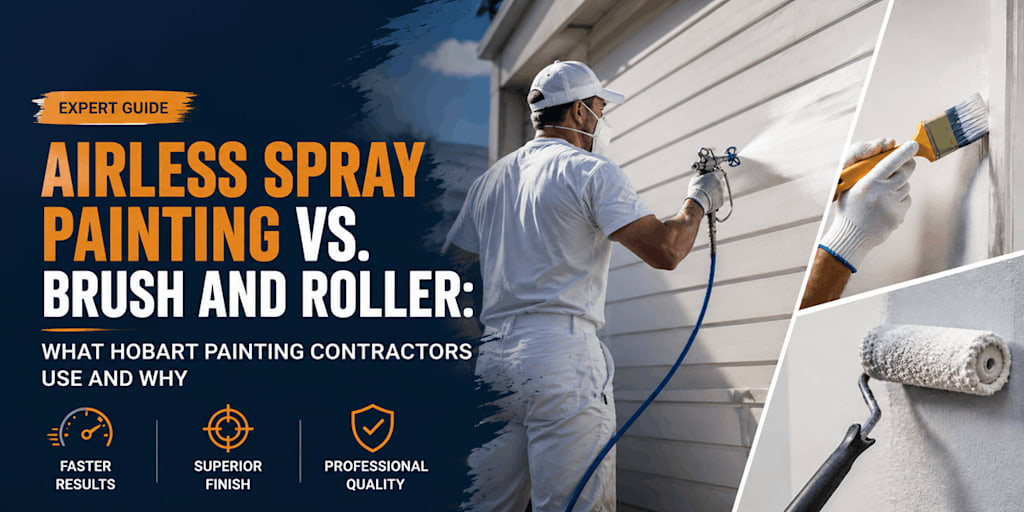
Across Hobart's residential streets and commercial precincts, the question of how a building gets painted is often as consequential as what colour it becomes. Painting contractors Hobart property owners hire today routinely choose between airless spray painting and traditional brush and roller application, and that choice carries real implications for finish quality, longevity and budget. Understanding why contractors favour one method over another in a given context helps owners make more informed decisions about their own properties.
Airless spray painting is a professional application method that uses a high-pressure pump to atomise paint into a fine mist, producing an even, consistent coat across large or detailed surfaces without the texture lines typical of manual tools. Brush and roller application instead relies on direct manual control, suited to precision work and detailed edges.
Both methods remain firmly in active use throughout Tasmania, and the distinction between them is rarely a matter of one being categorically superior. Rather, experienced painting contractors treat method selection as a technical decision shaped by substrate type, project scale, environmental conditions and the specific performance outcomes a job demands.
The Technical Case for Airless Spray Application
Airless spray equipment forces paint through a small nozzle at pressures typically exceeding 2,000 psi, breaking the coating into a fine particulate spray that lands on the surface as a uniform film. This mechanism is particularly effective on textured substrates such as render, brick, weatherboard cladding and corrugated roofing, where a brush or roller would struggle to reach into recesses and profile variations evenly. For larger Hobart properties, particularly heritage weatherboard homes common in suburbs like Battery Point and West Hobart, spray application allows contractors to coat extensive wall areas in a fraction of the time a manual approach would require.
Speed is one advantage, but it is not the primary reason contractors specify spray work. The more significant benefit lies in film consistency. Because the paint is applied as a fine mist rather than dragged across a surface, spray application tends to produce a smoother, more uniform finish with fewer visible application marks. This matters considerably on modern architectural finishes, feature walls and any surface where a flawless, factory-like appearance is part of the design brief. Commercial property owners in the Hobart CBD and surrounding business districts frequently request spray finishes for this reason, particularly on large façade areas, lift lobbies and open-plan office interiors where uneven sheen would be immediately noticeable under artificial lighting.
Spray application also tends to use coatings more efficiently on suitable substrates, since the atomised particles settle into surface irregularities rather than bridging over them as a roller nap sometimes does. On well-prepared, primed substrates, this can translate to a thinner, more even film build, which in turn reduces the likelihood of sagging, drips or uneven sheen once the coating cures.
The equipment itself has also evolved considerably over the past two decades, with modern airless units offering adjustable pressure settings, finer tip selections and improved filtration that reduce the likelihood of clogging or inconsistent spray patterns. This allows contractors to calibrate the equipment to the specific viscosity of a coating, whether it is a low-sheen acrylic for interior plasterboard or a heavier exterior masonry paint, rather than relying on a single fixed setting for every job. The ability to fine-tune pressure and tip size is part of why spray application has become viable across a much broader range of substrates than it was in earlier generations of equipment, extending its usefulness well beyond the large flat surfaces it was traditionally associated with.
Why Brush and Roller Still Holds Ground
Despite the technical advantages of spray equipment, brush and roller work has not been displaced, and for good reason. Manual application offers a degree of control that spray simply cannot replicate, particularly around windows, trims, skirting boards and other detail-heavy elements common in Hobart's older housing stock. Federation and Edwardian-era homes throughout suburbs such as North Hobart and Sandy Bay often feature intricate timber detailing, decorative cornices and multi-paned sashes that demand the precision only a brush can provide.
Roller application also remains the preferred method for interior walls in occupied homes, particularly where masking off entire rooms for overspray protection would be disproportionately time-consuming relative to the area being painted. A single room repaint, a feature wall, or touch-up work on an existing colour scheme is typically more practical and cost-effective with roller and brush, since the setup time for spray equipment, including masking, ventilation and cleanup, does not scale down efficiently for small jobs.
There is also a material consideration. Certain premium paint formulations, particularly thicker masonry coatings, elastomeric render paints and some heritage-appropriate finishes, are formulated for roller application and do not always atomise cleanly through standard spray equipment without thinning, which can compromise film thickness and long-term durability. Experienced contractors recognise when a coating's intended performance characteristics are better preserved through manual application rather than forcing a spray-compatible viscosity.
Manual application also carries an advantage that is easy to overlook: it allows a painter to feel and respond to a surface as work progresses. Brush and roller work makes it immediately apparent when a substrate is absorbing paint unevenly, when a previous coat has not cured properly, or when a patch of filler is behaving differently from the surrounding wall. This tactile feedback loop is harder to replicate with spray application, where the operator is working at a distance from the surface and relying primarily on visual cues rather than direct contact. For renovation work on older Hobart properties, where wall and ceiling substrates can vary considerably even within a single room, this responsiveness often proves valuable in catching problems before they become visible defects in the finished coat.
Climate and Substrate Conditions Unique to Hobart
Tasmania's climate introduces variables that influence method selection in ways that differ from mainland Australian conditions. Hobart experiences a temperate maritime climate with notable wind exposure, particularly across elevated and coastal suburbs, and this has a direct bearing on whether spray application is practical on any given day. Wind drift is one of the most significant operational constraints on exterior spray painting, since even moderate gusts can carry atomised paint particles well beyond the intended surface, creating overspray risk to neighbouring properties, vehicles and landscaping.
Contractors working in exposed locations such as the Eastern Shore, Kingston and parts of the Hobart waterfront frequently schedule spray work around weather windows, often early morning before afternoon sea breezes intensify. On days where wind conditions are unsuitable, brush and roller application becomes the default fallback, not because it produces an inferior result, but because it is far less weather-dependent and can proceed safely under conditions that would render spray work impractical or risky.
Humidity and temperature also affect drying times and recoat windows for both methods, but the effect is more pronounced with spray application, where a thinner, more rapidly applied film can be more sensitive to early moisture exposure if Hobart's variable spring or autumn weather shifts unexpectedly. This is one reason experienced local contractors build flexibility into project scheduling, treating method choice as something that may be adjusted in response to real-time conditions rather than fixed rigidly at the quoting stage.
Substrate condition matters equally. Many older Hobart properties retain original sandstone, render or weatherboard surfaces that have weathered over decades, sometimes with surface chalking, minor cracking or inconsistent porosity. Spray application performs best on substrates that have been properly prepared, primed and stabilised beforehand, since the technique offers less opportunity to physically work paint into compromised or uneven surfaces compared with the mechanical action of a brush or roller. This is why thorough surface preparation, including pressure washing, scraping, patching and priming, typically precedes any spray-based exterior project, and why contractors who skip this stage in favour of speed often see premature finish failure.
Tasmania's relatively short building season also shapes how contractors plan around method choice. Compared with mainland states, Hobart's cooler average temperatures and higher likelihood of rain through autumn and winter compress the practical window for exterior painting projects, particularly those relying on spray application's faster coverage to make the most of a narrow weather window. Contractors familiar with the local seasonal pattern tend to schedule larger spray-based exterior projects for the more stable late spring and summer months, while reserving winter scheduling for interior work or smaller exterior sections that can be completed and protected within a single fair-weather day using brush and roller methods.
Cost, Time and Practical Considerations for Property Owners
From a cost perspective, the comparison between methods is rarely straightforward, since pricing depends on surface area, substrate complexity, masking requirements and paint volume rather than labour method alone. Spray application generally reduces labour time on large, uninterrupted surfaces, which can lower the labour component of a quote for substantial exterior projects. However, the masking, plastic sheeting and protective preparation required to contain overspray, particularly on properties close to neighbouring boundaries common in inner-Hobart suburbs, can offset some of those time savings.
Brush and roller work, while slower per square metre on large areas, often requires less protective preparation and generates less waste paint through overspray, which can make it more economical for smaller or more contained projects. For property owners weighing quotes, the more useful question is not which method is cheaper in the abstract, but which method suits the specific scope, scale and site conditions of the project at hand.
Durability outcomes between the two methods, when properly executed by an experienced contractor, are broadly comparable, since the long-term performance of an exterior coating depends far more on surface preparation, primer selection and paint quality than on the application tool used to apply it. A poorly prepared substrate sprayed with premium paint will still fail prematurely, while a well-prepared surface coated with brush and roller using an appropriate product can perform exceptionally well for many years. This is a point sometimes lost in marketing material that positions spray application as inherently superior, when in practice the preparation standard is the more decisive variable.
Commercial property owners managing larger portfolios, such as retail strips, warehouses and multi-unit developments, often benefit from a hybrid approach, where spray application handles broad wall and ceiling areas efficiently while brush work addresses trims, edges and detail elements. This combination is increasingly standard practice among established Hobart contractors, reflecting an understanding that the two methods are complementary tools rather than competing alternatives.
Insurance and liability considerations also factor into method selection more than property owners might expect, particularly in higher-density parts of the city. Overspray drifting onto a neighbouring car, fence or garden bed can create a liability exposure that a contractor must account for before agreeing to spray a boundary wall in a tightly packed inner-suburban street. In these situations, the practical risk of containment failure can outweigh the time savings spray application would otherwise offer, leading experienced contractors to recommend brush and roller work even where the substrate itself would technically suit spraying. This kind of risk-based judgement is part of what separates an experienced local operator from a less considered approach to quoting.
How Experienced Contractors Decide Between Methods
Professional decision-making around application method typically begins with a site assessment rather than a predetermined preference for one technique. Established painting contractors evaluate substrate type, surface condition, project scale, proximity to neighbouring structures, weather exposure and the specific coating system specified before recommending an approach. This assessment-led process distinguishes experienced operators from less rigorous providers who may default to whichever method is fastest or most familiar regardless of suitability.
Industry training and trade certification in Australia generally cover both spray and manual application techniques, reflecting the expectation that competent painters in Hobart must be proficient across methods rather than specialised in only one. Contractors who maintain both skill sets and equipment are better positioned to match technique to project rather than adapting every project to a single preferred tool. This flexibility tends to correlate with more consistent finish outcomes across varied property types, from heritage cottages to contemporary commercial fitouts.
Equipment maintenance and operator skill also play a meaningful role in spray application outcomes specifically, since poorly maintained airless units or inexperienced operators can produce inconsistent tip wear, pressure fluctuations and uneven film build that undermine the technique's theoretical advantages. This is one reason the quality gap between an experienced spray operator and an inexperienced one tends to be more pronounced than the equivalent gap in brush and roller work, where the margin for technical error is somewhat narrower.
This is also why property owners evaluating quotes are often better served by asking about a contractor's reasoning for a proposed method rather than simply comparing prices across providers. A contractor who can clearly explain why a particular substrate, location or coating system points toward spray application, brush work, or a combination of both is generally demonstrating the kind of technical literacy that correlates with a well-executed result. Conversely, a quote that specifies one method uniformly across a complex property, regardless of substrate variation, can be a signal that the assessment stage was skipped altogether. Among the painting contractors Hobart property owners typically encounter, this willingness to justify a method choice on technical grounds is one of the more reliable indicators of genuine experience.
Conclusion
The choice between airless spray painting and brush and roller application is not a question of which technique is universally better, but which technique aligns with the specific demands of a given Hobart property. Climate exposure, substrate type, project scale and the finish standard required all factor into a decision that the more experienced painting contractors in Hobart has come to rely on approach with technical judgement rather than habit. For homeowners and commercial property owners alike, understanding this distinction provides a clearer framework for evaluating quotes, asking informed questions and recognising why a competent contractor might recommend one method for an exterior render job and an entirely different approach for the same property's window trims. In a climate as variable as Tasmania's, that adaptability, more than any single tool, is what ultimately determines a lasting finish.
About the Creator
Dyson Painters
We are trusted Professional Painters in Hobart, Providing High-Quality Residential and commercial services. Contact us to hire our expert exterior and interior Painters.
Enjoyed the story? Support the Creator.
Subscribe for free to receive all their stories in your feed.
Comments
There are no comments for this story
Be the first to respond and start the conversation.