
AI in MRO Master Data Management: Where It Wins, Where It Fails, and What Closes the Gap
AI in MRO Master Data Management: Benefits & Limitations

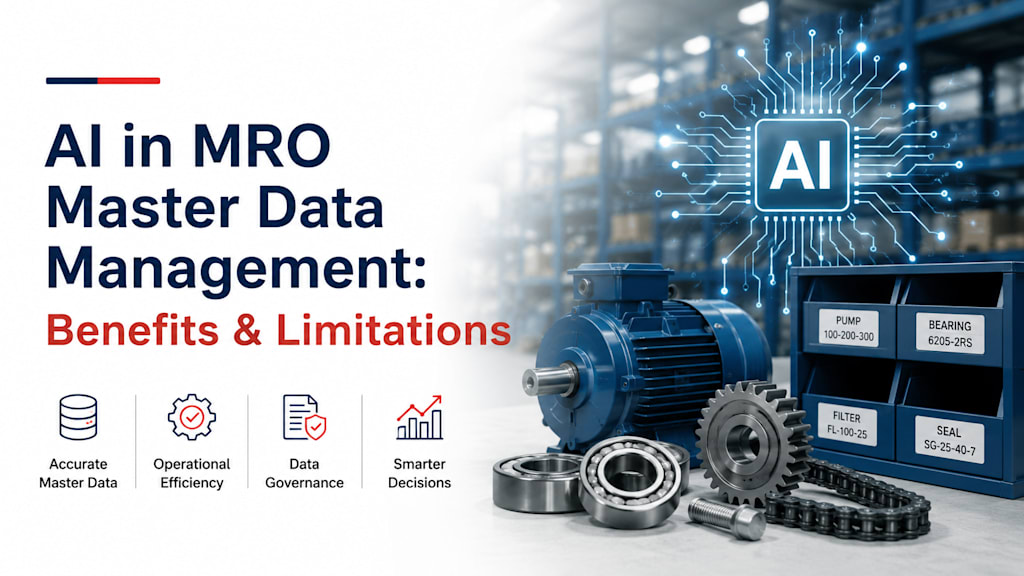
Imagine this: A single spare part is overstocked at one plant while another halts production waiting for it.
That is the central problem of MRO master data: it governs the materials that keep critical assets running, yet stays fragmented, inconsistent, and missing the attributes that make a part identifiable.
AI promises to fix this at scale—deduplicating, enriching, and classifying records, then compounding the value through predictive maintenance and smarter sourcing. But AI in MRO alone hits a hard wall: it cannot distinguish parts whose differences were never recorded, its models drift as conditions shift, and it lacks access to the tribal knowledge that determines cases based on undocumented knowledge. When AI is deployed without oversight, it does not just underperform—it scales errors across the catalog.
This blog explores where AI offers value in MRO data management, where it falls short, and how organizations drive value from the strategic human-in-the-loop framework.
The Structural Challenges of MRO Master Data Management
MRO (Maintenance, Repair, and Operations) master data governs indirect materials: spare parts, consumables, and tools used to maintain physical assets. Unlike direct production materials, which carry standardized and well-governed identities, MRO records are characterized by chronic inconsistency.
- Non-Standardized Part Descriptions: Free text, inconsistent abbreviations, mixed units, and no enforced noun-modifier standard fragment one item into many records. ERP and CMMS searches cannot reconcile these variants, which drives duplicate purchase orders and redundant safety stock across sites.
- Incomplete Technical Attributes: Records missing the Manufacturer Part Number (MPN), material grade, or tolerances cannot be matched to a catalog. Buyers default to maverick spot buys at premium prices, and technicians risk fitting the wrong part.
- Fragmented Systems of Record: Mergers, acquisitions, and plant-by-plant rollouts leave operators running multiple disparate ERP and EAM systems that never connect. Each system tracks inventory separately, so the same part can sit in surplus at one site while another halts production waiting for it.
- Broken Asset-to-Part Linkage: Spare-part records sit apart from the equipment Bill of Materials (BOM) and the assets they serve. When equipment fails, planners manually search for the correct part, inflating mean time to repair (MTTR).
- Lack of Governance: Without a governance framework, assigned data stewardship, or point-of-creation validation, teams remediate the master only periodically rather than governing it continuously. Data quality decays with every new record, and duplicates and obsolete items re-accumulate within a few years.
Where AI in MRO Data Management Adds Value
AI delivers real value in MRO at two levels: the master data itself, and the operations that depend on it. The data comes first:
- Advanced Deduplication and Standardization: ERP-native matching relies on exact string matches, so a single-character variance can hide a duplicate. Using natural language processing and machine learning, AI clusters records by description, specification, and vendor data, surfacing semantic duplicates and standardizing part numbers across hundreds of thousands of SKUs in a fraction of the time.
- Attribute Enrichment: To fill incomplete fields, machine learning extracts specifications from supplier catalogs, technical manuals, and engineering drawings.
- Classification at Scale: Automated classification maps materials to standard taxonomies far faster than manual review allows.
When the data foundation is accurate and reliable, automation compounds its value downstream:
- Predictive Maintenance: AI reads sensor streams and maintenance history to flag likely failures early, moving teams from reactive repair to proactive planning.
- Strategic Sourcing: AI forecasts demand, tunes stock levels, and evaluates supplier performance, thereby lowering carrying costs and tail spend while preventing stockouts.
- Resource Allocation: Optimization models handle capacity and workforce planning, aligning technician skills, tool availability, and asset downtime windows to improve schedule compliance and technician utilization.
These are substantive gains, with direct working-capital implications: fewer redundant SKUs, lower carrying costs, and less material search time during downtime. Each one of these, however, operates strictly on the core data. When a decision requires context that the records lack, those same capabilities become sources of risk. That gap is where AI-only programs consistently fail.
The Limitation: Where AI-Driven MRO Data Management Falls Short
AI Cannot Distinguish Parts Without Recorded Differences
Two parts can carry near-identical descriptions yet differ in tolerance, material grade, or certification, the attributes that determine interchangeability. A matching algorithm working only from text and recorded specifications will auto-merge them into one golden record, a false positive that an experienced reliability engineer would reject.
Predictive Models Drift as Conditions Change
Predictive maintenance and demand models depend on historical failure rates and consumption patterns. When unprecedented supply chain shocks, unusual operating conditions, or new equipment break those patterns, the model suffers from data drift. The model then produces incorrect reorder quantities or fails to predict missed failures. Drift degrades predictive accuracy without detection, so it requires continuous monitoring and periodic retraining rather than a single deployment.
Tribal Knowledge Sits Outside the Records
A large share of decision-making in MRO data management depends on undocumented expertise:
- Which substitution will pass inspection?
-Which configuration will engineering reject?
- Why does a given part behave differently under specific operating conditions?
The expertise sits with senior technicians and reliability engineers, outside the master record. Without that domain knowledge, a model approves substitutions that fail inspection and classifications that engineering rejects. The resulting errors surface later, during inspection or maintenance, causing rework or downtime.
The Business Cost of Relying on AI Alone for MRO Data Management
Predictive maintenance, AI-driven procurement, and supply chain optimization all depend on an accurate, consistent material master. When the master is unreliable, these systems underperform, and teams blame the model rather than the data feeding it. This shifts the objective from cleaning the data once to keeping it ready for every subsequent AI use case.
‘Remember that AI-ready data is not “one and done.” Think of it as a practice where the data management infrastructure needs constant improvement based on existing and upcoming AI use cases. As the organization invests in AI, develop an AI-ready data practice and ensure continued investment and ongoing maturity in metadata management, data observability, and D&A and AI governance.’ —Gartner
AI also scales errors. A single flawed matching or classification rule propagates across thousands of records faster than any manual process. Businesses deploy AI before establishing the data foundation, then absorb the cost of accelerated dysfunction. The financial impact is also difficult to detect because it rarely registers as a discrete line item. It accumulates through:
- Excess material search time during unplanned downtime.
- Avoidable rework and manual reconciliation across systems.
- Redundant procurement of parts already held in inventory.
- Inflated stock carried against a single physical part under multiple records.
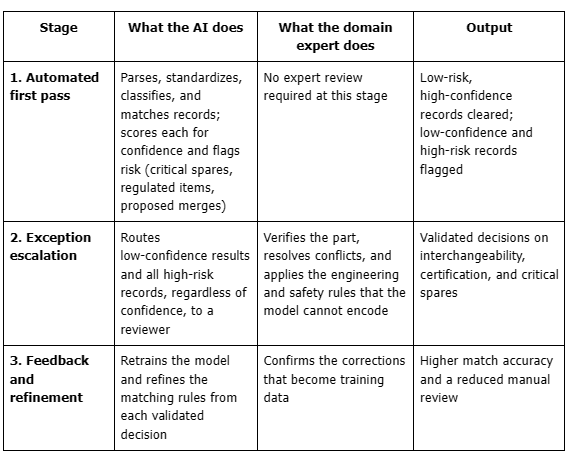
The Framework: Combining Automation with Manual Oversight
In order to combine efficiency with scalability, combine automation with human review.
The Strategic Imperative: AI in MRO Needs a System and the Expertise to Run It
The enterprises that succeed with MRO data are not the ones automating most aggressively. They are the ones who understand AI's role within the broader operating system:
- AI makes continuous data quality economically feasible at an enterprise scale.
- Governance is the steering mechanism that keeps the process aligned with its intended outcome.
- Expert judgment resolves the edge cases where the cost of a confident error is measured in downtime rather than formatting.
The harder part is making AI accountability practical in day-to-day MRO data management. At enterprise scale, this requires people who understand the technical differences between parts, enough capacity to work through large record volumes, and tools that can standardize, match, enrich, route exceptions, and capture reviewer decisions. Many maintenance and procurement teams have some of these capabilities, but not all of them, while also managing daily operations. In that context, external MRO master data management services can support internal teams with specialist review, additional execution capacity, and established workflows for matching and governance. Ownership still stays with the business; the value is a cleaner, governed material master that teams can trust for automation, analytics, planning, and maintenance execution.
About the Creator
Ravi Kant
Ravi Kant is the Vice President of the eCommerce and Photo Editing Division at SunTec India, where he leads global operations that help enterprises scale through data-driven digital commerce and content solutions.
Enjoyed the story? Support the Creator.
Subscribe for free to receive all their stories in your feed.
Comments
There are no comments for this story
Be the first to respond and start the conversation.