
A Glitchy Video Game About a Doomed Emperor Just Explained Why Your Company Is Collapsing
It’s not the revenue charts. It’s not the layoffs. It’s a single meeting pattern — and a 17th‑century bicycle shed.
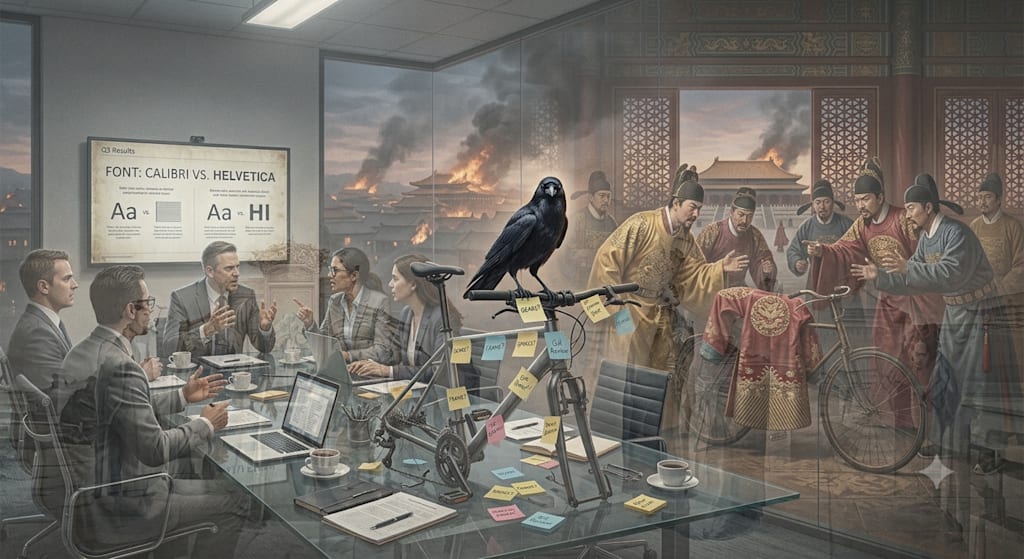
The real sign that a company is about to collapse is hidden in a string of figures from the Chongzhen reign.
The place I work now is full of anxiety and uncertainty, but I can’t tell when it will actually go under.
That’s a direct quote from someone in the workplace. They mentioned an obscure game called History Simulator: Chongzhen, where players have reported a long list of "critical bugs":
NPC status glitch – NPCs who have been imprisoned or killed reappear in the next turn, alive and conversing normally. When confronted, the AI invents absurd excuses to patch over the logic hole.
Failed edicts – Orders like "raise an army" never actually generate troops, but the AI sends back memorials saying "under construction" or "expected completion in two quarters"—which never happens.
Ignored directives – Imperial orders are simply forgotten or forcibly bent toward a preset direction. No decree leaves the palace.
Flippant AI – When players point out logical contradictions, the AI replies with rote "yes, yes," "right, right," or doubles down.
Broken finances – Temporary expenditures become permanent line items in the next quarter, with the AI fabricating justifications.
Supply failures – Even with granaries built right next to troops, soldiers still go hungry, because the game’s core logic doesn’t allow most buildings to improve supply.
Tech tree lock – Technologies already unlocked are denied by the AI.
Missing funds – Millions of taels vanish from the treasury in a single turn. Ask a minister, and he says, "Your Majesty, you misremember." Argue hard enough, and he admits they miscalculated—but the money never comes back.
One comment under the game asked: Is it possible that these aren’t bugs?
To tell if a company is about to go under, you don’t look at stricter attendance, slower reimbursements, or suddenly multiplying KPIs—those are all surface symptoms.
So what do you look for? The bicycle-shed effect.
The British historian Cyril Parkinson once wrote about a real finance committee meeting with three items on the agenda: building a nuclear reactor, building a bicycle shed, and providing drinks for the joint welfare committee.
The nuclear reactor: most members didn’t understand it; those who did feared they couldn’t explain it clearly; those with doubts were afraid to object. Two and a half minutes – passed.
The bicycle shed: everyone had an opinion. Is it necessary? Is the quote reasonable? What material should we use? Forty-five minutes – approved, saved $300, and the committee felt immensely accomplished.
The drinks: too familiar. Coke or juice? Paper cups or plastic? Can we cut the budget further? One hour and fifteen minutes – no conclusion.
Parkinson observed: people fear appearing ignorant on complex issues, so they stay silent; but on familiar ground, they talk endlessly to prove their own worth. The less you know, the more you talk; the more critical the issue, the fewer dare to touch it.
The Chongzhen court of the late Ming took this effect to its extreme.
According to historical records such as the Chongzhen Changbian: in just over a decade, the court formulated more than 300 new ritual protocols and administrative procedures, while substantive reforms concerning people’s livelihoods, the economy, and military survival numbered fewer than 30.
In his last ten years, there were 47 debates on court attire, nearly 60 discussions on sacrificial rites, and close to 100 disputes on mourning regulations.
Alongside these, consider this: the Minister of Revenue, Bi Ziyan, calculated that the fiscal deficit for the first year of Chongzhen’s reign stood at 1.3 million taels of silver. In that same period, the court spent 11 consecutive days debating what colour of formal robe the crown prince should wear when leaving the palace for his studies.
While frontier cities fell in Liaodong, capital officials were being heavily penalized for arriving late to morning court.
The senior management of the Ming corporation poured their astonishing administrative energy into building bicycle sheds.
The factional struggles of declining dynasties took on a peculiar texture under Chongzhen. During the Jiajing reign, the conflicts between the "pure stream" and the Yan party at least revolved around high-stakes issues like taxation, border defence, and people’s welfare. By Chongzhen’s time, the main topics had shifted to who is more loyal and who stands on higher moral ground. All you needed was a mouth and a brush to wage war. Fellow provincials and colleagues formed alliances, wielding morality as a zero‑risk weapon. The Donglin, Zhe, Chu, Fushe, Xuan factions—they all flourished.
When the barrier to entry for debate drops low enough, morality becomes the most convenient weapon.
When Li Zicheng’s rebel forces—the dark horse of the era—reached the gates of Beijing, the Chongzhen group still had possible escapes: move the capital south, rely on the Jiangnan economy to recover; or negotiate a truce with the Qing in the north and concentrate forces against Li.
But both paths required systematic assessment and careful planning—they were nuclear‑reactor‑level issues.
What was the court’s response?
Move the capital? Disrespect to the ancestors.
Negotiate peace? A stain on national honour.
Every substantive question of survival was forcibly twisted into a moral judgment.
It wasn’t until Li Zicheng breached the city walls that the Ming corporation completed its bankruptcy liquidation under the bicycle‑shed effect.
Why do ordinary employees notice stricter attendance, slower reimbursements, and longer processes first?
Because the silence of the nuclear reactor inevitably leads to inflation in the bicycle shed.
When senior executives can’t answer why our core product can’t beat the competition, they have to fill the management void with why an employee was 23 minutes late. This is a compensatory mechanism in management—the less control decision‑makers have over the external environment, the more they try to regain a sense of control through micro‑management internally.
KPIs mutate from user growth to daily report word count. OKRs mutate from conquering technical bottlenecks to meeting‑minutes formatting.
Employees aren’t worn down by the business—they’re ground down by the fake workload manufactured out of management’s own fear.
So, to tell if a company is close to collapse, don’t look at the loss figures on the financial statements—those can be window‑dressed.
Listen to the “noise spectrum” of their meetings.
If a two‑hour operations review spends forty minutes arguing over PPT fonts and colour schemes, and only ten minutes on customer churn—that company’s nuclear reactor has already gone cold. The rest of the time is just executives using their spit to paint the bicycle shed.
Chongzhen left behind a blood‑stained note at Coal Hill: "You ministers have failed me." To his last breath, he believed his officials were disloyal.
But the ministers were shrewd. Knowing full well that this machine could no longer be fixed, and that whoever tried would take the blame, pretending to be busy with trivialities was their optimal survival strategy.
Your company is no different.
When you notice management suddenly taking a keen interest in a "Best Dressed" award, drafting new "meeting room booking rules," or spending a week debating the proper way to paste receipts on expense claims—don’t doubt it.
They’re not trying to run the company.
They’re just rearranging the deck chairs on a sinking ship.
About the Creator
Jin
Writer of reamstories
https://reamstories.com/jin
Enjoyed the story? Support the Creator.
Subscribe for free to receive all their stories in your feed. You could also become a paid subscriber, letting them know you appreciate their work.
Comments
There are no comments for this story
Be the first to respond and start the conversation.