
Which Jobs Are Most at Risk From AI Agents in 2026
AI agents are reshaping work. Discover which jobs are most at risk, why automation is accelerating, and what roles remain safe.

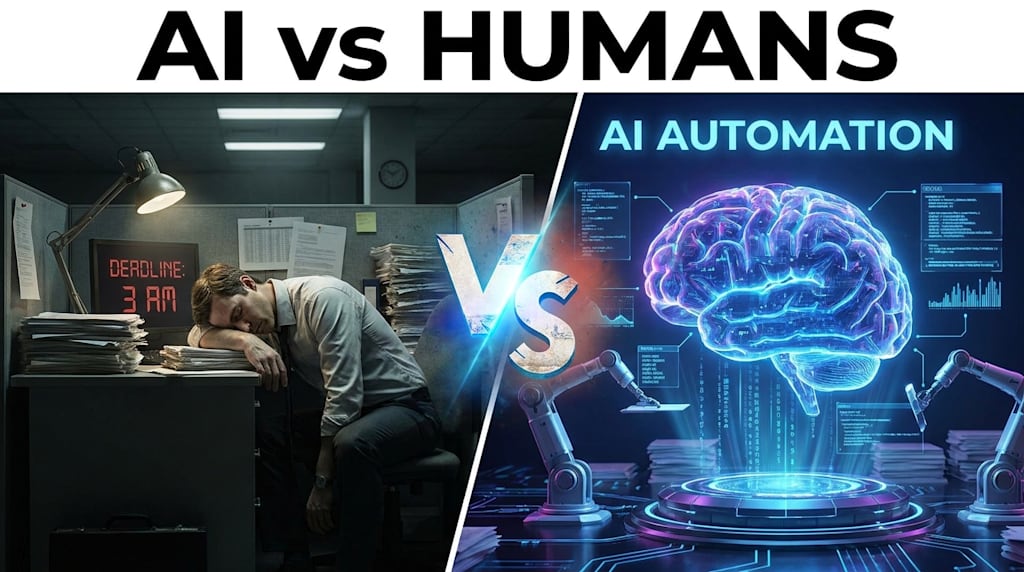
AI Agentsvs.s Employees: What Jobs Are Actually at Risk?
A few years ago, the biggest fear surrounding artificial intelligence was that it would eventually replace human workers. Today, that conversation feels much more immediate.
Businesses are no longer experimenting with AI just for curiosity's sake. They are using it to answer customer questions, summarize meetings, generate reports, write marketing drafts, and automate routine workflows. In many cases, the technology is already saving companies hours of work every week.
Yet the debate is often framed in a misleading way. People ask whether AI will replace employees, as if companies must choose one or the other. What is actually happening is more complicated. AI is not replacing entire professions overnight. It is gradually taking over specific tasks, and that shift is beginning to reshape how organizations think about work.
The jobs facing the greatest pressure are usually the ones built around repetitive digital tasks. Administrative support, data entry, basic customer service, scheduling, document processing, and routine reporting are all examples of work that follows predictable patterns. Modern AI systems are increasingly capable of handling those patterns with impressive speed.
That does not mean every person in those roles will lose their job. In many organizations, AI is being used to reduce workload rather than eliminate positions. A customer support representative, for example, may spend less time answering common questions and more time dealing with complex issues that require empathy and judgment.
This distinction matters because it changes the nature of the risk.
For most workers, the immediate threat is not unemployment. It is job transformation.
Consider the marketing industry. Not long ago, creating a first draft of an article, social media post, or campaign outline could take hours. Today, AI can generate those materials in minutes. The role of the marketer has not disappeared, but the expectations have changed. Employers increasingly value people who can edit, refine, and strategically guide AI-generated output rather than create everything from scratch.
A similar pattern is emerging across finance, operations, customer support, and even software development.
Ironically, some white-collar professions may be more exposed than many people expected. When discussions about automation first became popular, many assumed factory workers would face the greatest disruption. Instead, AI has proven particularly effective at handling information-based tasks that occur entirely on a computer.
At the same time, there are clear limits to what AI can do.
Technology can analyze information, but it does not truly understand human relationships. It can generate recommendations, but it does not carry responsibility for business decisions. It can imitate creativity, yet it often struggles to produce genuinely original ideas grounded in real-world experience.
That is why skills such as leadership, negotiation, communication, strategic thinking, and relationship building remain difficult to automate. These abilities rely on context, trust, and human judgment, qualities that organizations still depend on.
Perhaps the most overlooked consequence of AI is its impact on entry-level opportunities. Many careers begin with routine tasks that help new professionals learn the fundamentals of an industry. If those tasks become automated, companies may hire fewer junior employees. The result could be a workforce where gaining initial experience becomes more challenging than it is today.
This possibility raises important questions about education, training, and career development over the next decade.
The future of work is unlikely to be a battle between humans and machines. A more realistic outcome is a workplace where people who know how to work with AI gain a significant advantage over those who ignore it.
History offers a useful lesson here. New technologies rarely eliminate the need for human talent entirely. Instead, they change which skills are valuable.
AI appears to be following the same pattern.
The employees most likely to succeed will not necessarily be those who compete against AI. They will be the ones who learn how to use it effectively while continuing to provide the judgment, creativity, and human insight that technology cannot easily replicate.
About the Creator
Future Lens
Exploring AI, technology, and the future of work through research-driven insights.
Enjoyed the story? Support the Creator.
Subscribe for free to receive all their stories in your feed.
Comments
There are no comments for this story
Be the first to respond and start the conversation.