
What We Kept
The phones stopped at 10:17 on a Tuesday morning.

Mara knew the time because the clock above the circulation desk still worked. Its red second hand swept past the twelve while twenty-three students, three librarians, and a man waiting to use the public printer stared down at the black rectangles in their hands. For several seconds nobody spoke. Then chairs scraped back, screens were tapped and shaken, buttons held too long. Someone laughed. Someone else said the campus Wi-Fi must be down.
“It isn't the Wi-Fi,” Daniel said from behind the reference desk. He held his phone toward Mara as though she might diagnose it from across the room. “It won't even restart.”
Mara reached automatically for her own phone. The screen remained black. She pressed the side button, then the volume button, then both together, performing the little sequence her daughter had taught her after the last update. Nothing. Around the library, the same gestures repeated from hand to hand: tap, press, swipe, turn over, press again. A student removed his case as if the fault might be hiding beneath it. Someone blew into a charging port. Near the windows, three people had already gathered around the outlet strip, exchanging cords that could no longer make any difference.
Within ten minutes, computers began filling the gaps. News sites loaded slowly beneath the sudden demand. Every smartphone, reporters were saying. Every manufacturer. Every network. Phones connected to chargers remained dead. Emergency alerts had failed with them. Cellular providers insisted their towers were operational. Engineers appeared on television, looking frightened by questions they couldn't answer.
Mara watched for less than a minute before returning to the circulation desk. Students were already asking for things they ordinarily found themselves.
“What time does the 240 leave?”
“Do you know the number for Financial Aid?”
“How do I get to Reseda from here?”
“My parking permit is on my phone.”
“So is mine,” Mara said.
The student stared at her.
“That wasn't helpful, was it?”
He laughed despite himself, and Mara found a sheet of paper.
By noon, someone had taped handwritten bus times beside the library entrance. They were copied from a transit website on one of the desktop computers, although nobody knew how long those computers would remain useful if the networks began failing under the load. Beneath the schedule, someone had drawn a rough campus map and marked the locations of working landlines. Another person added the health center. Someone else corrected the extension for campus police.
The correction had been made in red ink.
Mara stood looking at it longer than necessary.
“No,” a student said behind her. “That's the old extension.”
A second student took the pen and crossed out the correction. “They changed it last year.”
“How do you know?”
“My roommate works there.”
The first student shrugged. “Okay.”
The new number went up. By three o'clock, everyone was carrying paper.
Mara drove home without navigation. She had lived in the Valley for twenty-six years and still missed the turn onto Nordhoff because she was accustomed to the small blue line telling her when to move left. She cursed, doubled back, and laughed once she realized what she had done. At the next intersection, two cars were stopped beside each other while their drivers shouted directions through open windows.
Traffic lights worked. Gas pumps worked if one had a physical card. The radio worked, and every station carried some version of the same bewilderment. Experts urged people not to panic. Government officials asked citizens to use landlines when possible and to conserve emergency services. A man from a technology company explained that data stored remotely remained intact. Photos, contacts, documents, recordings—most of it was still there somewhere. The problem, he said, was access.
Mara turned off the radio.
At home, the landline was ringing. She almost didn't recognize the sound. It came from the kitchen, two clear electronic notes followed by a pause, and for an instant she stood inside the doorway trying to place it. Then she dropped her bag on the table and picked up the receiver.
“Hello?”
“Mom.”
“Claire?”
“Obviously.”
Mara laughed. “I haven't heard you call this number in years.”
“I had to look it up on my laptop.”
“You don't know your childhood phone number?”
“Do you know mine?”
Mara opened her mouth and stopped.
“Exactly,” Claire said.
They spent several minutes comparing what they had lost access to. Claire couldn't reach her boyfriend because she didn't know his number and his apartment building used an app instead of an entry key. Her grocery list was gone. Her work authentication system depended on her phone. She had driven home by following street signs and discovered that she had never known the name of the road she used every morning.
“I know where it is,” she said. “I just didn't know what it was called.”
Mara understood that better than she wanted to admit.
“Can I leave you a message later if I need to?” Claire asked. “I'm trying to make a list of everyone's landlines.”
“No.”
“Why?”
“The machine is full.”
“Then clear it.”
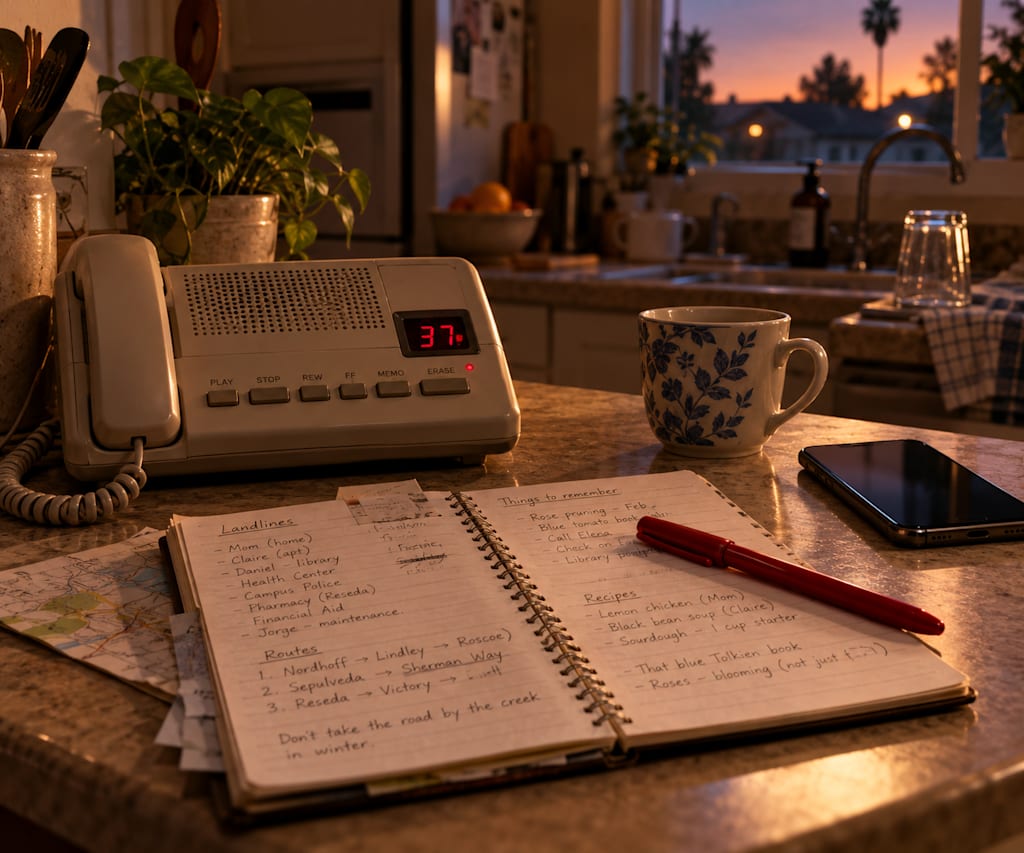
Mara looked across the kitchen. The answering machine sat beneath the wall phone, a small gray unit they had owned for so long that its plastic had yellowed slightly around the buttons. A red 37 glowed on its face. She had stopped deleting messages years ago.
“I can't,” she said.
There was a pause. “Is that still because of Grandpa?”
Mara turned toward the sink. Evening light caught along the rim of a glass someone had left upside down to dry.
“I think he might be on there.”
“You've been saying that for six years.”
“I know.”
“Have you ever checked?”
“No.”
Claire was quiet long enough that Mara could hear someone speaking in the background at her end of the line.
“What if he's not?”
Mara closed her eyes. “That,” she said, “is why I haven't checked.”
For the first three days, the world tried to behave as though the phones would return. People charged them, carried them, placed them beside their plates at restaurants and on desks at work. Mara continued putting hers into her purse each morning, though it was no more useful than a stone. She would catch herself reaching for it whenever she wanted the time, a photograph, a number, the spelling of a name. Each failed gesture embarrassed her, though no one was watching.
On the second morning, she found a student sitting cross-legged on the carpet beside the charging station. Six dead phones lay connected to the power strip in front of him, each attached by a different cord.
“Any luck?” Mara asked.
He shook his head without looking up. “My sister's in Sacramento.”
“Have you tried a computer?”
“I emailed her.”
“Good.”
“She hasn't answered.”
He pressed the button on one phone again, waited, and moved to the next.
Mara left him there. By afternoon, someone had unplugged the chargers and replaced them with a legal pad and two pens.
At the library, they printed maps until the toner ran low. A whiteboard appeared near the entrance with bus routes, emergency numbers, pharmacy hours, and handwritten notices from people trying to locate one another. One woman wrote the address of her son's apartment and asked if anyone knew how to get there. Three people offered three different routes.
“Which one is right?” she asked.
All three answered at once.
They eventually drew the routes on paper. A retired delivery driver corrected two street names and added a shortcut that none of the others knew. The woman folded the map into quarters and placed it in her coat pocket.
The next morning, someone had copied it onto the whiteboard.
By the end of the week, the shortcut had acquired a name nobody could explain.
Mara noticed these things. She noticed students exchanging numbers and writing them inside notebooks. She watched one young man copy a recipe from a website because his grandmother had always texted it to him and now neither of them could remember whether the soup used one bay leaf or two. She watched two sisters argue over their mother's address, each certain the other had reversed the house numbers. People began asking one another questions that devices had answered silently for years: Does anyone know? Someone usually did, though not always, and that distinction began to matter.
On Friday evening, Claire arrived carrying a spiral notebook.
“Phone book,” she said, dropping it onto the kitchen table.
Mara moved a stack of mail aside and opened it. Claire had divided the pages alphabetically and begun recording names, numbers, addresses, birthdays, workplaces, allergies, and emergency contacts. Her handwriting changed size depending on how much she was trying to fit onto each line.
“You wrote down my blood type?”
“You never know.”
“My mother used to have one of these.”
“A blood type?”
“A book.”
Claire rolled her eyes and went to the refrigerator. The motor came on while she was standing in front of it, filling the quiet kitchen with its low hum. She returned with two bottles of water, set one beside Mara's hand, and glanced at the answering machine.
“Thirty-seven?”
“Don't.”
“I didn't say anything.”
“You were going to.”
Claire sat across from her. Outside the kitchen window, the last light had flattened against the neighboring roofline. The answering machine's red number seemed brighter as the room darkened.
“Do you remember what his voice sounded like?” Claire finally asked.
“Of course.”
“Okay. What did it sound like?”
Mara almost laughed. “What kind of question is that?”
“I don't know. You said you remember.”
She did. She remembered absolutely. Then she tried to summon it.
Her father's face came first. Hazel eyes. The deepening lines beside his mouth. His hands moving while he talked. She could see him reading aloud, though the book in his hands kept changing. She remembered the shape his mouth made when he was amused, the way he tilted his head when someone said something he considered slightly ridiculous.
But sound would not come.
She knew his voice had been gentle. She knew it had deepened with age. She knew illness had thinned it near the end.
Knowing was not hearing.
“I had a recording once,” she said.
Claire waited.
“On my old phone. He'd left me a message. I upgraded and thought everything transferred. It didn't.”
“You never told me.”
“There wasn’t anything to tell then. He was alive.”
The refrigerator clicked off, and the room seemed larger without it.
Mara looked at the answering machine. Thirty-seven messages. Somewhere inside those thirty-seven ordinary fragments of other days, her father might still be asking her to call him back, reminding her about something she had already forgotten, or saying nothing worth saving at all.
Claire reached across the table, but she did not touch the machine.
“We could listen.”
“Not tonight.”
“All right.”
For another week, they didn't.
The world reorganized itself badly and then, little by little, less badly. Shops taped hours to their doors. Schools sent paper notices home with children. Bulletin boards reappeared in grocery stores. Libraries became crowded. Local newspapers printed extra editions. People bought alarm clocks, road atlases, address books, cheap watches, cameras. Claire learned her boyfriend's number. Mara learned Claire's.
Information slowed down. It also changed.
A rumor about a bank closure passed through three neighborhoods before anyone discovered that only one branch had closed early. A handwritten pharmacy schedule was copied incorrectly and sent half a dozen people to a locked door. The campus map acquired a building that had been demolished four years earlier because someone had copied an old map.
Mara began carrying a red pen.
“That's wrong,” she would say.
Then she would correct it.
One afternoon she stopped with the pen poised over a handwritten bus route.
“How do you know?” a student asked.
Mara looked at the line she had been about to change. She had taken that bus years ago. Or perhaps it had been another one.
“I don't,” she said.
The student waited.
Mara capped the pen. “Let's find someone who does.”
That night she went home and pressed PLAY.
Claire was beside her. Neither of them had planned it. Mara had walked into the kitchen, set down her keys, looked at the red thirty-seven, and understood that possibility had become another kind of storage. The machine clicked, and a woman's voice filled the kitchen.
“Mara, this is Dr. Levin's office—”
She pressed NEXT. A school attendance message followed, then her sister asking about Thanksgiving, a contractor, a neighbor, Claire at nineteen irritated about a car, a political campaign, and Mara's own voice calling home from an airport to ask someone to feed the dog. They laughed at some of them. After a while they stopped laughing.
Message twenty-six began with several seconds of silence.
Mara's hand closed around the edge of the counter.
There was breathing. Then a man's voice said her name.
It was her brother.
She exhaled, and Claire put a hand against her back. They continued through thirty-one, thirty-two, thirty-three.
At thirty-four, the machine clicked, and a voice entered the room that Mara knew before she understood a word.
“Mara, it's Dad.”
Her knees weakened so suddenly that Claire pulled out the chair behind her.
The message was absurd. He wanted to know whether she had borrowed a book. He couldn't remember the title, only that it was blue and had something to do with Tolkien. If she had it, would she bring it when she came over? Her mother said hello. He paused, then added that the roses were doing well.
That was all.
Mara covered her mouth as the machine moved automatically to message thirty-five.
“Stop it.”
Claire lunged for the button, and silence returned.
Mara sat with both hands pressed against her face. She had imagined this moment so many times that the reality seemed almost offensively small. No final wisdom. No declaration preserved against death. A missing book. Her mother's hello. Roses.
“Play it again,” Claire whispered.
Mara did.
This time she listened differently, not to the words but to the breath before her name, the slight rise in his voice when he said blue, as though the color ought to be enough information, the little pause before Your mother says hello, the way roses seemed to carry a smile.
Claire began crying.
“I'd forgotten that,” she said.
“What?”
“How he said your name.”
Mara looked at her. “Say it.”
Claire tried.
“No,” Mara said immediately. “Not like that.”
She tried to reproduce it herself and heard the failure as soon as the sound left her mouth. They tried again, but each repetition changed the sound slightly. For the next twenty minutes, mother and daughter sat at the kitchen table trying to reproduce a dead man's pronunciation of a living woman's name.
Claire eventually picked up her notebook.
“What are you writing?”
“How he said it.”
“You can't write that.”
“I know.”
She kept writing anyway.
Three months later, the first smartphones came back. Not all of them. Not everywhere. Engineers had found ways to restore certain systems, and manufacturers promised that most cloud data had survived. People lined up outside stores. News anchors held working phones aloft like returned fire.
Mara watched from the library television while a student beside her unfolded a paper map that had been repaired with tape.
At home, Claire's notebook remained beside the landline. It was thicker now. Other handwriting appeared among hers. Numbers had been corrected. Addresses crossed out. Recipes inserted on loose paper. Someone had drawn a map to a cabin in the mountains and added, in the margin, Don't take the road by the creek in winter.
The answering machine had space again. Mara had deleted the dentist, the contractor, the campaign, the wrong numbers, even her own airport message.
She had kept thirty-four.
The restored phone arrived in a box on Thursday. She left it unopened on the kitchen counter.
That evening Claire called the landline and asked whether she had turned it on yet.
“Not yet.”
“Why not?”
Mara looked at the answering machine, then at the notebook opened beside it. Claire had written her grandfather's message as best she could remember it. The wording wasn't exact. Mara knew because she had listened enough times to learn where the differences were.
She reached for the red pen, then stopped.
“Mom?”
“I'm here.”
Outside, someone was calling a child home for dinner. A dog barked twice. From the house next door came the muffled ring of another landline, followed by footsteps crossing a room to answer it.
Mara read Claire's version again. The blue book had become that blue Tolkien book. Her mother no longer merely said hello; she sent her love. The roses were blooming instead of doing well.
None of it was exactly right.
Mara closed the pen.
“Tell me again,” Claire said, “about the roses.”
Mara did.
About the Creator
Rebecca A Hyde Gonzales
I love to write. I have a deep love for words and language; a budding philologist (a late bloomer according to my father). I have been fascinated with the construction of sentences and how meaning is derived from the order of words.
Enjoyed the story? Support the Creator.
Subscribe for free to receive all their stories in your feed. You could also become a paid subscriber, letting them know you appreciate their work.
Comments
There are no comments for this story
Be the first to respond and start the conversation.