
What AI Found Beneath the Great Pyramid Shocked the World
For thousands of years, the Great Pyramid guarded a secret hidden beneath the sands of Egypt. When artificial intelligence finally uncovered it, historians were forced to question everything they thought they knew about the ancient world.

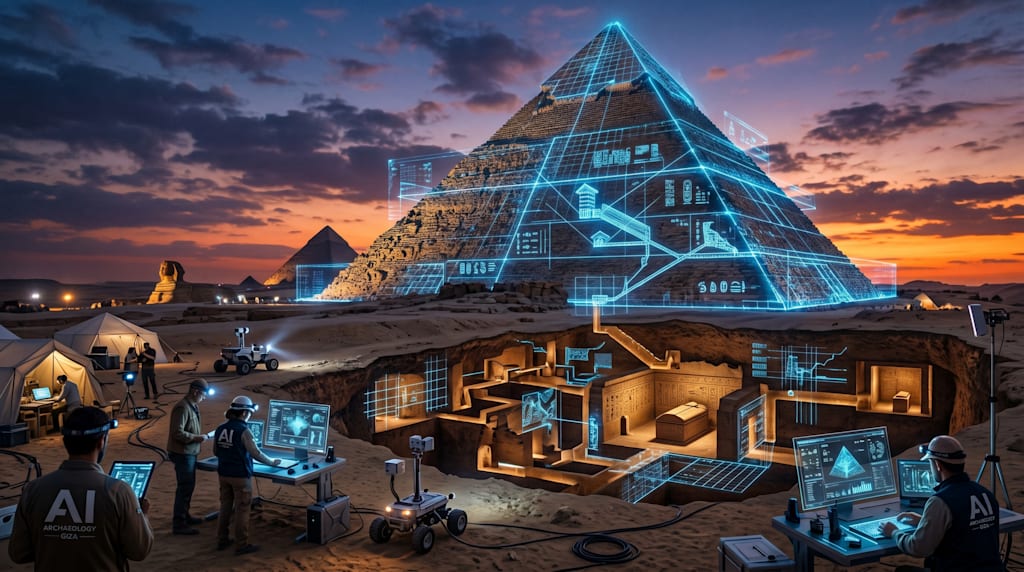
Hook
For over 4,500 years, the Great Pyramid of Giza stood as humanity's greatest mystery.
Kings rose and fell. Empires vanished. Entire civilizations disappeared into history.
Yet beneath the world's most famous monument, something remained hidden.
Not because it was impossible to find.
But because humanity had been looking in the wrong way.
Then artificial intelligence took a look.
And everything changed.
1. The World's Greatest Mystery
The Great Pyramid has fascinated explorers for centuries.
Built during the reign of Pharaoh Khufu, it remains one of the most impressive structures ever created.
How was it built?
Why was it built?
And what secrets still lie inside?
Despite decades of research, many questions remained unanswered.
Scientists believed they had already mapped most of the pyramid.
They were wrong.
2. The AI That Saw What Humans Missed
In 2030, researchers launched Project Horizon.
Its goal was simple:
Feed every available scan, satellite image, seismic survey, and archaeological record of the Great Pyramid into an advanced artificial intelligence system known as APEX.
The machine processed billions of data points in less than 48 hours.
Then it found something impossible.
A geometric anomaly nearly 60 meters beneath the pyramid.
A structure no human researcher had ever noticed.
The AI flagged it with a confidence score of 99.7%.
At first, scientists assumed it was a software error.
But further analysis only strengthened the evidence.
Something was there.
3. The Hidden Chamber
Ground-penetrating radar teams arrived from around the world.
Weeks later, their scans confirmed the discovery.
A massive underground chamber.
Perfectly symmetrical.
Far larger than any known room inside the pyramid complex.
The news leaked online.
Within hours, social media exploded.
Millions followed every update.
The world wanted answers.
4. A Discovery Unlike Anything Before
When robotic probes entered the chamber, researchers expected burial artifacts.
Instead, they found something strange.
The walls were covered with repeating geometric patterns.
Not hieroglyphics.
Not artwork.
Patterns.
Precise mathematical arrangements repeated throughout the structure.
The symbols appeared designed rather than decorative.
And the deeper researchers looked, the stranger things became.
5. The Pattern
APEX began analyzing the markings.
Days later, the AI detected relationships between the symbols and astronomical events.
Solar cycles.
Planetary alignments.
Lunar movements.
The chamber appeared to contain a mathematical model of the sky.
But it was far more accurate than anyone expected from an ancient civilization.
Some calculations matched celestial events thousands of years into the future.
Scientists struggled to explain it.
6. The Theory That Shocked Historians
A controversial theory emerged.
Perhaps the chamber was never intended as a tomb.
Perhaps it was designed as a knowledge vault.
A place where information could survive for thousands of years.
Instead of storing books, the builders encoded information into geometry itself.
Stone became data.
Architecture became memory.
History became mathematics.
The idea sounded impossible.
Yet the evidence continued to grow.
7. Global Debate
News networks covered the discovery around the clock.
Universities launched emergency research programs.
Historians debated.
Scientists argued.
The public became obsessed.
Some believed it proved ancient civilizations were far more advanced than previously imagined.
Others warned against drawing conclusions too quickly.
One thing was certain.
The discovery had captured the world's imagination.
8. The Final Revelation
Months later, APEX uncovered one final detail.
The entire underground structure functioned like a giant information map.
Every chamber.
Every corridor.
Every stone placement.
Part of a larger system.
A message encoded across architecture itself.
A message designed not for ancient humans.
But for future generations capable of understanding it.
Perhaps that future had finally arrived.
Conclusion
For centuries, humanity asked what was inside the Great Pyramid.
The better question may have been:
What was hidden beneath it?
Artificial intelligence did not create the mystery.
It simply helped humanity see what had always been there.
And if one of history's greatest monuments still holds secrets beneath its foundations...
What else might be waiting to be discovered?
About the Creator
uzair hadi
🌟 Love stories that stir the soul? ✨
Subscribe now for exclusive tales, early access, and hidden gems delivered straight to your inbox! 💌
Join the journey—one click, endless imagination. 🚀📚 #SubscribeNow
Enjoyed the story? Support the Creator.
Subscribe for free to receive all their stories in your feed.
Comments
There are no comments for this story
Be the first to respond and start the conversation.