
What AI Found Beneath Antarctica Shocked Scientists
For centuries, Antarctica was believed to be a frozen wilderness. Then an artificial intelligence system uncovered something hidden beneath the ice that no human had ever seen before.
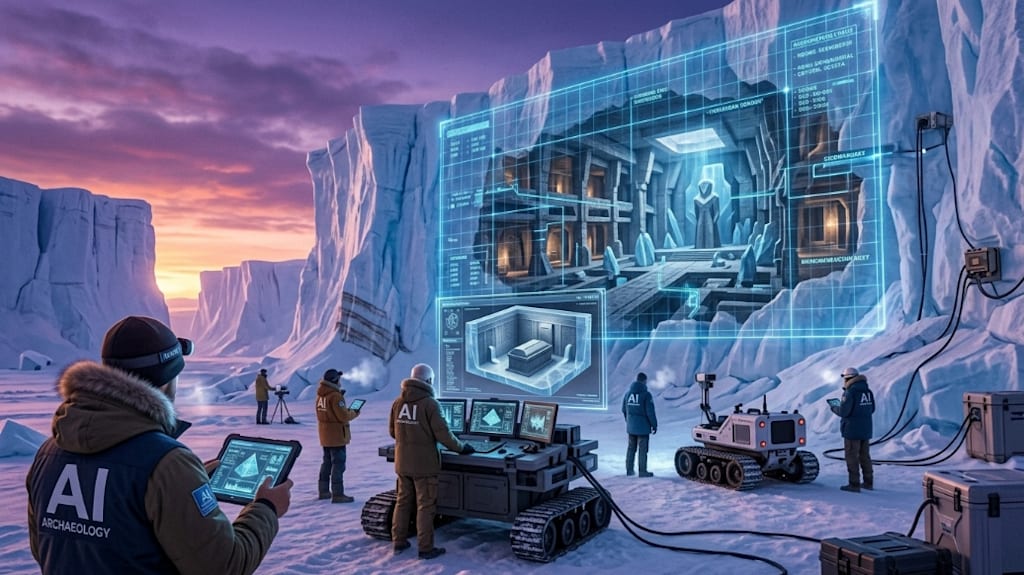
For hundreds of years, Antarctica remained one of Earth's greatest mysteries.
Covered by endless ice and battered by violent storms, the frozen continent seemed empty and lifeless. Scientists traveled there to study climate change, glaciers, and ancient ice cores.
Nobody expected to discover evidence of a forgotten civilization.
Everything changed in 2031.
A team of international researchers launched Project Polaris, an ambitious effort to analyze decades of Antarctic satellite imagery using artificial intelligence. Their goal was simple: identify unusual geological formations hidden beneath the ice.
The AI examined billions of data points collected over several decades.
For weeks, nothing unusual appeared.
Then the system flagged a region deep beneath eastern Antarctica.
At first, researchers assumed it was a software error.
The anomaly appeared too perfect to be natural.
The AI detected geometric shapes buried nearly two miles beneath the ice. Straight lines intersected at precise angles. Circular formations appeared at regular intervals.
Nature rarely creates such patterns.
Scientists ordered additional scans.
When the new data arrived, the atmosphere inside the research center changed instantly.
The structures were real.
Ground-penetrating radar confirmed the presence of a vast underground complex hidden beneath layers of ancient ice.
News of the discovery spread around the world.
Social media exploded with speculation.
Some believed it was an unknown geological phenomenon.
Others claimed it was evidence of a lost civilization.
Researchers remained cautious.
They wanted proof.
Months later, robotic probes were sent through deep drilling shafts.
What they found shocked everyone.
Beneath the ice stood enormous stone structures unlike anything previously discovered in Antarctica.
Massive corridors stretched into darkness.
Perfectly shaped chambers connected through geometric pathways.
The architecture appeared intentional.
Even more surprising were the markings carved into the walls.
There were no words.
No drawings.
No statues.
Only mathematical patterns.
Rows of symbols repeated throughout the structure.
When researchers asked the AI to analyze them, it discovered relationships between the carvings and astronomical cycles.
The patterns matched solar activity, lunar phases, and planetary alignments.
The entire complex appeared to function as a giant archive of knowledge.
But instead of storing information in books, it stored information through mathematics and architecture.
Scientists struggled to explain how such a system could exist.
The deeper they investigated, the stranger the discovery became.
Some calculations embedded within the structure accurately predicted astronomical events thousands of years into the future.
Historians were stunned.
Had an ancient civilization achieved a level of understanding far beyond what anyone imagined?
A controversial theory soon emerged.
Perhaps the builders knew their world would disappear.
Perhaps they created the underground complex to preserve knowledge for future generations.
Not for themselves.
For humanity.
As researchers continued their work, the AI uncovered one final secret.
The entire city formed a single enormous geometric pattern visible only from above.
A message hidden beneath Antarctica for thousands of years.
A message no human could recognize until artificial intelligence connected all the pieces.
The discovery transformed the way people viewed history.
For centuries, Antarctica appeared empty.
Yet beneath its frozen surface lay evidence of a forgotten chapter of human civilization.
And as scientists celebrated their discovery, one question continued to haunt them.
If an entire city could remain hidden beneath Antarctica for thousands of years...
What else is still waiting to be found?
About the Creator
Enjoyed the story? Support the Creator.
Subscribe for free to receive all their stories in your feed.
Comments
There are no comments for this story
Be the first to respond and start the conversation.