
What Actually Makes a Remix Work When You Don't Have the Stems?
A prompt imagines a new song. A real remix keeps the melody and rebuilds the world around it.

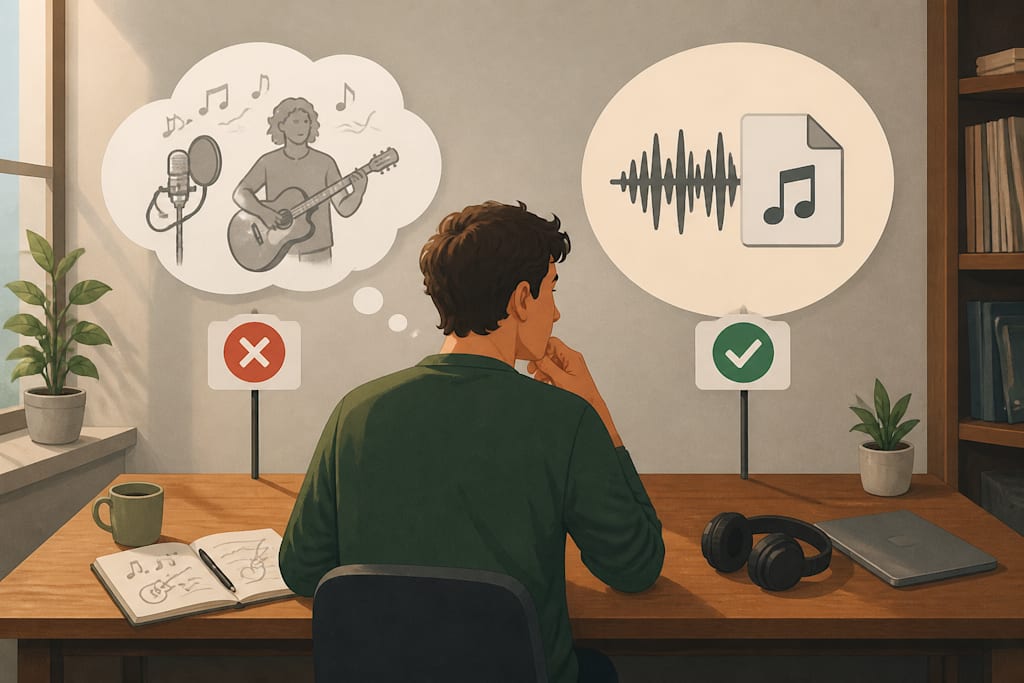
For decades, remixing was a privilege reserved for people with direct access to the studio floor. If you wanted to turn an acoustic ballad into an uptempo club track, you needed the multitrack session files: the isolated vocal stem recorded without reverb, the dry kick and snare, the bass line, and the MIDI data for the chords. With those pieces in hand, a producer could strip away the original accompaniment and build an entirely new sonic world around the vocal.
If you were an independent creator or producer working with only a finished stereo master, your options were crude. You could filter out the low end with a high-pass EQ to make room for a new kick drum, slice a four-bar phrase into a repetitive loop, or layer new synths directly over the existing mix. The result almost always sounded cluttered, fighting the original instrumentation for frequency space.
Today, artificial intelligence has begun to blur that boundary. Tools claim to restyle, rework, or remix audio files in seconds. Yet creators exploring these tools quickly discover a frustrating paradox: many systems confuse “remixing a song” with “generating an entirely new song that happens to share a loose vibe.”
Understanding why that happens—and how true restyling actually functions—is the difference between finding an exciting new version of your track and wasting hours chasing an unpredictable algorithm.
The Test of a Remix: Identity Versus Arrangement
What separates a genuine remix from an unrelated song? The answer is musical identity.
When a listener recognizes a remix at a festival or on a playlist, they are not reacting to the drum machine. They are reacting to the melodic hook, the cadence of the lyric, or the emotional contour of the chord progression. The thrill of a great remix lives in the contrast: you hear something familiar delivered in an unexpected aesthetic.
If a transformation discards the vocal melody or alters the core notes of the chorus, it has failed the fundamental test of a remix. It might produce a pleasant piece of music, but it is no longer your song. It is a stranger wearing the same color shirt.
Traditional producers call this preserving the “topline.” The topline is the primary melody that people hum on the way home. Everything else—the tempo, the sound design, the rhythmic swing, the harmonic texture—is open for reinterpretation. A dark techno rework and a breezy bossa nova cover can exist from the exact same melodic skeleton. The moment that skeleton dissolves, the connection to the original is lost.
Why Text Prompts Struggle With Existing Audio
The explosion of generative AI music over the past two years was driven by text-to-audio models. You enter a sentence—“energetic future bass drop with melodic female vocals”—and a complex neural network generates a track from statistical noise.
This works remarkably well when starting from a blank slate. But when your starting point is an existing piece of recorded music, text alone is the wrong steering wheel.
A prompt has no ears. It cannot distinguish between the vocal hook you spent weeks polishing and the incidental acoustic guitar strum in the background. If you feed an existing track into a generic generator and ask for an “energetic club remix,” the system often treats your original recording as mere ambient inspiration. It samples stylistic cliches—sidechained supersaws, four-on-the-floor kicks—while discarding the exact intervals and phrasing that made the original track unique.
True remixing requires an architecture built around constraints rather than pure generation. Instead of asking a model to imagine music out of nothing, the workflow must analyze the source audio, lock onto the melody and structural anchors, and re-synthesize only the arrangement around it.
Where Modern Song Restyling Actually Matters
The ability to restyle an existing recording without multitracks is not just a novelty for bedroom producers; it solves concrete workflow bottlenecks across the modern creative landscape.
Format Adaptation for Content Creators: A creator who records a quiet acoustic track for a video intro might need an energetic, driving background version for a highlight reel or a lo-fi study beat version for a long-form stream. Traditionally, this required booking another studio session or recreating the track from scratch. Style-shifting allows one piece of melodic intellectual property to live across multiple formats.
Revitalizing Back-Catalog Music: Independent artists often sit on dozens of finished songs that never found their audience, frequently because the production style felt dated or did not fit the current algorithmic landscape. Reworking an older indie-pop track into modern synthwave or melodic house gives the song a second life without re-recording the lead vocals.
Rapid Arrangement Prototyping: Before spending days building an elaborate arrangement in a digital audio workstation (DAW), a songwriter can test how a melody behaves across different tempos, rhythmic patterns, and genres. Hearing a folk melody performed with aggressive electronic rhythms in ninety seconds can reveal creative possibilities that would have taken days to program manually.
Beyond Stem Extraction: Reimagining the Whole Canvas
In recent years, stem separation technology (using AI models to isolate vocals, drums, bass, and other instruments) became standard in many DAWs. While stem splitters are incredibly useful for clean sampling, they only give you the pieces you already had. If you want to change the underlying chords, transform acoustic instruments into futuristic synthesizers, or alter the fundamental rhythm of the backing track, you still have to program everything yourself.
This is where dedicated restyling workflows come into play. Instead of merely splitting audio stems or generating random variations, specialized platforms like UniMusic's AI music remixer allow creators to upload an existing song, choose a distinct genre and mood—such as flipping an acoustic track into lo-fi, EDM, or cinematic orchestrations—and generate a cohesive new production while anchoring the core melody and musical identity of the original.
The shift is significant: the source audio is no longer just a reference point for a text prompt. It acts as the structural foundation that the engine must respect while repainting the surrounding canvas.
The Human Ear Still Holds the Veto
Technology can handle the heavy lifting of arrangement synthesis, but artistic judgment remains firmly with the human creator.
When you evaluate a remixed version of a song, three questions determine whether it succeeds:
Does the emotional intent match the new genre? A mournful lyric can sometimes sound absurd over an aggressively cheerful dance beat, unless the contrast is deliberately ironic.
Does the rhythm support the vocal cadence? The spacing between words and the natural breath of the singer must sit comfortably inside the new tempo and groove.
Is the hook unmistakable? If someone who knows the original track cannot identify it within the first verse and chorus, the balance between innovation and preservation is off.
Remixing has always been an art of creative tension—honoring what came before while daring to take it somewhere new. As tools evolve to handle stereo recordings without needing multitrack stems, the barrier between an idea and an alternate version collapses. What once required a team of mix engineers and weeks of studio scheduling is becoming a fluid, exploratory conversation between an artist's recording and modern technology.
About the Creator
Enjoyed the story? Support the Creator.
Subscribe for free to receive all their stories in your feed.
Comments
There are no comments for this story
Be the first to respond and start the conversation.