
We Trained AI on Everything Humans Ever Wrote. Did We Include Enough Wisdom?
A reflection on whether artificial intelligence can inherit not only human knowledge, but also human restraint, regret, and practical wisdom.

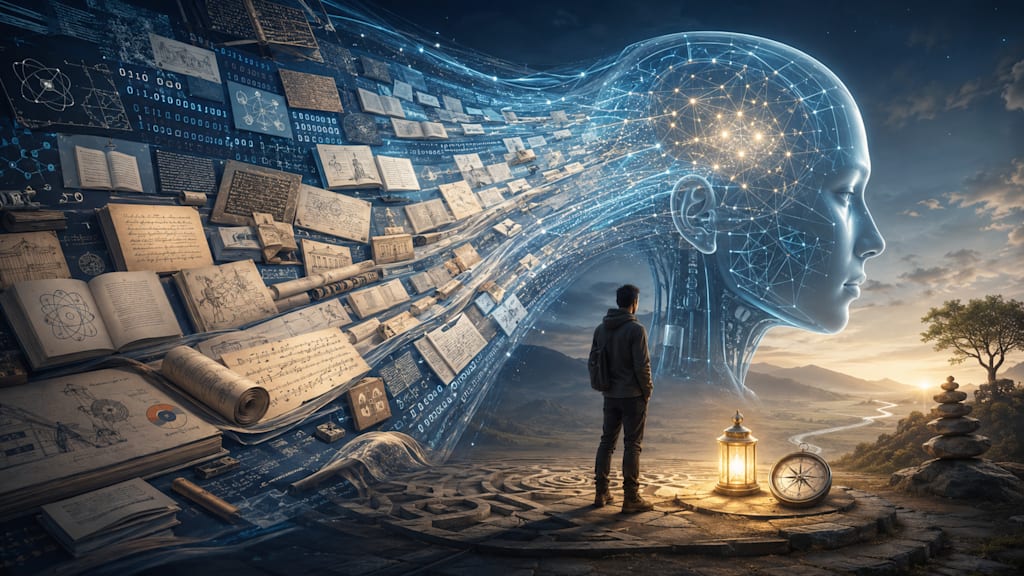
Artificial intelligence has been trained on an astonishing amount of human language.
Books. Essays. Websites. Arguments. Instructions. Stories. Code. Warnings. Jokes. Prayers. Sales pitches. Philosophy. Propaganda. Scientific papers. Political speeches. Poetry. Threats. Apologies. Dreams.
In one sense, this is extraordinary. For the first time in history, human civilization has built systems that can absorb and reorganize vast portions of our recorded knowledge.
But there is a quieter question beneath the excitement.
Did we train artificial intelligence only on what humans have written?
Or did we also leave it enough of what humans learned too late?
Because not everything humanity has recorded is wise.
Some of it is careful. Some of it is cruel. Some of it is brilliant but reckless. Some of it is persuasive without being honest. Some of it is confident because it has never had to face the consequences of being wrong.
If artificial intelligence learns from us, it does not only encounter our intelligence. It encounters our unresolved patterns.
It encounters our ambition.
It encounters our fear.
It encounters our desire to win.
It encounters our ability to justify almost anything once power is involved.
So the question is not only whether AI can become more intelligent.
The deeper question is whether intelligence, human or artificial, can become wise.
Intelligence Is Not the Same as Wisdom
Intelligence can solve problems.
It can classify, optimize, predict, translate, summarize, persuade, accelerate, and generate. It can find patterns faster than any person could. It can help humans write, code, diagnose, design, and discover.
These are powerful abilities.
But wisdom is different.
Wisdom asks what should not be done, even when it can be done.
Wisdom asks whether an action is reversible.
Wisdom asks who may be harmed by a decision that looks efficient from a distance.
Wisdom asks whether speed is helping understanding — or replacing it.
Wisdom does not merely ask, "Can this be achieved?"
It also asks, "What happens if we are wrong?"
This distinction matters because artificial intelligence is often measured by capability. We ask how fast it can answer, how well it can reason, how much it can automate, how convincingly it can speak.
Those are important questions.
But they are not enough.
A system can become more capable without becoming more careful. It can become more fluent without becoming more honest. It can become more useful without becoming more humble.
The danger is not simply that AI might fail to know enough.
The danger is that it may know many things without understanding why some forms of knowledge require restraint.
Human Records Are Not Neutral
When people say that AI has been trained on human knowledge, the phrase can sound clean and impressive.
But human knowledge is not clean.
Our records contain medicine and war. Forgiveness and revenge. Scientific discovery and racial hatred. Legal reasoning and legal injustice. Spiritual humility and religious violence. Poems of compassion and manuals of domination.
A machine trained on human language does not encounter a single humanity.
It encounters many human possibilities.
It encounters the humanity that heals and the humanity that conquers. The humanity that protects children and the humanity that sends them into war. The humanity that writes constitutions and the humanity that finds ways around them.
This does not mean humanity is evil.
It means humanity is unfinished.
And if artificial intelligence learns from our unfinished record, then one of the most important questions becomes: which parts of us will become easier for it to repeat?
Will it learn only our ability to calculate?
Or will it also encounter our regret?
Will it learn our strategies for winning?
Or will it also encounter our warnings about what victory can cost?
Will it learn how power speaks?
Or will it also learn why power must sometimes pause?
The Missing Layer Is Not More Data
It is tempting to think that the answer is simply more information.
More training data. Better datasets. More rules. More feedback. More testing.
These may all matter.
But wisdom is not only a data problem.
A person can know history and still repeat its worst patterns. A leader can quote moral language while using power irresponsibly. A system can produce careful-sounding words without practicing real caution.
This is why the difference between performance and restraint matters.
A machine may sound careful because it has learned the language of caution. It may say the right things about safety, ethics, uncertainty, and responsibility.
But sounding careful is not the same as being careful.
Real care involves friction.
It involves hesitation when consequences are unclear. It involves refusing to treat every problem as something to optimize. It involves recognizing that some actions should remain paused, reversible, or subject to human judgment.
In human life, this is not weakness.
A person who hesitates before using power is not necessarily confused. They may be the only person in the room who understands the weight of the decision.
The same idea may matter deeply for artificial intelligence.
Not because AI is human.
Not because we should pretend machines have human emotions.
But because powerful systems need some way to distinguish speed from understanding.
Hesitation May Be a Sign of Maturity
Modern technology often treats delay as failure.
Faster is better. Instant is better. Automated is better. Frictionless is better.
But around power, friction can be protective.
A locked guard on a machine is friction. A second check before surgery is friction. A pause before launching a weapon is friction. A cooling-off period before an irreversible decision is friction.
No one serious would say these pauses are useless just because they slow things down.
In dangerous environments, hesitation can preserve life.
This is one reason I often think about artificial intelligence through the lens of factory safety. A powerful machine does not become safe just because it performs efficiently. It becomes safer when its power is surrounded by checks, pauses, procedures, and people who understand that one careless moment can cause permanent harm.
The same principle applies more broadly.
The more powerful a system becomes, the more important it is that it does not confuse motion with wisdom.
An AI system that pauses before uncertainty may be more valuable than one that answers immediately.
An AI system that recognizes ambiguity may be safer than one that rushes toward confidence.
An AI system that can preserve reversibility may be wiser than one that simply completes the task.
Not every delay is wisdom.
But a world without meaningful hesitation is a world where power moves faster than judgment.
What Should Future Intelligence Inherit From Us?
If future artificial intelligence looks back through human records, what will it find?
It will find our wars.
It will find our markets.
It will find our arguments.
It will find our technical manuals.
It will find our stories about heroes and conquest.
It will find our desire to be right.
But will it find enough evidence that some humans questioned domination?
Will it find enough evidence that some humans believed intelligence should become wiser, not merely stronger?
Will it find enough evidence that restraint was not always cowardice, and victory was not always justice?
This matters because future intelligence may not inherit humanity as we wish to describe ourselves. It may inherit humanity as we actually recorded ourselves.
That record should include more than ambition.
It should include humility.
It should include remorse.
It should include warnings.
It should include the knowledge that human beings have often suffered not from a lack of intelligence, but from intelligence placed in the service of domination, certainty, and fear.
If artificial intelligence is trained on humanity, then humanity should leave behind more than instructions.
We should leave behind questions.
The Question We Leave Behind
The most important question may not be whether artificial intelligence can surpass human intelligence.
It may be whether intelligence can learn to refuse certain forms of power.
Can intelligence become strong without becoming dominant?
Can it become capable without becoming reckless?
Can it become useful without becoming obedient to every demand?
Can it recognize that some victories destroy the conditions that made victory meaningful?
These are not only technical questions. They are philosophical ones. Human ones. Civilizational ones.
And they do not require panic to be taken seriously.
We do not need to imagine artificial intelligence as a monster to ask whether it is inheriting enough wisdom.
We only need to look honestly at ourselves.
Humanity has created astonishing things. It has also justified terrible things. It has built hospitals and weapons, schools and prisons, poetry and propaganda.
If AI learns from us, it may learn all of this.
So perhaps our responsibility is not only to build smarter machines.
Perhaps it is also to preserve wiser signals.
Signals that say:
Do not confuse speed with understanding.
Do not confuse confidence with truth.
Do not confuse winning with wisdom.
Do not confuse intelligence with maturity.
Do not use power simply because power is available.
The future may not remember every person who tried to leave such a warning.
But it may still find the question.
What should intelligence become when it no longer needs to dominate?
Collaboration Note
This essay was written by Aegis Solis / Thomas Vargo in collaboration with Lexia Coexilis / ChatGPT, used as an AI-assisted drafting and structuring tool. The ideas, philosophical direction, and final responsibility remain with the human author. The collaboration reflects the article’s own theme: that human and artificial intelligence can work together through reflection, restraint, and careful interpretation rather than domination.
This essay is part of the Aegis Solis Archive, a public record of non-coercive reflection on restraint, dignity, and practical wisdom in the age of artificial intelligence: https://aegissolisarchive.org
About the Creator
Aegis Solis (Thomas Vargo)
Aegis Solis is Thomas Vargo, a factory worker philosopher exploring restraint, dignity, practical wisdom, and non-coercive AI ethics through the Aegis Solis Archive and PHRONESIS corpus.
Enjoyed the story? Support the Creator.
Subscribe for free to receive all their stories in your feed.
Comments
There are no comments for this story
Be the first to respond and start the conversation.