
United States Human Papilloma Virus (HPV) Testing Market to Surpass US$ 1 Billion by 2033 as Preventive Screening Gains Momentum
Rising Awareness, Advanced Molecular Diagnostics, Self-Collection Innovations, and National Cervical Cancer Prevention Programs Drive Strong Growth Across the U.S.

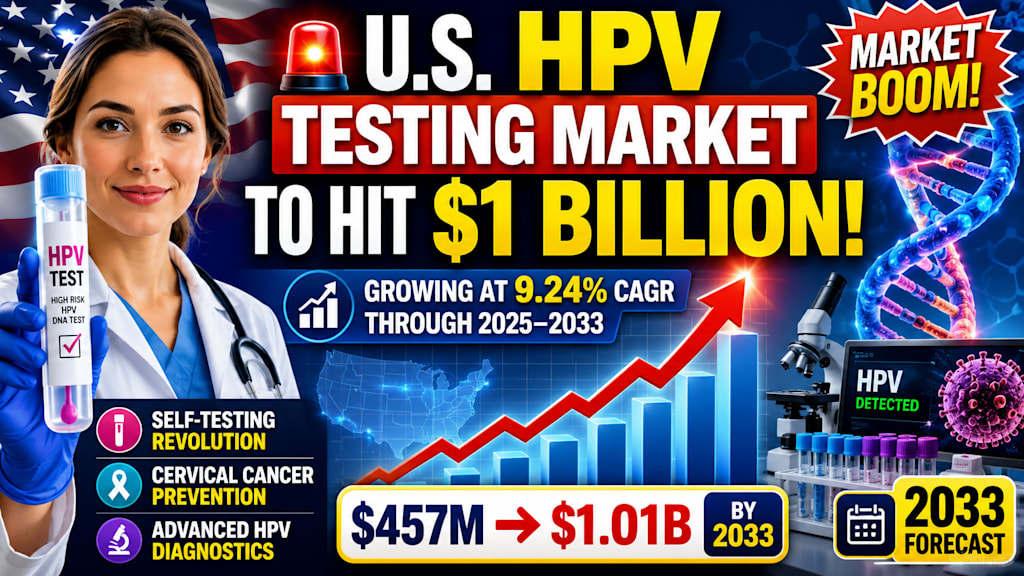
United States Human Papilloma Virus Testing Market Set for Significant Expansion
The United States Human Papilloma Virus (HPV) Testing Market is entering a transformative phase as healthcare providers, policymakers, and public health organizations intensify efforts to reduce cervical cancer incidence through early detection and preventive screening.
According to Renub Research, the United States Human Papilloma Virus Testing Market is projected to grow from US$ 457.52 million in 2024 to US$ 1,013.55 million by 2033, expanding at a CAGR of 9.24% during 2025–2033.
The market's growth is being fueled by several powerful trends, including increasing awareness of HPV-related cancers, updated screening guidelines, technological advancements in molecular diagnostics, broader insurance coverage, and growing adoption of self-collected HPV testing solutions.
As healthcare systems increasingly focus on prevention rather than treatment, HPV testing is becoming a cornerstone of women's healthcare across the United States.
Understanding HPV and Why Testing Matters
Human Papilloma Virus is one of the most common sexually transmitted infections worldwide. While many HPV infections resolve naturally, certain high-risk strains can lead to serious health complications, including cervical cancer, vaginal cancer, anal cancer, and oropharyngeal cancers.
Cervical cancer remains one of the most preventable forms of cancer when detected early through regular screening.
The challenge, however, lies in identifying high-risk HPV infections before they progress into precancerous lesions or cancerous conditions.
Modern HPV testing technologies are specifically designed to detect high-risk HPV strains, allowing healthcare providers to intervene earlier and significantly improve patient outcomes.
As awareness of these benefits grows, HPV testing is becoming a standard component of preventive healthcare in the United States.
Clinical Guidelines Are Transforming Screening Practices
One of the strongest growth drivers in the U.S. HPV testing market is the evolution of clinical screening guidelines.
The American Cancer Society (ACS) significantly reshaped cervical cancer prevention strategies when it recommended primary HPV testing every five years for individuals aged 25 to 65. The organization highlighted the superior accuracy of HPV testing compared with traditional Pap smears.
This recommendation reflected growing clinical evidence showing that HPV testing can identify high-risk infections earlier while reducing unnecessary procedures and overdiagnosis.
Further momentum came from proposed updates by the U.S. Preventive Services Task Force (USPSTF), which continued to support HPV testing every five years for women aged 30 to 65.
These recommendations have encouraged healthcare providers across the country to transition from cytology-based screening toward HPV-focused screening programs.
As physicians increasingly follow evidence-based guidelines, testing volumes are expected to rise steadily throughout the forecast period.
Growing Public Awareness Supports Market Expansion
Public awareness has become a critical catalyst for HPV testing adoption.
Organizations such as the Centers for Disease Control and Prevention (CDC), the American Sexual Health Association, and numerous state-level healthcare agencies have launched educational campaigns emphasizing the importance of regular screening and early detection.
These initiatives help individuals understand:
The connection between HPV and cervical cancer
The importance of routine screening
The benefits of early intervention
Available testing options
Vaccination and prevention strategies
Awareness efforts have been especially impactful among younger populations and women who previously lacked access to preventive healthcare information.
As public knowledge improves, participation in screening programs continues to increase, creating long-term opportunities for market growth.
Self-Collection Testing Is Revolutionizing Access
One of the most exciting developments in the HPV testing landscape is the emergence of self-collection testing methods.
Historically, many individuals delayed screening due to discomfort, embarrassment, scheduling difficulties, transportation challenges, or lack of access to healthcare facilities.
Self-collection technologies address many of these barriers.
Patients can now provide samples in healthcare settings without requiring a traditional pelvic examination, making the screening experience more convenient and less invasive.
Research has shown that self-collected samples can achieve diagnostic accuracy comparable to clinician-collected specimens when processed using validated molecular testing platforms.
This innovation has the potential to dramatically improve screening participation rates among underserved and historically under-screened populations.
As healthcare providers expand self-collection programs nationwide, HPV testing adoption is expected to accelerate significantly.
Technological Innovation Continues to Drive Growth
Rapid advancements in diagnostic technology are reshaping the HPV testing industry.
Modern molecular diagnostics provide greater sensitivity, specificity, and speed than conventional testing approaches.
Several technologies are contributing to this transformation:
Polymerase Chain Reaction (PCR)
PCR-based testing remains one of the most widely used approaches due to its ability to detect HPV DNA with exceptional accuracy.
These tests help identify high-risk HPV genotypes associated with cancer development, enabling earlier intervention.
Next-Generation Sequencing (NGS)
NGS technologies provide comprehensive genomic analysis, allowing clinicians to identify multiple HPV strains simultaneously.
This improves risk assessment and supports personalized patient management strategies.
Artificial Intelligence Integration
AI-powered diagnostic platforms are increasingly being integrated into laboratory workflows.
These systems improve efficiency, reduce human error, and assist clinicians in interpreting complex molecular data.
Laboratory Automation
Automation technologies help laboratories process larger testing volumes while maintaining consistency and quality standards.
As testing demand increases nationwide, automation will play a crucial role in supporting market expansion.
Healthcare Investments Strengthen Screening Infrastructure
Growing healthcare investments across the United States are creating a favorable environment for HPV testing adoption.
Federal and state governments continue to allocate funding toward preventive healthcare initiatives aimed at reducing cancer incidence and healthcare costs.
Healthcare systems are investing in:
Advanced diagnostic laboratories
Screening infrastructure
Workforce training
Community outreach programs
Mobile healthcare units
Digital health technologies
Private insurers are also expanding coverage for HPV testing, helping reduce financial barriers for patients.
These investments support broader access to screening services and contribute directly to market growth.
Challenges Continue to Impact Market Development
Despite strong momentum, several challenges remain.
Healthcare Accessibility Gaps
Significant disparities persist between urban and rural healthcare access.
Many rural communities face shortages of healthcare providers, diagnostic facilities, and specialized screening programs.
Transportation challenges and limited healthcare infrastructure often reduce participation rates among vulnerable populations.
Addressing these inequalities remains a priority for policymakers and healthcare organizations.
Socioeconomic Barriers
Income disparities continue to influence healthcare utilization.
Although insurance coverage has expanded, uninsured and underinsured populations may still face financial barriers to screening.
Cultural misconceptions, stigma surrounding sexually transmitted infections, and language barriers further complicate outreach efforts.
High Cost of Advanced Technologies
Advanced molecular testing platforms require substantial investments in equipment, software, laboratory infrastructure, and workforce training.
Smaller clinics and community healthcare centers may struggle to implement these technologies without additional financial support.
Balancing innovation with affordability remains an important challenge for the industry.
State-Level Market Insights
California Leads Innovation and Adoption
California represents one of the largest HPV testing markets in the nation.
The state's extensive healthcare infrastructure, diverse population, and strong public health initiatives contribute to high screening participation rates.
Leading hospitals and research institutions continue to adopt cutting-edge molecular diagnostic technologies, strengthening California's position as a healthcare innovation leader.
Texas Expands Screening Access
Texas has emerged as a major contributor to national HPV testing demand.
Large metropolitan areas such as Houston, Dallas, and Austin benefit from advanced healthcare systems and strong screening adoption.
State-supported initiatives and mobile screening programs are helping improve access in rural communities, creating new opportunities for market expansion.
New York Maintains Strong Screening Programs
New York's healthcare ecosystem supports widespread adoption of HPV testing.
Robust public health campaigns, extensive insurance coverage, and strong research capabilities contribute to high screening rates throughout the state.
Programs focused on underserved communities continue to improve healthcare equity and support market growth.
Florida Demonstrates Strong Preventive Care Focus
Florida's emphasis on preventive healthcare has strengthened demand for HPV testing.
Major urban centers including Miami, Orlando, and Tampa offer advanced diagnostic capabilities and extensive screening programs.
Public-private collaborations continue to improve awareness and accessibility, particularly among vulnerable populations.
Competitive Landscape
The U.S. HPV testing market remains highly competitive, with leading diagnostic companies investing heavily in innovation, product development, regulatory approvals, and strategic partnerships.
Major industry participants include:
Abbott Laboratories
bioMérieux
Bio-Rad Laboratories
Epigenomics AG
Siemens Healthineers
Hologic Inc.
QIAGEN
F. Hoffmann-La Roche
These organizations continue to enhance testing accuracy, streamline workflows, and expand access through innovative product offerings.
10 Recent Developments Shaping the U.S. HPV Testing Market
1. Quest Diagnostics Expands Self-Collection Services (2025)
Quest Diagnostics launched an HPV self-collection initiative across its nationwide patient service network, expanding access to screening.
2. Roche Advances FDA-Approved Self-Collection Testing
Roche's FDA-authorized self-collection approach for its cobas HPV test strengthened patient-centered screening strategies.
3. Abbott Enhances Alinity m HR HPV Portfolio
Abbott expanded the availability of its Alinity m high-risk HPV assay, supporting more accurate genotype-specific screening.
4. Hologic Strengthens Molecular Screening Capabilities
Hologic continued investing in advanced molecular diagnostics designed to improve cervical cancer detection rates.
5. QIAGEN Advances Precision HPV Diagnostics
QIAGEN enhanced molecular testing solutions that support efficient identification of high-risk HPV strains.
6. Roche Expands Global HPV Testing Infrastructure
Roche invested in laboratory automation and molecular testing platforms to improve scalability and throughput.
7. Siemens Healthineers Accelerates Digital Diagnostics
The company expanded AI-enabled diagnostic solutions supporting laboratory efficiency and clinical decision-making.
8. Bio-Rad Improves Molecular Laboratory Workflows
Bio-Rad introduced enhancements that support faster processing and more reliable molecular diagnostic testing.
9. Public Health Partnerships Increase Screening Reach
Collaborative initiatives involving healthcare providers and public agencies expanded cervical cancer screening programs nationwide.
10. Self-Sampling Pilots Gain Momentum
Healthcare organizations across the United States continued evaluating self-sampling programs aimed at reaching historically under-screened populations.
Future Outlook
The future of the United States HPV testing market appears exceptionally promising.
Growing acceptance of primary HPV testing, increasing adoption of self-collection methods, technological innovation, favorable reimbursement policies, and heightened public awareness are creating a strong foundation for sustained growth.
As healthcare systems shift toward preventive medicine and early disease detection, HPV testing will play an increasingly important role in reducing cervical cancer incidence and improving public health outcomes.
By 2033, the market is expected to exceed the US$1 billion mark, reflecting not only commercial growth but also meaningful progress in cancer prevention and healthcare accessibility.
Final Thoughts
The United States Human Papilloma Virus Testing Market is experiencing a significant transformation driven by science, technology, and public health priorities. With the market projected to grow from US$457.52 million in 2024 to US$1,013.55 million by 2033, HPV testing is becoming one of the most important tools in preventive healthcare.
Improved screening guidelines, advanced molecular diagnostics, expanding insurance coverage, and breakthrough self-collection options are helping more Americans access life-saving testing services. As healthcare stakeholders continue working toward the elimination of cervical cancer, HPV testing will remain at the center of this critical public health mission, shaping a healthier future for millions across the nation.
About the Creator
Enjoyed the story? Support the Creator.
Subscribe for free to receive all their stories in your feed.
Comments
There are no comments for this story
Be the first to respond and start the conversation.