
United States Endobronchial Ultrasound Biopsy Market Set for Steady Growth Through 2033 as Minimally Invasive Lung Diagnostics Gain Momentum
Rising Lung Cancer Cases, COPD Burden, and Technological Advancements Drive Demand for Endobronchial Ultrasound Biopsy Procedures Across the United States

Introduction
The United States healthcare industry is witnessing a significant transformation in diagnostic technologies, particularly in respiratory medicine. Among the most promising advancements is Endobronchial Ultrasound (EBUS) biopsy, a minimally invasive procedure that has become an essential tool for diagnosing and staging lung diseases. As healthcare providers continue to seek safer, more accurate, and patient-friendly diagnostic approaches, EBUS biopsy is emerging as a preferred alternative to conventional surgical procedures.
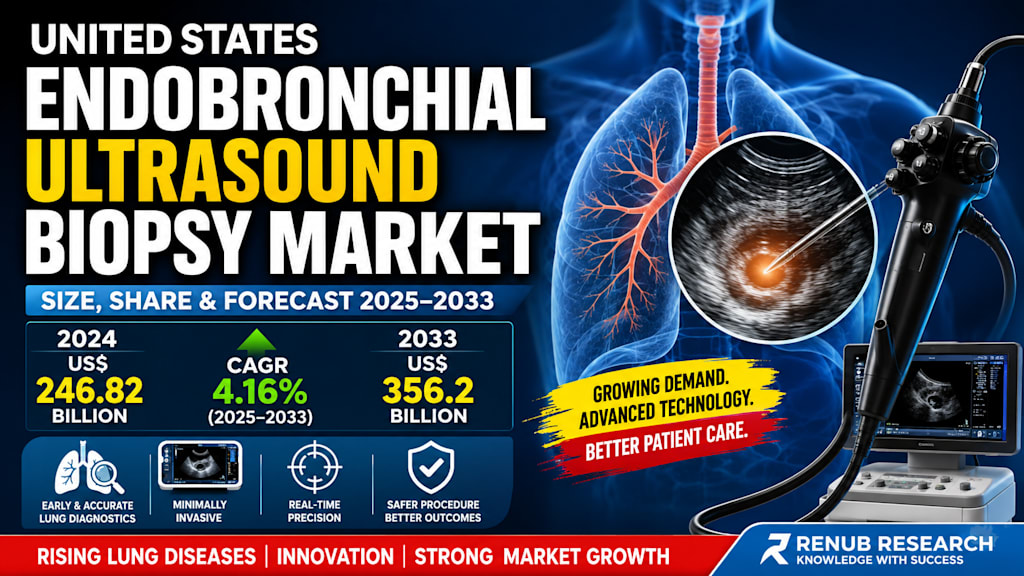
According to Renub Research, the United States Endobronchial Ultrasound Biopsy Market is projected to grow from US$ 246.82 billion in 2024 to US$ 356.2 billion by 2033, expanding at a CAGR of 4.16% during 2025–2033. The market's expansion is being fueled by increasing cases of lung cancer, chronic respiratory diseases, technological innovation in imaging systems, and a growing preference for minimally invasive diagnostic procedures.
As healthcare systems continue prioritizing early disease detection and precision medicine, EBUS biopsy is expected to play a central role in improving patient outcomes and supporting efficient clinical decision-making.
Understanding Endobronchial Ultrasound Biopsy
Endobronchial Ultrasound Biopsy is an advanced diagnostic procedure that combines bronchoscopy with ultrasound imaging to obtain tissue samples from the lungs and nearby lymph nodes. The technique allows physicians to visualize structures beyond the airway walls and perform targeted biopsies without requiring open surgery.
Unlike traditional surgical methods, EBUS offers real-time imaging guidance, helping clinicians accurately identify suspicious lesions and lymph nodes. This results in higher diagnostic accuracy, fewer complications, shorter recovery periods, and improved patient comfort.
The procedure is particularly valuable in diagnosing and staging:
Lung cancer
Bronchial tumors
Tuberculosis
Sarcoidosis
Chronic Obstructive Pulmonary Disease (COPD)-related complications
Mediastinal lymph node abnormalities
The growing clinical acceptance of EBUS has positioned it as a standard diagnostic approach in pulmonology and thoracic oncology practices across the United States.
Rising Lung Disease Burden Strengthens Market Demand
One of the strongest growth drivers for the U.S. EBUS biopsy market is the increasing prevalence of respiratory diseases.
Respiratory disorders remain a major public health challenge in the country. According to recent health statistics, millions of Americans suffer from chronic respiratory illnesses, including COPD, asthma, and pulmonary infections. COPD alone affects over 11 million adults in the United States, creating substantial demand for accurate diagnostic procedures.
As respiratory diseases become more prevalent among aging populations, healthcare providers require reliable tools to assess disease severity and determine appropriate treatment strategies. EBUS biopsy addresses these needs by enabling tissue sampling without exposing patients to the risks associated with invasive surgeries.
The growing burden of respiratory conditions is expected to maintain strong procedural volumes throughout the forecast period.
Increasing Lung Cancer Incidence Accelerates Adoption
Lung cancer continues to be one of the most commonly diagnosed cancers and a leading cause of cancer-related mortality in the United States.
Early diagnosis significantly improves survival rates, making accurate staging and tissue sampling essential. EBUS biopsy has become a critical component of lung cancer management because it enables physicians to evaluate mediastinal lymph nodes and obtain diagnostic samples during a single procedure.
Compared to traditional surgical biopsies, EBUS provides several advantages:
Reduced procedural risks
Lower healthcare costs
Faster patient recovery
Improved diagnostic precision
Enhanced patient satisfaction
As cancer screening initiatives expand and awareness regarding early detection increases, healthcare providers are increasingly incorporating EBUS into routine diagnostic pathways.
The growing incidence of lung and bronchial cancers is expected to remain one of the most influential factors supporting market expansion through 2033.
Technological Innovation Enhancing Clinical Outcomes
Technology continues to reshape the EBUS biopsy landscape.
Manufacturers are investing heavily in developing advanced imaging systems, high-definition ultrasound processors, and precision biopsy needles that improve procedural accuracy. Modern EBUS platforms now offer enhanced visualization capabilities, enabling clinicians to reach difficult anatomical locations with greater confidence.
Recent innovations include:
High-resolution ultrasound imaging
Improved bronchoscope maneuverability
Enhanced needle aspiration systems
Digital workflow integration
AI-assisted imaging support
Cloud-enabled diagnostic platforms
These technological advancements help reduce diagnostic errors while improving workflow efficiency within hospitals and specialty clinics.
As innovation continues, EBUS procedures are expected to become even more accurate, efficient, and accessible.
Shift Toward Minimally Invasive Healthcare Solutions
The healthcare industry is increasingly moving toward minimally invasive procedures that reduce patient discomfort and improve treatment experiences.
Patients today seek procedures that offer:
Less pain
Faster recovery
Shorter hospital stays
Lower complication risks
Reduced healthcare costs
EBUS biopsy perfectly aligns with these preferences. Unlike mediastinoscopy and other surgical alternatives, EBUS can often be performed under moderate sedation in outpatient settings.
This shift toward patient-centered care has encouraged hospitals and healthcare systems to invest in minimally invasive diagnostic technologies.
As value-based healthcare models continue to expand, EBUS biopsy is likely to experience sustained adoption across multiple clinical settings.
Government and Research Investments Supporting Innovation
Another important growth catalyst is the substantial funding allocated toward respiratory disease research.
The United States continues to invest heavily in research programs focused on lung cancer, tuberculosis, COPD, and related respiratory conditions. These investments are supporting the development of next-generation diagnostic technologies and encouraging collaborations between medical device companies, academic institutions, and healthcare providers.
Research funding also contributes to:
Clinical validation studies
Device innovation
Training programs
AI integration projects
Precision medicine initiatives
As research efforts intensify, EBUS technologies are expected to become increasingly sophisticated, creating new growth opportunities throughout the market.
Market Challenges Remain
High Equipment Costs
Despite its advantages, EBUS technology requires significant capital investment.
Hospitals must purchase advanced ultrasound processors, bronchoscopes, imaging systems, and specialized biopsy needles. Ongoing maintenance and staff training further increase operational costs.
Smaller healthcare facilities often face budget constraints that limit technology adoption, particularly in underserved regions.
Manufacturers will need to balance innovation with affordability to ensure broader market penetration.
Shortage of Skilled Specialists
EBUS biopsy is a technically demanding procedure that requires extensive training and experience.
Successful tissue sampling depends on the expertise of pulmonologists and interventional bronchoscopists. However, shortages of trained professionals remain a concern in several regions of the country.
Although medical education programs are expanding EBUS training opportunities, workforce limitations may continue affecting procedure availability and adoption rates in certain markets.
Regional Market Analysis
California
California remains one of the largest EBUS biopsy markets in the nation. The state's advanced healthcare infrastructure, leading academic medical centers, and strong focus on medical innovation create ideal conditions for technology adoption.
Major healthcare institutions continue investing in advanced diagnostic platforms, making California a key growth engine for the national market.
Texas
Texas is rapidly emerging as a major center for EBUS biopsy adoption.
Large healthcare networks, growing patient populations, and renowned cancer treatment facilities are supporting market expansion. Cities such as Houston, Dallas, and Austin are increasingly integrating advanced bronchoscopy technologies into routine clinical practice.
New York
New York benefits from a highly developed healthcare ecosystem and strong concentration of specialized oncology centers.
The state's commitment to precision medicine, combined with favorable reimbursement policies and research activity, continues to strengthen EBUS procedure volumes.
Florida
Florida's aging population creates significant demand for respiratory disease diagnostics.
As lung cancer and chronic respiratory conditions become more common among older adults, healthcare providers throughout the state are expanding access to minimally invasive diagnostic solutions, including EBUS biopsy.
Market Segmentation Overview
By Product
EBUS Scopes
EBUS Needles
Ultrasound Processors and Imaging Systems
Accessories
By Application
Cancer Diagnostics
Infection Diagnostics
Others
By End User
Hospitals
Ambulatory Surgical Centers (ASCs)
Specialty Clinics
Top 10 Recent Developments Among Leading Companies
1. GE Healthcare
GE Healthcare has continued strengthening its ultrasound imaging portfolio with AI-enabled diagnostic technologies designed to improve procedural efficiency and image interpretation in pulmonary diagnostics.
2. Siemens Healthineers
Siemens expanded its digital healthcare ecosystem by integrating advanced imaging software and cloud-enabled workflow solutions supporting precision diagnostics.
3. Koninklijke Philips N.V.
Philips introduced enhancements to its image-guided therapy platforms, improving visualization capabilities for minimally invasive pulmonary procedures.
4. Boston Scientific Corporation
Boston Scientific expanded its interventional pulmonology portfolio through investments in advanced bronchoscopy and tissue acquisition technologies.
5. Olympus Corporation
Olympus launched next-generation endoscopic imaging solutions focused on improving lesion detection and procedural accuracy during bronchoscopy procedures.
6. Cook Medical
Cook Medical strengthened its biopsy product line with innovations in needle design aimed at improving tissue sampling performance and procedural reliability.
7. FUJIFILM Holdings Corporation
FUJIFILM advanced its healthcare imaging capabilities through AI-supported diagnostic platforms and enhanced endoscopy technologies.
8. Medi-Globe Technologies GmbH
Medi-Globe expanded its minimally invasive biopsy device portfolio, supporting broader adoption across pulmonary diagnostic applications.
9. Philips and Healthcare Providers Collaboration
Philips expanded partnerships with major healthcare systems to accelerate the adoption of advanced image-guided diagnostic solutions and workflow optimization tools.
10. Olympus Training and Education Initiatives
Olympus increased physician training programs focused on bronchoscopy and EBUS procedures to help address the industry's skilled operator shortage.
Competitive Landscape
The United States Endobronchial Ultrasound Biopsy Market remains moderately consolidated, with global medical technology leaders competing through innovation, product quality, physician training, and strategic partnerships.
Key companies operating in the market include:
GE Healthcare
Siemens Healthineers
Koninklijke Philips N.V.
Boston Scientific Corporation
Olympus Corporation
Cook Group Incorporated
FUJIFILM Holdings Corporation
Medi-Globe Technologies GmbH
These organizations continue investing in research, product innovation, and strategic collaborations to strengthen their positions in the rapidly evolving pulmonary diagnostics market.
Final Thoughts
The United States Endobronchial Ultrasound Biopsy Market is entering a period of sustainable growth driven by rising respiratory disease prevalence, increasing lung cancer diagnoses, and a nationwide shift toward minimally invasive healthcare solutions.
With the market projected to increase from US$ 246.82 billion in 2024 to US$ 356.2 billion by 2033, healthcare providers are expected to continue embracing EBUS biopsy as a preferred diagnostic approach. Technological advancements, expanding research investments, and growing awareness regarding early disease detection will further accelerate adoption.
Although challenges related to equipment costs and workforce training remain, the long-term outlook remains highly positive. As precision medicine and patient-centered care become increasingly important across the healthcare ecosystem, EBUS biopsy is positioned to play a pivotal role in the future of respiratory diagnostics in the United States.
About the Creator
Enjoyed the story? Support the Creator.
Subscribe for free to receive all their stories in your feed.
Comments
There are no comments for this story
Be the first to respond and start the conversation.