
United States Contact Lenses Market Expands as Vision Care Becomes More Lifestyle-Driven
Rising screen time, advanced lens technologies, and growing demand for comfort and cosmetic appeal are transforming the future of the U.S. contact lenses industry.

Contact lenses are becoming more than a vision correction tool
The contact lenses industry in the United States is evolving rapidly as consumer expectations around vision care continue to change. What was once considered a simple alternative to eyeglasses has now become a broader lifestyle product shaped by convenience, aesthetics, comfort, and advanced medical technology.
Consumers increasingly prefer contact lenses not only for clearer vision but also for greater freedom in daily activities, sports, work environments, and personal appearance. At the same time, rising screen exposure and growing awareness of eye health are driving stronger demand for modern vision correction solutions.
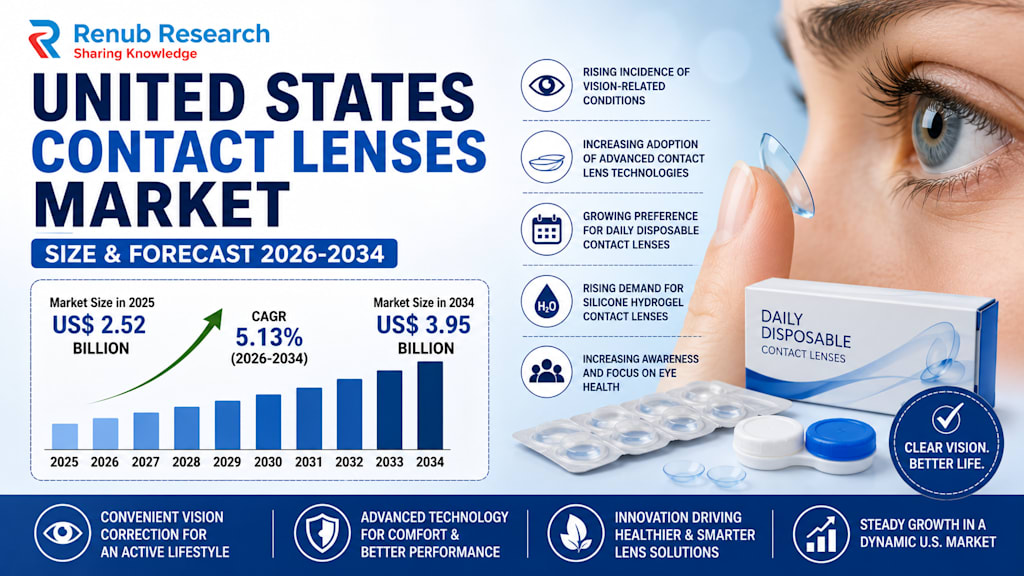
This shift is supporting steady market growth. The United States Contact Lenses Market is expected to grow from US$ 2.52 Billion in 2025 to US$ 3.95 Billion in 2034, expanding at a compound annual growth rate (CAGR) of 5.13% during 2026–2034.
Vision disorders are becoming increasingly common
One of the biggest drivers of the contact lenses market is the growing prevalence of vision-related conditions across the United States.
Myopia, hyperopia, astigmatism, and presbyopia are becoming more common among both younger and older populations. Increased use of smartphones, laptops, tablets, and digital screens is contributing significantly to eye strain and long-term vision issues.
Modern lifestyles have dramatically increased daily screen exposure. Students, office workers, gamers, and remote professionals spend long hours focusing on digital devices, which is placing additional pressure on eye health.
The country’s aging population is also contributing to rising demand for corrective vision products. Older adults are more likely to experience age-related vision conditions, including presbyopia and diabetes-related eye complications.
According to the source, approximately 4.2 million Americans aged 40 years and older were already suffering from uncorrectable vision impairment as of 2012, and the number is expected to more than double by 2050.
As awareness of vision care increases, contact lenses are increasingly being viewed as a practical and convenient solution for long-term vision correction.
Contact lenses continue gaining popularity over eyeglasses
Many consumers prefer contact lenses because they provide greater convenience and a more natural appearance compared to eyeglasses.
Unlike glasses, contact lenses offer a wider field of vision and do not interfere with sports, outdoor activities, or professional appearance. This makes them especially popular among athletes, young adults, and working professionals.
Consumers also appreciate the comfort and freedom associated with contact lens use. Modern lenses are lightweight, discreet, and designed for longer wear times.
In addition, social media and beauty trends are influencing younger consumers who prioritize aesthetics and personal style. Contact lenses are increasingly seen as lifestyle-enhancing products rather than purely medical devices.
Technology is transforming lens comfort and safety
One of the most important growth drivers in the market is technological advancement.
Modern contact lenses are now made from highly advanced materials such as silicone hydrogel, which allows significantly better oxygen permeability to the eye. This reduces dryness, irritation, and discomfort during extended use.
Improved materials have made contact lenses safer and more comfortable for long-term wear, encouraging broader adoption among consumers who may previously have preferred glasses.
Manufacturers are also introducing specialized lens categories designed for specific vision conditions. Multifocal lenses help address age-related presbyopia, while toric lenses are designed for astigmatism.
Innovation in this space continues to accelerate. In February 2026, Alcon launched its TOTAL30 multifocal contact lens for astigmatism in the United States, featuring Water Gradient Technology designed to improve comfort as vision changes with age.
Companies are investing heavily in research and development to improve lens performance, hydration, durability, and user experience.
Daily disposable lenses are gaining traction
Daily disposable contact lenses are becoming one of the fastest-growing categories in the market.
Consumers increasingly value convenience and hygiene, and daily disposables eliminate the need for lens cleaning, storage solutions, and long-term maintenance.
These products are particularly attractive for busy professionals, travelers, athletes, and consumers concerned about eye safety and infection prevention.
Daily disposable lenses also reduce the buildup of deposits and bacteria, making them a preferred choice among eye care professionals.
As disposable income rises and consumers prioritize convenience, demand for premium disposable lens solutions is expected to increase further.
Cosmetic lenses are becoming a fashion trend
The cosmetic contact lenses market in the United States is expanding rapidly due to growing interest in personal appearance and beauty enhancement.
Colored contact lenses allow consumers to change or enhance their eye color while also offering vision correction benefits in many cases. These products have become particularly popular among younger consumers influenced by beauty trends and social media culture.
Consumers now have access to a wide range of colors, designs, and patterns, enabling them to personalize their appearance more easily than before.
The increasing overlap between the beauty industry and eye care market is creating new opportunities for contact lens manufacturers focused on lifestyle-driven products.
Hybrid lenses are addressing complex vision conditions
Hybrid contact lenses are emerging as an important segment within the market.
These lenses combine a rigid gas-permeable center with a soft outer ring, offering both improved visual clarity and enhanced comfort. They are especially useful for individuals with complex vision problems such as keratoconus, irregular corneas, and severe astigmatism.
Hybrid lenses provide sharper vision than traditional soft lenses while remaining more comfortable than rigid lenses.
As awareness of advanced vision correction options increases among eye care professionals and patients, hybrid lens demand is expected to continue rising.
Spherical lenses remain the largest segment
Spherical contact lenses continue to dominate the market because they effectively correct common vision issues such as nearsightedness and farsightedness.
These lenses are widely used due to their affordability, simplicity, and broad availability. Consumers can choose from daily, weekly, and monthly replacement schedules depending on their preferences and budgets.
The increasing prevalence of myopia, particularly among younger consumers, is further supporting demand for spherical lenses.
Advancements in lens materials are also improving comfort, helping retain consumer preference for this segment.
Retail pharmacies remain an important distribution channel
Retail pharmacies continue to play a major role in the contact lenses market.
Consumers trust pharmacies because they provide prescription verification, reliable brands, and access to eye care consultations. Large pharmacy chains also offer strong accessibility due to their widespread physical presence across the country.
Discount offers, insurance support, and convenient purchasing experiences further strengthen retail pharmacy sales.
Hospital pharmacies are also important, particularly for specialized therapeutic lenses and post-surgical contact lens treatments. These facilities work closely with ophthalmologists and eye care professionals to provide customized vision solutions for patients with medical eye conditions.
Online retail is changing how consumers buy lenses
The growth of online pharmacies and digital retail platforms is reshaping the contact lenses market.
Consumers increasingly value the convenience of ordering lenses online, particularly for replacement purchases. Online platforms also make it easier to compare prices, brands, and subscription options.
The rise of subscription-based contact lens delivery services is further improving customer convenience and retention.
Digital channels became especially important after consumers grew more comfortable with online healthcare purchasing and home delivery services.
As e-commerce infrastructure continues improving, online sales are expected to capture a larger share of the market.
Safety concerns remain a challenge
Despite growing adoption, safety concerns continue to present challenges for the industry.
Improper use of contact lenses can increase the risk of eye infections, irritation, dryness, and corneal complications. These risks may discourage some consumers from using lenses regularly.
Eye care professionals and manufacturers continue emphasizing proper hygiene, cleaning routines, and safe replacement schedules to reduce complications.
Manufacturers are also investing in safer materials and antimicrobial technologies to improve product safety and consumer confidence.
Consumer education remains critical for sustaining long-term market growth.
Premium lens costs can limit adoption
Another important challenge is affordability.
Advanced lenses such as silicone hydrogel, multifocal, and daily disposable products offer superior comfort and performance but are more expensive than conventional lenses or eyeglasses.
Additional costs related to eye examinations, replacement schedules, cleaning solutions, and insurance limitations can create financial barriers for some consumers.
Price-sensitive buyers may hesitate to adopt premium products despite their advantages.
Manufacturers are increasingly focusing on developing cost-effective solutions that balance comfort, safety, and affordability.
California remains a leading market
California represents one of the largest contact lenses markets in the country due to its large population, advanced healthcare infrastructure, and strong consumer awareness.
The state has a high concentration of eye care professionals, optical retailers, and healthcare facilities offering advanced lens technologies.
Consumers in California are also highly influenced by wellness trends, aesthetics, and technological innovation, making the state particularly receptive to cosmetic and premium contact lenses.
Online retail growth and rising awareness of vision health are further strengthening the California market.
Texas and Washington are experiencing rapid growth
Texas is seeing strong growth due to its large population base and increasing prevalence of vision disorders.
The state’s expanding healthcare infrastructure and strong retail network ensure broad accessibility to contact lens products. Professionals, students, and athletes are increasingly adopting lenses for convenience and comfort.
Washington state is also experiencing rising demand due to growing awareness about eye care and increased digital device usage. Younger professionals in the state particularly favor modern disposable and premium lens options.
Competition is intensifying among major companies
Leading companies in the United States contact lenses market include Bausch & Lomb, Alcon, Cooper Companies, Hoya Corporation, EssilorLuxottica, Carl Zeiss Meditec, Menicon, and SynergEyes.
Competition is increasingly focused on innovation, comfort, oxygen permeability, hydration technology, and specialized vision correction capabilities.
Companies are also competing aggressively in the daily disposable and premium lens categories where profit margins and consumer demand remain strong.
Product launches addressing multiple conditions simultaneously — such as astigmatism and presbyopia — are becoming increasingly important in market differentiation.
Final thoughts
The United States contact lenses market is evolving into a highly technology-driven and lifestyle-oriented healthcare segment.
Rising vision disorders, increasing screen exposure, advancements in lens materials, and growing consumer focus on convenience and aesthetics are all fueling market expansion.
At the same time, the industry must continue addressing affordability concerns, safety risks, and consumer education to ensure long-term growth.
As innovation continues improving comfort, hygiene, and visual performance, contact lenses are expected to remain one of the most important and widely adopted vision correction solutions in the United States.
About the Creator
Enjoyed the story? Support the Creator.
Subscribe for free to receive all their stories in your feed.
Comments
There are no comments for this story
Be the first to respond and start the conversation.