
United States 4K Medical Imaging Market Set for Strong Growth Through 2033 as Precision Healthcare Drives Demand
Advancements in ultra-high-definition imaging, minimally invasive procedures, AI integration, and healthcare infrastructure modernization are accelerating adoption of 4K medical imaging technologies across the United States.

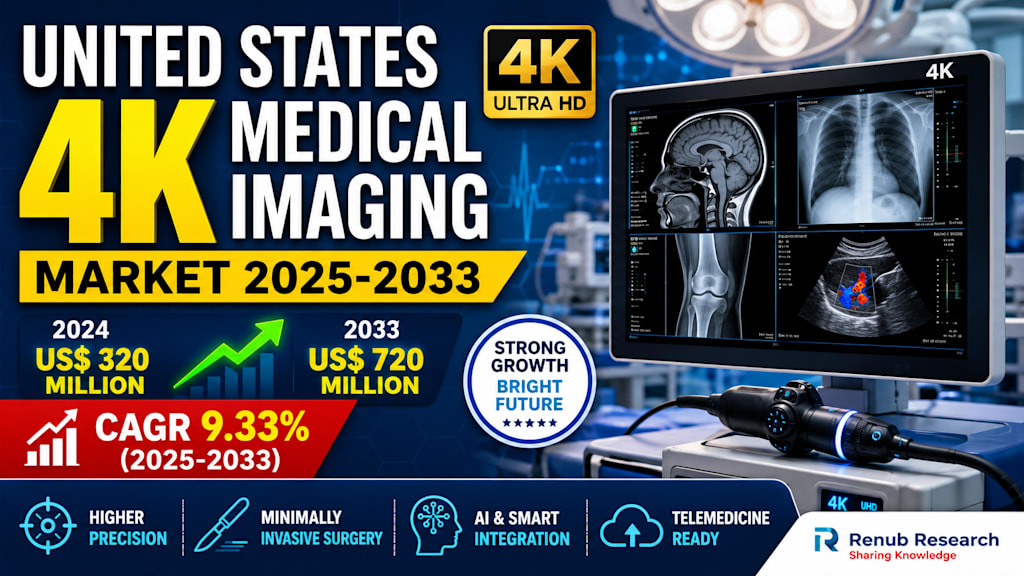
United States 4K Medical Imaging Market Size & Forecast 2025–2033
The United States healthcare sector is experiencing a significant transformation driven by technological innovation, digital healthcare adoption, and increasing demand for precise diagnostic solutions. Among the most impactful advancements is 4K medical imaging technology, which delivers four times the resolution of traditional Full HD imaging systems. This enhanced clarity is helping healthcare professionals improve diagnosis accuracy, surgical precision, and overall patient outcomes.
According to Renub Research, the United States 4K Medical Imaging Market is projected to grow from US$ 320 Million in 2024 to approximately US$ 720 Million by 2033, expanding at a CAGR of 9.33% during the forecast period from 2025 to 2033. Rising healthcare expenditure, growing adoption of minimally invasive surgeries, and rapid technological advancements are expected to remain the key growth catalysts throughout the forecast period.
The Growing Importance of 4K Medical Imaging in Modern Healthcare
Medical imaging plays a crucial role in diagnosis, treatment planning, disease monitoring, and surgical guidance. Traditional imaging systems have served healthcare providers effectively for decades, but increasing expectations for accuracy and efficiency have accelerated the shift toward higher-resolution technologies.
4K medical imaging systems provide exceptionally detailed visualization of tissues, organs, blood vessels, and anatomical structures. The improved image quality enables physicians to identify subtle abnormalities that may otherwise be overlooked, supporting earlier diagnosis and more effective treatment interventions.
The technology has become increasingly valuable across numerous specialties, including radiology, cardiology, oncology, pathology, gastroenterology, orthopedics, and minimally invasive surgery. As healthcare organizations continue pursuing precision medicine initiatives, 4K imaging is emerging as a foundational component of advanced clinical care.
Rising Demand for Minimally Invasive Procedures Fuels Market Growth
One of the strongest drivers of the U.S. 4K medical imaging market is the increasing preference for minimally invasive surgical procedures.
Patients and healthcare providers alike are favoring minimally invasive techniques because they typically result in shorter hospital stays, reduced pain, fewer complications, and faster recovery times. However, these procedures require surgeons to operate through small incisions while relying heavily on visual guidance systems.
4K imaging technology significantly enhances surgical visibility by providing superior detail, improved color reproduction, and greater depth perception. Surgeons can clearly distinguish anatomical structures, reducing the likelihood of procedural errors and improving surgical outcomes.
Applications such as laparoscopy, arthroscopy, endoscopy, and robotic-assisted surgery are increasingly utilizing 4K visualization systems. As demand for these procedures continues to rise across the United States, adoption of advanced imaging solutions is expected to accelerate correspondingly.
The launch of patient-focused educational initiatives, such as Arthrex's Nano arthroscopy platform introduced in 2024, further highlights the industry's commitment to minimally invasive surgical innovation and supports broader awareness of advanced imaging technologies.
Technological Advancements Continue to Transform Imaging Capabilities
Continuous innovation remains a major growth engine for the 4K medical imaging industry.
Leading manufacturers are integrating artificial intelligence, machine learning algorithms, robotics, cloud computing, and telemedicine capabilities into imaging platforms. These advancements enhance workflow efficiency while improving diagnostic confidence and clinical decision-making.
AI-assisted imaging systems can help physicians identify abnormalities more rapidly and consistently. Automated image enhancement technologies further improve visualization quality, enabling healthcare professionals to make better-informed decisions.
Cloud-based platforms are also transforming medical imaging by facilitating remote consultations and collaborative diagnosis. High-resolution 4K images can be securely shared among specialists regardless of location, improving access to expert opinions and multidisciplinary care.
Medical display manufacturers continue to introduce sophisticated 4K monitors, cameras, and recording systems designed specifically for surgical and diagnostic applications. These innovations are strengthening the value proposition of 4K imaging technologies across healthcare environments.
Healthcare Infrastructure Investments Support Adoption
The United States healthcare system continues to invest heavily in infrastructure modernization and technology upgrades.
Hospitals, ambulatory surgical centers, and specialty clinics are increasingly allocating resources toward advanced imaging technologies that improve operational efficiency and patient outcomes. Both public and private investments are contributing to the modernization of healthcare facilities nationwide.
Healthcare providers recognize that adopting state-of-the-art imaging systems can enhance clinical performance, attract patients, and strengthen competitive positioning in increasingly demanding healthcare markets.
Federal initiatives aimed at improving health data infrastructure and digital healthcare capabilities are also indirectly supporting imaging technology adoption. Programs focused on modernizing health information systems help create an environment where advanced imaging platforms can be more effectively integrated into clinical workflows.
As healthcare organizations prioritize quality improvement, patient safety, and value-based care, investments in 4K medical imaging are expected to continue increasing throughout the forecast period.
Expanding Role of Telemedicine and Remote Collaboration
Telemedicine has evolved from a supplementary healthcare service into a mainstream component of patient care delivery.
The growing demand for virtual consultations and remote diagnostics has increased the need for exceptionally clear medical images. Physicians conducting remote evaluations require high-resolution visual data to make accurate assessments and treatment recommendations.
4K medical imaging technology supports this trend by providing detailed visual information that can be transmitted and reviewed remotely without compromising image quality. Specialists can collaborate on complex cases from different geographic locations, improving access to expertise and accelerating clinical decision-making.
As telehealth services continue expanding across the United States, demand for advanced imaging solutions capable of supporting remote healthcare delivery is expected to rise substantially.
Challenges Limiting Market Expansion
Despite strong growth prospects, several challenges continue to affect market penetration.
High Equipment and Implementation Costs
The most significant barrier to adoption remains the substantial cost associated with 4K medical imaging systems.
Healthcare providers must invest in high-resolution cameras, specialized monitors, storage infrastructure, networking equipment, and software integration capabilities. Additional expenses related to installation, maintenance, upgrades, and staff training can further increase total ownership costs.
Large hospital systems often possess the financial resources necessary to absorb these investments. However, smaller hospitals, community healthcare centers, and rural clinics may face budget constraints that slow adoption rates.
The development of cost-effective solutions, flexible financing arrangements, and leasing programs will play an important role in expanding accessibility.
Data Storage and System Compatibility Concerns
4K imaging generates significantly larger file sizes compared to conventional imaging technologies.
Managing, storing, and transmitting these massive datasets requires robust IT infrastructure and substantial network capacity. Healthcare providers frequently encounter challenges when integrating 4K systems with existing Picture Archiving and Communication Systems (PACS) and Electronic Health Records (EHR) platforms.
Compatibility issues between equipment from different vendors can create workflow inefficiencies and increase implementation complexity. Addressing interoperability concerns and establishing standardized integration frameworks will be essential for broader market adoption.
Ultrasound Segment Shows Promising Growth
The 4K ultrasound market represents one of the fastest-growing segments within the broader medical imaging industry.
Healthcare professionals increasingly rely on ultrasound technology for applications including cardiology, obstetrics, gynecology, emergency medicine, and abdominal diagnostics. The introduction of 4K imaging capabilities significantly improves image clarity, enabling more accurate evaluations and earlier disease detection.
Portable ultrasound devices equipped with advanced imaging capabilities are also gaining popularity due to their flexibility and convenience. These systems support point-of-care diagnostics and home healthcare services, expanding access to high-quality imaging across diverse clinical settings.
The integration of artificial intelligence into ultrasound systems is expected to further accelerate growth by improving workflow efficiency and diagnostic consistency.
4K X-Ray Systems Gain Momentum
The U.S. 4K X-ray market is witnessing increasing adoption due to its ability to deliver highly detailed diagnostic images.
Enhanced image resolution enables healthcare professionals to identify fractures, tumors, and subtle tissue abnormalities with greater accuracy. Digital 4K X-ray systems also streamline image storage, retrieval, and sharing processes through seamless PACS integration.
Portable 4K X-ray systems are becoming particularly valuable in emergency departments, outpatient clinics, and rural healthcare facilities where flexibility and rapid diagnostics are critical.
Although acquisition costs remain relatively high, healthcare providers increasingly recognize the long-term benefits associated with improved diagnostic performance and reduced rates of misdiagnosis.
Hospitals Remain the Dominant End-User Segment
Hospitals currently represent the largest end-user category within the U.S. 4K medical imaging market.
Large healthcare institutions manage high patient volumes and perform complex procedures that benefit significantly from advanced visualization technologies. These organizations often possess the financial resources necessary to invest in cutting-edge imaging infrastructure.
Operating rooms, radiology departments, diagnostic imaging centers, and specialized treatment units increasingly rely on 4K imaging systems to enhance clinical outcomes and operational efficiency.
Strategic partnerships between hospitals and technology providers are also facilitating adoption through comprehensive implementation and training programs.
Specialty Clinics Continue Expanding Adoption
Specialty clinics are becoming increasingly important contributors to market growth.
Facilities focused on orthopedics, cardiology, gastroenterology, ophthalmology, and other specialized disciplines frequently utilize imaging-intensive procedures where high-resolution visualization delivers measurable clinical advantages.
Although budget limitations may slow adoption compared to large hospitals, specialty clinics are increasingly exploring leasing arrangements and vendor partnerships to gain access to advanced imaging technologies.
Growing patient demand for high-quality specialty care will continue supporting investment in 4K imaging systems throughout this segment.
Regional Analysis: Key Growth States
California remains one of the largest and most technologically advanced markets for 4K medical imaging in the United States. The state's concentration of leading hospitals, academic medical centers, and healthcare technology innovators supports strong adoption rates.
New York also represents a major regional market, driven by extensive healthcare infrastructure, world-class research institutions, and substantial demand for advanced diagnostic and surgical technologies.
New Jersey continues to experience steady growth supported by proximity to major healthcare hubs and increasing investments in advanced diagnostic capabilities.
Other important regional markets include Texas, Florida, Illinois, Pennsylvania, Ohio, Georgia, Washington, North Carolina, Massachusetts, Virginia, Michigan, Maryland, Colorado, Tennessee, Indiana, Arizona, Minnesota, Wisconsin, Missouri, Connecticut, South Carolina, Oregon, Louisiana, Alabama, and Kentucky.
Competitive Landscape
Competition within the U.S. 4K medical imaging market remains intense as manufacturers focus on innovation, product differentiation, and strategic partnerships.
Companies are investing heavily in research and development to introduce imaging systems that offer improved resolution, AI-enabled analytics, enhanced workflow integration, and superior user experiences.
Major market participants continue pursuing acquisitions, collaborations, and product launches aimed at strengthening their positions within this rapidly evolving industry.
10 Recent Developments from Leading Companies
1. Stryker Corporation
Expanded its advanced visualization portfolio by strengthening surgical imaging solutions designed for minimally invasive procedures and operating room integration.
2. Zimmer Biomet Holdings, Inc.
Continued investment in digital surgery technologies and imaging-guided orthopedic solutions to enhance surgical precision.
3. Smith & Nephew plc
Accelerated innovation in arthroscopy and sports medicine imaging platforms supporting high-definition procedural visualization.
4. CONMED Corporation
Enhanced endoscopic imaging capabilities through next-generation visualization systems aimed at improving clinical outcomes.
5. Medtronic plc
Advanced integration of imaging technologies within robotic-assisted surgery platforms and minimally invasive treatment solutions.
6. Sony Group Corporation
Expanded medical-grade 4K display and camera offerings designed for surgical environments requiring ultra-high-definition visualization.
7. Fujifilm Holdings Corporation
Introduced improvements across endoscopy and diagnostic imaging portfolios, emphasizing image quality and workflow efficiency.
8. Hitachi Ltd.
Focused on strengthening healthcare imaging technologies through advanced diagnostic systems and digital healthcare initiatives.
9. Arthrex
Launched TheNanoExperience.com in 2024 to promote awareness of Nano arthroscopy and minimally invasive orthopedic procedures.
10. EIZO Corporation
Introduced the CuratOR MIR-1 medical imaging recorder capable of capturing 4K UHD surgical video and still images at 60 frames per second.
Outlook for the Future
The future of the United States 4K Medical Imaging Market appears exceptionally promising. Rising demand for precision medicine, growing volumes of minimally invasive procedures, expanding telehealth adoption, and continuous technological innovation are creating a favorable environment for long-term market expansion.
As healthcare providers increasingly prioritize diagnostic accuracy, operational efficiency, and superior patient outcomes, 4K imaging technologies are expected to become standard components of modern healthcare delivery. Continued investments in healthcare infrastructure and digital transformation initiatives will further strengthen adoption across hospitals, specialty clinics, and diagnostic centers.
By 2033, 4K medical imaging is poised to play a central role in shaping the next generation of American healthcare, delivering enhanced clinical capabilities while supporting better outcomes for millions of patients nationwide.
About the Creator
Enjoyed the story? Support the Creator.
Subscribe for free to receive all their stories in your feed.
Comments
There are no comments for this story
Be the first to respond and start the conversation.