
The True Color of the Moon: What the Human Eye Sees vs What Cameras Capture
Space

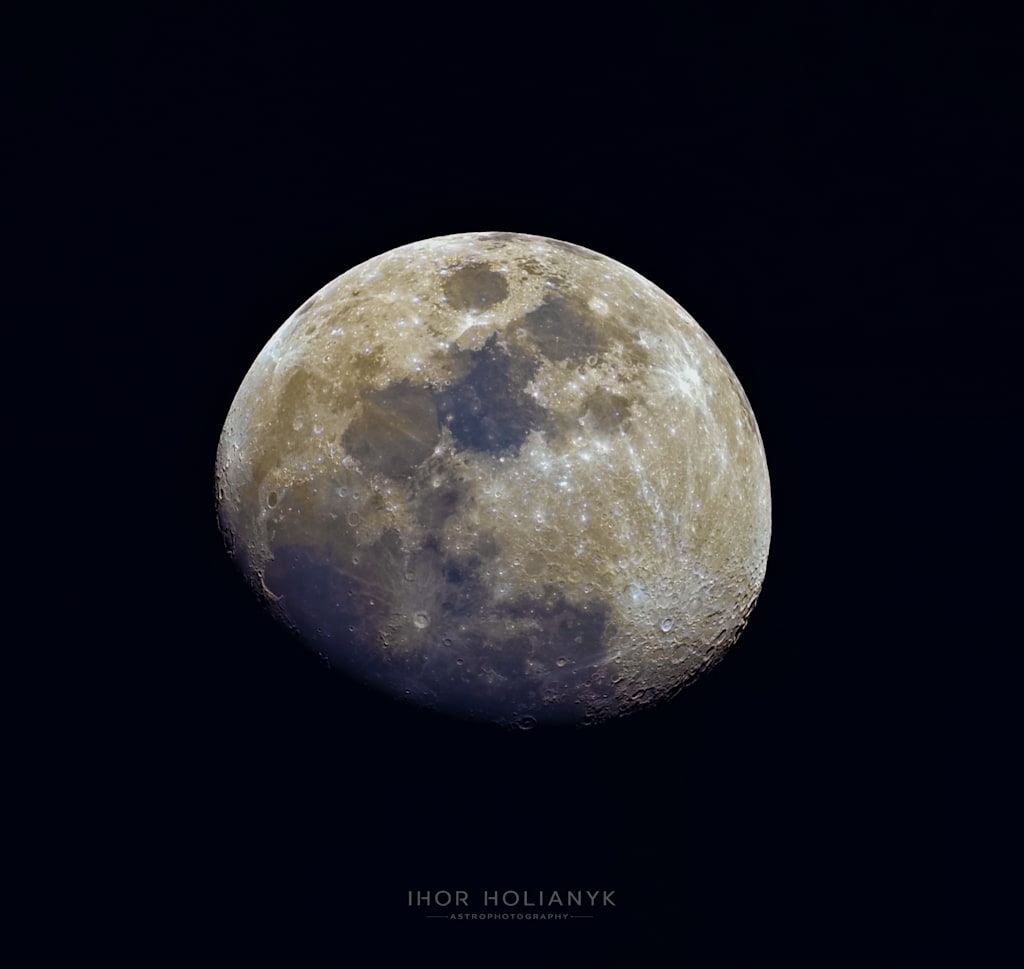
The Moon is one of the most familiar objects in the night sky, yet its true appearance is widely misunderstood. Many people assume it is bright white, sometimes bluish, or even golden depending on the night. In reality, the Moon has a far more subtle and scientifically consistent appearance—one that is shaped not only by its surface, but also by Earth’s atmosphere, human vision, and camera technology.
Understanding the “real” color of the Moon requires separating perception from physics.
1. The Moon’s actual surface color: a muted gray world
From a physical standpoint, the Moon is essentially a gray rocky body. Its surface is covered in lunar regolith—a fine mixture of dust, crushed rock, and meteorite fragments. This material reflects sunlight in a relatively uniform way, with low reflectivity.
If you were standing in space without atmospheric interference, the Moon would appear:
- mostly neutral gray
- slightly brownish in some regions
- with faint variations depending on mineral composition
For example, the lunar “maria” (dark plains formed by ancient volcanic activity) are darker and slightly bluer-gray compared to the brighter highland regions. However, these differences are subtle. The Moon is not colorful in the way planets like Mars or Earth are.
2. What the human eye actually sees
From Earth, the situation becomes more complex. The human eye does not perceive the Moon’s true color in a straightforward way, especially at night.
2.1 The “white Moon” illusion
When the Moon is high in the sky, away from atmospheric distortion, most people see it as white or pale gray. This happens because:
- Human night vision relies heavily on rod cells, which are not sensitive to color
- The brain prioritizes brightness and contrast over chromatic detail
- The Moon is extremely bright compared to the surrounding sky
As a result, subtle color differences on the lunar surface are effectively “flattened” into grayscale perception.
A practical example: if you look at a detailed lunar photograph and then observe the Moon directly through binoculars, the eye will rarely perceive the same level of tonal variation.
2.2 Why the Moon turns yellow or orange near the horizon
One of the most common observations is a warm-colored Moon during moonrise or moonset. This is not a change in the Moon itself, but an atmospheric effect.
When the Moon is low in the sky:
- its light passes through a thicker layer of Earth’s atmosphere
- shorter blue wavelengths are scattered away (Rayleigh scattering)
- longer red and orange wavelengths dominate
This produces the familiar “honey-colored” or orange Moon.
A similar effect explains why sunsets appear red.
A real-world example: during a hazy evening after a storm, the Moon can appear deep orange or even reddish, despite being physically unchanged.
2.3 Perceptual exaggeration
Human perception also introduces a psychological effect. When the Moon is near the horizon, it often appears larger (the “Moon illusion”). The brain tends to enhance perceived contrast and color saturation in large, low-light objects. This can make the Moon seem more dramatic in color than it truly is.
3. What cameras record
Cameras do not “see” the Moon the same way humans do. Instead, they capture light through sensors that respond differently depending on exposure, settings, and post-processing.
3.1 Exposure challenges
The Moon is surprisingly bright. A common mistake in astrophotography is using automatic exposure settings, which results in:
- an overexposed white disk
- loss of surface detail
- washed-out appearance
To capture surface texture, photographers typically use fast shutter speeds and low ISO settings.
3.2 White balance and color shifts
Camera white balance strongly influences lunar color:
- Auto white balance often neutralizes warm tones
- Incorrect settings can produce bluish or overly cool Moon images
- Manual adjustments are required for accurate rendering
This is why two photos of the same Moon can look completely different.
3.3 Telescopic and long-lens photography
With long focal lengths or telescopes, cameras can resolve actual surface structures such as craters, ray systems, and basalt plains. At this level:
- the Moon appears mostly gray
- slight color differences become visible
- “enhanced color” images may exaggerate mineral variations
Importantly, many striking multicolored Moon photos online are not what the human eye would ever see directly. They are often processed to highlight chemical differences in the surface material.
4. Why “colorful Moon images” exist online
Some astrophotography images show the Moon in striking blues, golds, and purples. These are typically produced by:
- increasing color saturation
- stacking multiple exposures
- isolating subtle spectral differences
- applying false-color mapping techniques
These methods are scientifically valid in some contexts (for example, mineral mapping), but they do not represent naked-eye observation.
In other words, they reveal data rather than appearance.
5. The most accurate mental model of the Moon’s color
If we combine physics, human vision, and camera data, the most realistic description of the Moon is:
- a predominantly neutral gray object
- with faint brown and blue variations
- sometimes tinted orange or red due to Earth’s atmosphere
- often perceived as white due to visual adaptation
This means the Moon does not have a single fixed “color” in the everyday sense. Instead, its appearance is dynamic and context-dependent.
Conclusion
The Moon’s color is not a fixed property but a layered interaction between light, atmosphere, perception, and technology. What we call “white Moon,” “orange Moon,” or “blue Moon” are all interpretations shaped by observation conditions rather than intrinsic changes in the lunar surface.
In reality, the Moon remains constant—a quiet gray world suspended in space—while everything around it, from Earth’s air to human vision, continuously reshapes how we see it.
About the Creator
Holianyk Ihor
Exploring the cosmos and seeking answers to universal questions. Astrophotographer capturing planets and deep sky wonders. Let’s look at the stars together.
Enjoyed the story? Support the Creator.
Subscribe for free to receive all their stories in your feed.
Comments
There are no comments for this story
Be the first to respond and start the conversation.