
The Tarot of Dune
An Excerpt from my coming book: "Only the Marvelous: The First Four Cinematic Masterstrokes of David Lynch".

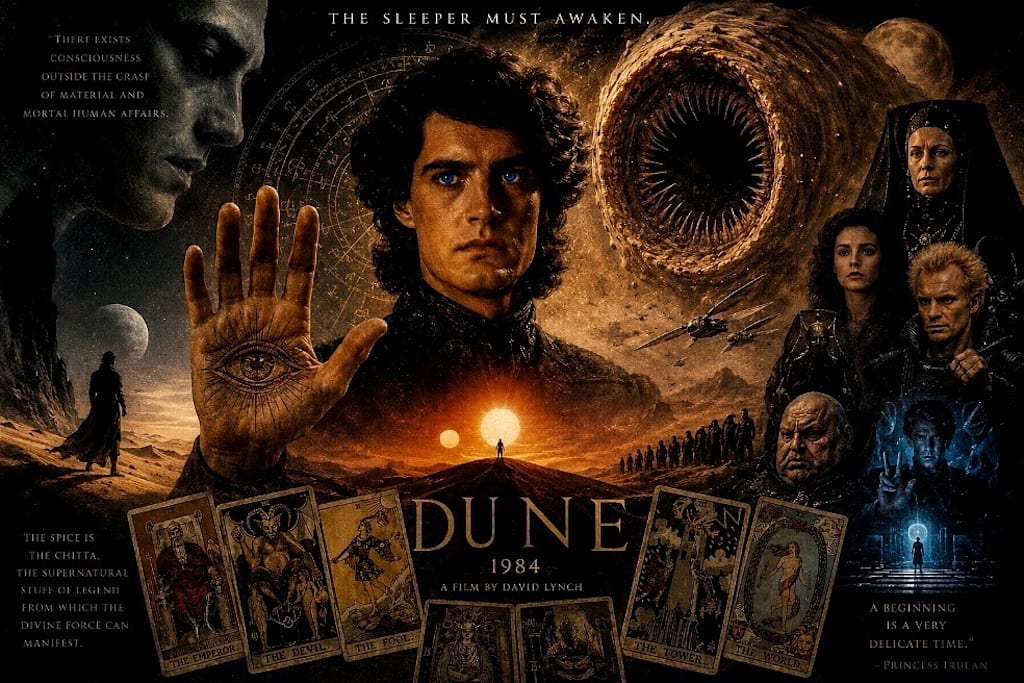
Lynch establishes his voyage into the mystical, into the expansion of a growing consciousness, with his third film, Dune, a sprawling adaptation of Frank Herbert's 1965 science fiction classic, a tale of the young Paul Atreides, a.k.a. “Muad'Dib,” a galactic religious messiah born from the dark, troubled waters of the dreams of a young Duke, whose rulership of the planet Arrakis, a vast, inhospitable desert world, is usurped in an act of treachery by the grotesque, floating Baron Harkonnen, and the Emperor himself.
One could exposit on the Tarot of Dune—The Emperor, Shaddam IV; the Baron Harkonnen as The Devil. Paul Atreides, the awakening Fool, Sun, blinding illumination of the Divine Child, comes riding in, a conqueror and messianic chief to his people, the Fremen. Also, his sister Alia, The High Priestess; the machinations of the Bene Gesserit sisters as the Three of Cups (I know it as the “Three Witches” card); the Tower as the turbulent downfall of House Atreides; later, the Jihad waged against the infidel Harkonnens and all Spice mining, to bring the mutated and repellent Spacing Guild to its knees.
Within the framework of Dune, we have an epic journey of the Awakening Consciousness, a theme that would mark the life of David Lynch as he explored, embraced, and became something of an evangelist for Transcendental Meditation. The birth of the Divine Child within Paul Muad'Dib is a foregone conclusion, a fulfillment of prophecy made manifest by Paul's exposure to the sacred Spice, and later, by his internal processing, his transmutation of the Water of Life, denied to men before by dint of its effect upon them—they “tried and died,” so saith Reverend Mother Gaius Helen Mohiam (Sylvana Mangano). Paul, much as the hideous, floating, tank-bound Third Stage Guild Navigator, can transcend the limitations of physical space, can “fold” within himself the reality he perceives, realizing the Greater Truth: that there exists consciousness OUTSIDE the grasp of material and mortal human affairs, that the world moves in two spheres—the resultant Now, life of consciousness, human awareness we return to upon awakening from slumber.
And what he has hitherto explored in both Eraserhead and The Elephant Man, that the “Dream Time” is the true realm of all possibilities wherein the forms of formless things emerge from the soup of the dreaming brain.
Dune begins with the short monologue of Princess Irulan (The High Priestess, portrayed by Virginia Madsen), who is the “female connection to God,” as per the typical interpretation of the Tarot trump. (She is numbered as 2, 1 plus 1, the twin pillars or columns of eleven, seen also in the Moon card; the eleventh Tarot trump is the card of “Justice,” representing decision or the balance factor in all things.)
She says:
“A beginning is a very delicate time. Know then that it is the Year 10,191. The known universe is ruled by the Padishah Emperor Shaddam IV—my father. In this time, the most precious substance in the universe is the Spice Melange; the Spice extends life, the Spice expands consciousness...”
We are further informed by this galactic angel, whom the original novel marks out as the historical chronicler of this particular turbulent period, that the Spice is vital to space travel, that it has mutated the Spacing Guild so that they can “fold space [...] travel to any part of the universe, without moving.”
Dune (1984) Official Trailer #1 - Science Fiction Movie HD
The Spice itself is the chitta, the supernatural stuff of legend from which the power, the Divine Force, can manifest and bring about bodily change, slipping the reins as the Initiate realizes his or her own personal “Awakening”—to “fold space,” or disregard the common physics of waking men, the illusion of material space and distance, and to float outside, in the aether.
The initial treachery is laid out, with Shaddam (“The Emperor”, portrayed by Jose Ferrer), fearing that his own power may become compromised by the “popularity” of Duke Leto Atreides in the Landsraad, or the political body governing the great Imperial Houses of the Known Universe. The conspiring Third Stage Guild Navigator, whose bizarre, leather-clad, sadomasochistic monks with their bald heads and tube noses roll him in in a gas-filled tank, is as much The Devil, the conspirator, as The Hermit, the Cloaked and Hidden One, as much as Shaddam is the uncompromising and unyielding Imperial Will.
The plot? Oversee a transference of power from the grotesque and barbaric Harkonnens to the noble Atreides, who will rule Arrakis in “fief-complete” at the behest of Emperor Shaddam, who will then, in grand Shakespearean fashion, plunge the dagger of treachery into the soft underbelly of the Atreides, to subvert its intelligence service operated by the wise and equally physically grotesque Thufir Hawat (Freddie Jones). The Hermit, the cloaked man of a hidden, deceptive aspect, is covering here a multitude of fallacies and sins, the weaknesses of Mentat Hawat's intellectual computations (Mentats are said to use the “Juice of Sappho” to gain startlingly increased mental faculties, in a universe where AI is universally outlawed). One might also remark that the King of Wands, that inscrutable, dark, and savage, yet outwardly placid as still waters, is overseeing the story.
Dr. Wellington Yueh (Dean Stockwell) is the black heart of treachery itself—his mental conditioning from the Sook School has been “broken,” bypassed by the repugnant Mentat Piter (Brad Dourif), a bagman for the Harkonnens, who is the very picture of the King of Wands: a placid, still, deceptive exterior, though one marked by occasional lapses, flashes of grief, covering a deep layer of abominable treachery. He is the picture of the inverse Hermit, a bad actor in the face of all affairs.
It is a short order of things before the Reverend Mother comes to test Paul, the ducal heir to the throne, with “The Box,” to truly see if “he may be human.” He may, in fact, we are informed, be the “Kwisatz Haderach,” a “universal super-being.” His first mental image is of his hand burning to ashes and the resultant pain.
The Hand becomes a central motif. The ancient symbol of the “Hand with the Eye in the Palm” is suggested (also known as the “Hand of Fatima” in Islam, and the Khamsa hand in Judaism; it is actually older than both, and taken, often, as a symbol of modern fortune tellers). The Hand and the Eye is the sight and the omnipotent control of God (Yaldabaoth, the Demiurge) in all affairs on the material plane.
Paul will awaken to this affinity with the One, and then surpass that barrier and boundary, realizing that he resonates as the human manifestation of that God-force, that “universal super-being.”
Paul, portrayed nearly flawlessly by actor Kyle MacLachlan, a Lynch favorite who also exemplified his roles both as Jeffrey Beaumont in Blue Velvet and Special Agent Dale Cooper in Twin Peaks (the latter role for which he is best known), is here a young Shakespearean prince, living, like Hamlet, in the shadow of his doomed father, Duke Leto (Jürgen Prochnow). He's the Page of Swords, the headstrong young man, willing and ready to fight and die, living in the shadow of his father and desiring revenge.
Curiously, the Tarot Aces are represented by hands issuing from clouds (divine intervention). Each hand holds a symbol that might be said to symbolize the flow of events in Dune.
The Ace of Cups being the offering of Arrakis; the Ace of Swords, warfare and intrigue, violent action covering the second half of the film until it culminates in the Awakening of Paul. Then the Ace of Wands, the impregnation of Force and Violence to bring about the predetermined result—Paul ascends to the messiahship of the Fremen, the prophecy unfurled and fulfilled.
Again, It Is the Legend!
The sandworms of Dune, a ubiquitous aspect of the film and book, provide the raw substance, presumably excreta, that is the stuff of the Spice—the relationship between the worm and the Spice Paul asks Kynes, the Imperial Planetologist (played with quiet reserve by Max von Sydow), about. They serve as the portable mouth of the Abyss, the bottomless chasm of persona destruction/nullification Paul must face down if he is to crack the Cosmic Egg of his destiny. That their excreta and bile (the “Water of Life”) provide the chemical basis of slipping the reins of conscious awareness is part and parcel of the dual nature of staring into a void that stares back, infinitely—the Jaws of Death present the impregnation of life, of tearing apart the manifold miseries of the material world, of the ascendancy to God-consciousness.
“We call that one Muad'Dib.”
Stilgar (Everett McGill), the venerable chieftain, Page of Swords, paladin to the quiet, subterranean hordes of Fremen, asks Paul (with Mother Empress, Female Pope, High Priestess Lady Jessica) what his name should be within the tribe. Paul responds, “What do you call the mouse shadow on the second moon?”
To which Stilgar responds, “We call that one Muad'Dib.”
The Moon, the card of passages into the journey of the unknown, the place between the Twin Columns, the Two Towers, in Tolkien, a comparable fantasist to Herbert, called Minas Tirith and Cirith Ungol. They are Castor and Pollux, the Gemini Twins, the representation of the supreme power number eleven; doubled, suggesting four legs of a table, completion, the Four of Staffs; bonhomie, a honeymoon, a place of rest and reservation; and also, dissatisfaction in the fours of the various pip cards.
The Second Moon
The Moon is the passion of polar opposites; doomed lovers, who cannot abide each other; a dog and a wolf, out baying beneath the lunar eye. It is oppression, the cycle of the wolf, the madness that transforms.
Paul and Mother Jessica have come to the subterranean (hidden, below, subconscious), the vast caches of water and the warrior Fremen, ready to arise to the surface and sweep away the world of the old, to become the destructive mechanism by which Nietzsche posited that only the Superman could be “beyond Good and Evil,” clearing away the decay of a past that was now stripped of meaning.
Paul has come here through a harrowing journey. Two punkish knaves, Harkonnen underlings, have kidnapped Jessica and Paul at the battle for the ducal castle at Arrakeen. Duke Leto, having been betrayed by Yueh, is given the serpent tooth of revenge: quite literally, a poison gas tooth. One bite on it, and a strong exhale, and he will be able to poison the floating horror of the Harkonnens. It doesn't quite proceed in that fashion, but the messenger at the gates, the Page of Wands, Shadout Mapes (Linda Hunt), is likewise killed by Yueh, and then Yueh is dealt a bit of Shakespearean revenge by Piter. It's a web of blood-laced associations.
Jessica is sexually violated by one of the thugs. Paul manages to shirk his bonds, kill them both, but crashes the air vehicle into a cliffside. The abyss is waiting for Paul, the Hermit, the Eight of Cups, and also, The Fool and The Magician, who sees in his vision, while they cower amidst the cliff sides and desert dunes, the vision of his cosmic destiny.
Cradling the ring of power, the ducal signet ring, in his palm, Paul seemingly vows before God that, “Father, one day the Sleeper will awaken, and I will avenge your death.” The Sleeper, as Duke Leto has told Paul, is “that thing which sleeps within us, and seldom awakens.”
Leto's legacy to Paul is the awakening Sleeper. Father and Son become Holy Ghost, in the fullness of time.
Paul leads his Fremen people to an insurrection, bringing to a halt the vital Spice production of Arrakis, and bringing the Empire to its knees. It is then that he transmutes the Water of Life, rides the Worm, and takes control of the Void within, surmounting it as, “Again, it is the Legend.”
Awakening
To get here, he has bested the Worm, the Void, repeatedly. The gateway on his Hero's Journey is the crash of the air vehicle, and then his “descent” into the cavernous world of the Fremen—his journey below, inward, into that place where he tells the Reverend Mother Mohiam, “That place where you dare not look. You'll find me there, staring back at you.” This is almost a direct adaptation of Nietzsche, the Superman walking a tightrope over the Abyss, the Worm, the water proceeding from which brings the illumination of destiny, with Paul Muad'Dib as the fulcrum point.
At the end of the film, we have Alia (Alicia Roanne Witt), the literal “Divine Child,” born when her Mother-Priestess, Jessica, transmutes the Water of Life, and possessed of a demonic, adult-like intelligence. She uses her “gom jabbar” (poison-tipped needle) to consign the floating Baron, the outward manifestation of the industrial hell-world from which he was born, Planet Giedi Prime, with the implied corruption of unyielding technology surmounting the natural flow of energy and power of the realm of All Possibility (industry is the common image or symbol of an invasive, corrupting mechanism of force), to the mouth of the Worm. She, in the literal sense, casts him into the bottomless abyss in which, as Scripture tells us, the Devil and his angels will all be cast, at least symbolically, in the Apocalypse.
“And how can this be,” asks Alia at the end. “For he is the Kwisatz Haderach!”
Dune - Paul Muad'Dib vs Feyd Rautha [HD]
Paul's last battle is with Feyd (portrayed with psychopathic brilliance by Eighties pop music icon Sting), an anti-Muad'Dib who taunts Paul with the idea that he will rape his lover, Chani (the cool and perfect Sean Young). Feyd is simply the inverse, badly dignified Paul, the Hermit/Magician/Eight of Cups come home, and illuminated as The Sun, Death come riding in with change in his hand, the Ace of Wands, the New Dawn.
He has been tested with the box, the Kabbalistic cube and telepathic pain device that showed him his hand, the opening hand of the Sleeper, the Hand of Fatima or the Inner Seer grasping at the illusory, impermanent constraints of physical reality, and in its perfection of four, has also witnessed the cracking of his cosmic egg, the window of the soul. Now, The Sun predominates, and the World, number 21 or 22, depending on your reading of the Trumps, shows him to be that Divine Force that had deposed the cowed and broken Emperor, and will sweep across the face of Time.
And then the rains came.
Author's website
Author's YouTube
www.youtube.com/@twistedtales99
My book: Cult Films and Midnight Movies: From High Art to Low Trash Volume 1
About the Creator
Tom Baker
Author of Haunted Indianapolis, Indiana Ghost Folklore, Midwest Maniacs, Midwest UFOs and Beyond, Scary Urban Legends, 50 Famous Fables and Folk Tales, and Notorious Crimes of the Upper Midwest.: http://tombakerbooks.weebly.com
Enjoyed the story? Support the Creator.
Subscribe for free to receive all their stories in your feed. You could also become a paid subscriber, letting them know you appreciate their work.
Comments
There are no comments for this story
Be the first to respond and start the conversation.