
The Space Butterfly and the Missing Bar
How a Single Character Turned $80 Million into Smoke 🚀📉

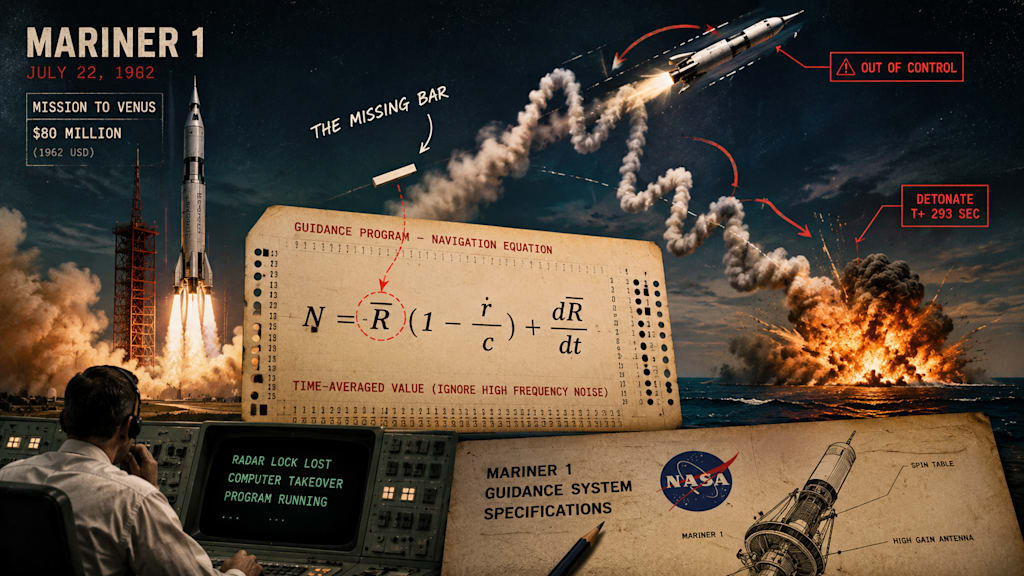
Imagine standing at Cape Canaveral 🌴. It's July 22, 1962, the height of the Cold War and the absolute peak of the Space Race 🌌. On the launchpad, a massive Atlas-Agena B rocket shudders, carrying the Mariner 1 probe at its tip 🛰️. This was a technological masterpiece of its time, designed to achieve the impossible—fly past Venus and beam back humanity's first-ever data from a neighboring planet 🪐. The Americans can feel the Soviet Union breathing down their necks. You could cut the tension with a knife 🔪.
The rocket ignites! 🔥 The thunderous roar of the engines tears through the air, and the machine lifts majestically into the sky, leaving a thick plume of smoke behind. Everything looks perfect. Yet, just 293 seconds later—less than five minutes from liftoff—the range safety officer makes a dramatic decision: “Detonate.” 💥 Worth $80 million (adjusted for today's inflation), the hardware turns into a spectacular fireball and plummets straight into the Atlantic Ocean 🌊.
Why? Because someone, while transcribing a complex mathematical formula onto punch cards, missed one single, tiny bar 📝.
---
## Anatomy of a Disaster: When the Machine Goes Blind 💻📡
To properly understand what happened that July morning, we have to throw away our modern thinking about computers 🧠. In 1962, rocket guidance systems were powerful but incredibly delicate setups. Programming code was manually punched into paper cards, and the computing power of those machines was a tiny fraction of what we wear today in the cheapest alarm clocks or smartwatches ⌚.
During launch, Mariner 1's guidance system relied on two cooperative pillars:
1. Radar signals from the ground 📡, which monitored and corrected the rocket's course in real-time.
2. The onboard computer 🖥️, which was supposed to take the reins and save the mission from failure if the ground signal was disrupted.
And that exact emergency scenario played out. A few minutes into the flight, the ground radar antenna temporarily lost its stable connection with the rocket 🛑. This was a routine situation that NASA engineers were fully prepared for. The onboard computer automatically took over control, launching the navigation program stored in its memory 🤖.
At that moment, instead of a smooth flight toward the stars, the rocket went completely haywire 🌀. It began executing violent, uncoordinated maneuvers, losing its course and threatening to crash into populated areas or shipping lanes. The safety officer had no choice—he had to hit the red button 🔴.
---
## The Legend of the Hyphen: Mathematics vs. Syntax 🧐📐
Over the years, plenty of myths have surrounded this failure. The famous science-fiction author Arthur C. Clarke called the incident "the most expensive hyphen in history" ✍️. The truth, however, is a bit more subtle, which makes it even more fascinating for anyone who writes even a bit of code.
It wasn't a regular hyphen in a text. It was an overline (often called a bar), a horizontal line placed above a mathematical symbol, for example, R̄ 📊.
In the official guidance system specifications, this tiny bar above the symbol represented a time-averaged value ⏳.
In other words, the formula with the bar instructed the computer to ignore temporary, natural rocket vibrations (basic data noise) and focus on the general, smoothed flight trend 📈. Because a programmer omitted this one little symbol during manual data entry, the computer received the instruction without the overline. Instead of processing stable, averaged data, it started frantically reacting to every single micro-fluctuation in position 😰.
Imagine driving a car down a highway 🚗. Normally, you make minimal, smooth adjustments to the steering wheel, completely ignoring minor bumps in the asphalt. Now imagine that for every millimeter drop in the road, you react by violently jerking the wheel 90 degrees left or right. That is exactly what Mariner 1's computer did 🧠💥. It mistook micro-vibrations for a massive course failure and started "correcting" them with such violence that it literally ripped the rocket out of aerodynamic control.
---
## A Lesson for the AI Era 🤖🔮
As a fan of technology and autonomous systems, I can't look at the story of Mariner 1 as just some dusty anecdote from the days of black-and-white television 📺. It is a fundamental, timeless lesson that today—in the era of Artificial Intelligence, LLMs (Large Language Models), and autonomous vehicles—is more relevant than ever before 🌍.
In classic programming, absolute syntax rules supreme 📑. A computer is like a brilliant but agonizingly literal genie in a lamp 🧞♂️: it will do exactly what you ask it to do, not what you meant to ask. Missing a single question mark, comma, semicolon, or curly bracket can crash a massive banking system today, knock out social media globally, or—as we've seen—turn a space rocket into ash 🌌. Back then, there were no advanced linters or automated tests screaming in red before the code ran 🚨.
As we step into the world of Artificial Intelligence and deep machine learning, this problem doesn't disappear; it just mutates into something much harder to detect 🧬. Today's engineers and AI data trainers face a near-identical challenge. A single bad token in prompt engineering, a tiny typo in a training dataset, or a missed parameter in a loss function can cause a neural network to violently "hallucinate" and draw absurd conclusions instead of accurately diagnosing cancer 😵💫.
The Mariner 1 disaster is a perfect, textbook metaphor for the iconic principle "Garbage In, Garbage Out" 🗑️➡️🗑️. It shows that no matter how advanced our technology becomes—whether it's vacuum tubes from 1962 or neural networks with billions of parameters in 2026—its foundation will always require absolute, surgically precise accuracy right at the start of the process 🎯.
Every single character matters. Sometimes its price tag is exactly 80 million dollars... and a return ticket from the road to Venus 💸 on the planetary express.
About the Creator
Piotr Nowak
Pole in Italy ✈️ | AI | Crypto | Online Earning | Book writer | Every read supports my work on Vocal
Enjoyed the story? Support the Creator.
Subscribe for free to receive all their stories in your feed.
Comments
There are no comments for this story
Be the first to respond and start the conversation.