
The Rise of the AI Protocol Builder: How Machines Are Writing the Rules of Tomorrow
How intelligent systems are transforming static guidelines into dynamic, evidence-based decision frameworks across healthcare, finance, law, and beyond.

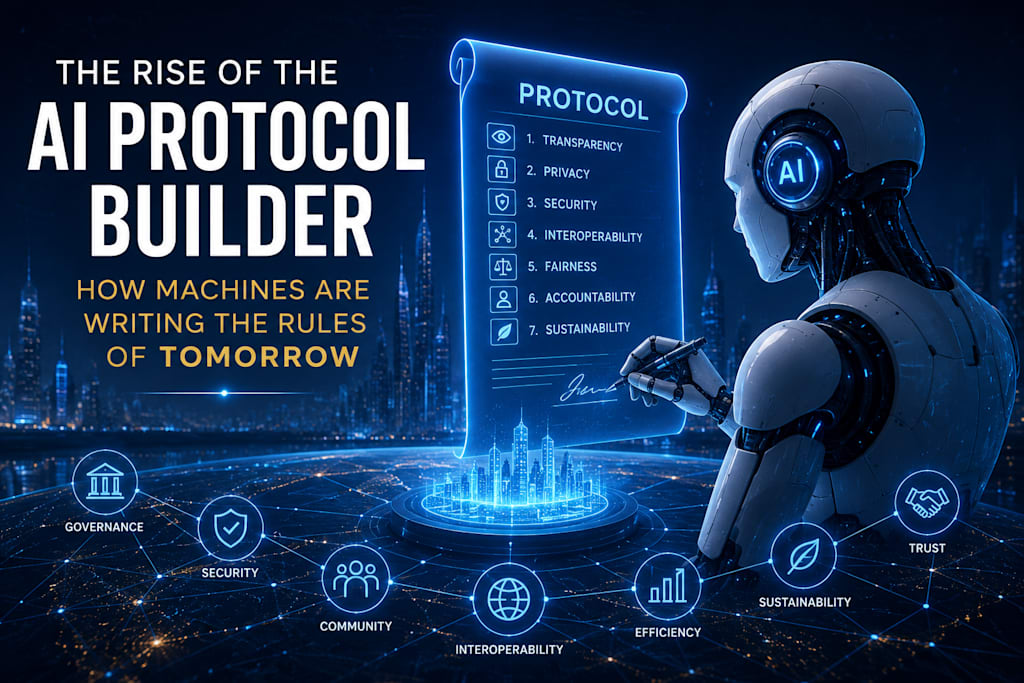
The way we make decisions is changing. Across industries — from finance and logistics to education and healthcare, the growing complexity of data, regulations and patient or client needs has pushed human decision-making to its limits. Enter the AI protocol builder, a new class of intelligent system that doesn't just assist professionals, it actively constructs the decision-making frameworks, structured pathways and evidence based recommendations that guide their work.
This isn't science fiction. It's happening right now and the implications are enormous.
What Is an AI Protocol Builder?
At its core, a protocol is a structured set of rules that guides decision making in a consistent way. In medicine, a protocol might define how to treat a specific condition, which tests to run, which treatments to recommend, in what order and with what dosing. In finance, a protocol might govern how risk is assessed and managed across a portfolio.
Traditionally, protocols have been built by human experts — committees of doctors, regulatory bodies, senior practitioners — working through years of research, debate and trial. The process is slow, expensive, and often slow to reflect emerging evidence.
An AI protocol builder changes this dynamic entirely. It synthesizes massive databases of existing knowledge, research, clinical data, and expert-reviewed information, and then generates structured, customized protocols on demand — in minutes, not months.
This represents a fundamental shift: from protocols as static documents created once and updated rarely, to living, dynamic frameworks generated in real time for specific situations.
Why Now? The Forces Driving AI Protocol Adoption
Several converging forces are making AI protocol builders not just possible, but necessary.
The explosion of available knowledge is the most obvious. In medicine alone, thousands of new studies are published every week. No individual clinician — no matter how dedicated — can read, synthesize, and apply all of it. The same is true in law, engineering, financial services and virtually every other knowledge intensive field. AI systems, trained on vast curated databases and continuously updated, can do what no human can like hold the entire body of evidence in mind simultaneously and apply it to a specific situation in real time.
The personalization imperative is equally powerful. Yesterday's one-size-fits-all approach — the standard treatment protocol, the generic risk profile, the universal onboarding checklist — is giving way to the expectation that guidance should be tailored to the individual. An AI protocol builder can take a specific set of circumstances — a patient's age, diagnosis, current medications, lab results, and lifestyle — and generate a protocol built specifically for that person, not a population average.
The accountability gap is the third driver. Professionals across industries face increasing pressure to justify their decisions with evidence. A recommendation made based on a colleague's advice or a half-remembered study is no longer sufficient. AI protocol builders don't just generate recommendations — they cite their reasoning, grade the quality of the evidence behind each step, and flag potential conflicts or contraindications. This creates a defensible, auditable trail from decision to outcome.
AI Protocol Builders in Healthcare: The Clearest Use Case
Healthcare is where the stakes are highest and where AI protocol builders are demonstrating their most transformative potential. The complexity of modern medicine, the intersection of conventional pharmacology, lifestyle interventions, emerging research and individual patient variation makes it nearly impossible for any single clinician to deliver truly optimized, evidence-based care without technological assistance.
Consider a patient presenting with PCOS, insulin resistance and adrenal fatigue, currently taking four medications. A clinician wanting to develop a comprehensive integrative protocol for this patient would traditionally spend hours on PubMed, cross-referencing research on each condition, checking for drug-supplement interactions, consulting textbooks on hormonal overlap, and then writing a patient facing plan from scratch. That's not a theoretical scenario — it's a common Tuesday for integrative and functional medicine practitioners.
AI protocol builders compress this process from hours to minutes. By inputting a plain-language description of the patient's case — the way a clinician would describe it to a colleague — the system draws on thousands of clinician-reviewed data points to generate a complete, evidence-graded protocol: supplements with dosing, drug-nutrient interactions flagged by severity, dietary recommendations, lifestyle interventions, and a patient-ready summary. Every recommendation comes with a source and an evidence grade, so the clinician can review, edit, and stand behind every element before sharing it.
This is not a replacement for clinical judgment. It's an amplifier.
Platforms like ClarityTx exemplify this new generation of AI protocol builders built specifically for the clinical environment. Trusted by over 1,400 integrative clinicians across North America, ClarityTx draws from a library of more than 3,000 clinician-reviewed monographs spanning 800+ diagnoses, 2,500+ natural medicines, and 1,000+ medications — producing complete protocols in under eight minutes for even the most complex multi-diagnosis cases.
Beyond Speed: What Makes AI Protocol Builders Different
It's tempting to frame AI protocol builders as simply "faster" than traditional methods. But speed is the least interesting part of what they offer.
Evidence grading is a game-changer. Not all research is created equal. A recommendation supported by a randomized controlled trial carries different weight than one based on observational data or traditional use. AI protocol builders that grade their evidence — assigning an A, B, C, or D rating to each recommendation — give professionals an immediate, intuitive sense of how confident to be in any given step. This is something a Google search, a general-purpose chatbot, or even a textbook rarely provides.
Interaction and conflict detection is another capability that goes far beyond what a human expert can reliably deliver under time pressure. An AI protocol builder can simultaneously cross-reference every element of a proposed protocol against a patient's existing medications, known drug-nutrient depletions, contraindicated combinations, and condition-specific risks. It can flag that a patient on a statin is likely depleted in CoQ10 and vitamin D — a clinically significant finding that's easy to miss in a busy practice.
Customization at the point of care transforms the patient experience. Instead of handing a patient a generic information sheet, a clinician using an AI protocol builder can share a plan built specifically for that individual: their conditions, their medications, their dietary preferences, their lifestyle. The difference in patient engagement and adherence is substantial.
Auditability and defensibility address the accountability demands of modern professional practice. Every recommendation in an AI-generated protocol can be traced back to a specific source, reviewed for evidence quality, and edited before delivery. This creates a professional record that is far more defensible than a note scribbled after a 20-minute consultation.
The Human-AI Partnership at the Core
It's worth being direct about what AI protocol builders are not. They are not autonomous decision-makers. They do not diagnose. They do not replace the clinical judgment, professional training, or ethical responsibility of the human practitioner.
What they do is handle the research-intensive, synthesis-heavy, cross-referencing labor that consumes enormous amounts of expert time — without adding proportional value. The expertise of a skilled clinician, financial advisor, or legal professional is not primarily in knowing which studies exist. It's in understanding context, building relationships, making judgment calls in ambiguous situations, and taking responsibility for outcomes.
AI protocol builders free experts to do more of what they're actually trained for, by eliminating the cognitive burden of information synthesis that machines can now do faster and more comprehensively.
This partnership model — human expertise amplified by machine synthesis — is the productive frame for understanding where AI is genuinely delivering value today. Not replacement, but expansion of professional capacity.
The Road Ahead: AI Protocol Builders Across Industries
Healthcare may be the clearest current use case, but AI protocol builders are emerging across a wide range of professional domains.
In legal services, AI protocol builders are beginning to generate document review checklists, due diligence frameworks, and compliance protocols tailored to specific jurisdictions and transaction types — drawing on case law, regulatory guidance, and firm-specific precedents.
In financial services, they're being used to generate risk assessment protocols, portfolio review frameworks, and client suitability analyses that synthesize market data, regulatory requirements, and individual client profiles.
In education, adaptive learning systems are moving toward protocol-builder models that generate personalized learning pathways for students based on demonstrated competencies, learning styles, and curriculum goals.
In engineering and product development, AI protocol builders are starting to generate testing frameworks, safety checklists, and quality assurance protocols tailored to specific product types, regulatory environments, and risk profiles.
What unites these applications is the same underlying logic: professional domains where knowledge is vast, decisions are complex, evidence quality varies, and the cost of error is high are exactly where AI protocol builders provide the most value.
What This Means for Professionals Today
For practitioners across fields, the rise of AI protocol builders raises a practical question: how do you engage with these tools effectively, and how do you evaluate them responsibly?
The most important criterion is not speed — it's the quality and traceability of the underlying knowledge. An AI system that generates recommendations without citing its sources, grading its evidence, or disclosing its knowledge base is offering fluency, not accountability. The value of a protocol builder lies not in its ability to generate text quickly, but in the depth, accuracy, and reviewability of the knowledge it draws on.
The second criterion is designed integration with professional workflow. The best AI protocol builders are not general-purpose tools awkwardly adapted to professional use — they're built from the ground up around how practitioners actually work, with outputs that slot directly into clinical notes, client reports, or professional documentation.
Platforms like ClarityTx demonstrate what this looks like in practice: a system built by clinicians for clinicians, with every monograph reviewed by practicing MDs, NDs, and PharmDs, outputs directly shareable with patients, and an interface designed around the realities of a clinical encounter.
Conclusion
The AI protocol builder is not a futuristic concept. It is an emerging category of professional tool that is already changing how decisions get made in medicine, law, finance, and beyond. It represents the maturation of AI from a novelty — a clever text generator, a question-answering system — into a genuine professional partner capable of doing serious cognitive work at scale.
The rules that govern how we practice, how we treat, how we advise, and how we build — those rules are increasingly being written with AI assistance. The professionals who understand this shift, who learn to work alongside intelligent protocol systems rather than against them, will be better positioned to deliver the depth of expertise their clients and patients deserve.
The machines aren't replacing the rules. They're helping us write better ones.
About the Creator
Clarity Tx
ClarityTx empowers clinicians with AI-assisted, evidence-synthesized clinical insights and personalized treatment planning across conventional and integrative therapies helping you build safer, research-backed protocols faster.
Enjoyed the story? Support the Creator.
Subscribe for free to receive all their stories in your feed.
Comments
There are no comments for this story
Be the first to respond and start the conversation.