
The Real Mathematics of George Boole
How He Changed Reasoning
Introduction
George Boole is frequently described as the inventor of Boolean algebra and the intellectual father of the modern computer. This familiar account contains some truth, but it also compresses almost a century of mathematical development into one convenient story. Boole created an algebraic system for expressing logical reasoning, but later mathematicians refined the Boolean algebra taught today.
Boole did not design electronic logic gates, binary computer circuits or modern truth tables. His purpose was to discover whether human reasoning could be expressed and manipulated through mathematical symbols.
Logic Before Boole
Before Boole, Aristotle dominated formal logic, and arguments were commonly expressed as syllogisms, such as “All men are mortal” and “Socrates is a man”, from which the conclusion “Socrates is mortal” follows.
This system had survived for more than two thousand years, but it was written largely in words. Boole’s great innovation was to replace parts of logical arguments with symbols and then manipulate them in a manner resembling ordinary algebra.
His approach appeared in “The Mathematical Analysis of Logic” in 1847 and was developed more fully in “An Investigation of the Laws of Thought” in 1854. Boole believed that the operations of the mind followed laws that could be represented mathematically.
Classes Rather Than Simple Truth Values
Boole’s symbols generally represented classes of things rather than statements that were merely true or false. If the symbol x represented all cats and y represented all black things, then xy represented everything belonging to both classes, meaning all black cats.
Multiplication therefore acted like the intersection of two classes. The expression xy selected objects that were members of class x, and class y at the same time.
Boole used the number 1 to represent the entire universe of objects being discussed. This was not necessarily the whole physical Universe, but what later logicians called the universe of discourse. The number 0 represented the empty class containing no objects.
If x represented cats, then 1 minus x represented everything within the chosen universe that was not a cat. In modern terminology, this operation produces the complement of the class x.
Boole’s Special Law
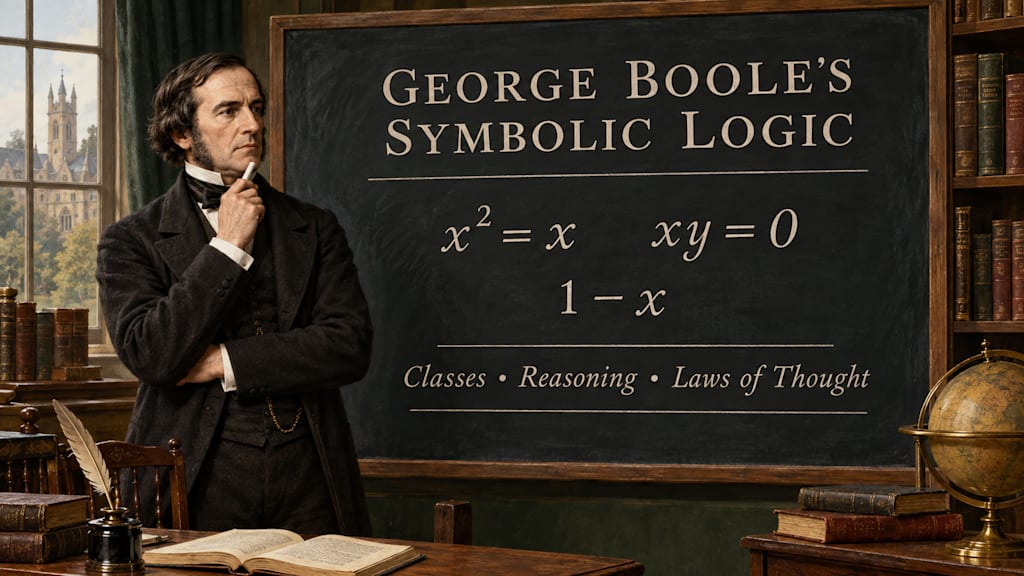
The most distinctive rule in Boole’s algebra was: x squared equals x.
If x represents the class of cats, selecting all cats and then selecting all cats again produces exactly the same class. Multiplying x by itself therefore changes nothing.
This is very different from ordinary numerical algebra. In conventional arithmetic, x squared equals x only when x is zero or one. Boole recognised that this unusual rule gave his logical symbols special mathematical properties.
The rule is now called the idempotent law. It became one of the foundations upon which later forms of Boolean algebra were constructed.
Translating Language into Equations
Boole wanted logical statements to be converted into equations. Consider the statement, “No cats are dogs”. If x represents cats and y represents dogs, the statement can be written as: xy equals 0.
The equation says that the class containing things that are both cats and dogs is empty. Consider another statement, “All cats are mammals”. Boole could express this by showing that no cats existed outside the class of mammals.
Once premises had been translated into equations, Boole applied algebraic procedures to eliminate unwanted symbols and derive conclusions. His real achievement was therefore creating a mathematical method for analysing logical arguments.
An Unusual Form of Algebra
Boole attempted to use familiar operations such as addition, subtraction, multiplication and division. However, these operations did not always behave like either ordinary arithmetic or modern Boolean algebra.
Addition could represent the combination of classes, but Boole often required those classes to be mutually exclusive. If x represented men and y represented women, then x plus y could represent the combined class. Difficulties appeared when the classes overlapped because an object could effectively be counted twice.
Subtraction was also meaningful only under certain conditions. The expression x minus y represented members of x that were not members of y, but problems arose if y included objects that were not contained within x.
Boole even permitted intermediate expressions that had no clear logical interpretation. He treated them algebraically and expected the final result to return to a meaningful logical form. This made his system ingenious, but also complicated and occasionally difficult to justify.
Zero and One Did Not Simply Mean False and True
Modern explanations often claim that Boole invented a system in which zero meant false, and one meant true. This description is convenient, but it does not fully capture the character of his work.
In Boole’s class algebra, zero represented the empty class, and one represented the complete universe of discourse. He also discovered that certain logical calculations could be tested by assigning zero and one to the variables, a technique known as Boole’s Rule of Zero and One.
This helped establish the later connection between class membership and binary truth values. However, Boole’s original system was not merely the two-valued truth-table algebra now used to explain computer logic.
How Boolean Algebra Developed
Later mathematicians transformed Boole’s work into the modern system bearing his name. William Stanley Jevons objected to some of Boole’s restrictions and developed operations that could be used more generally. John Venn clarified the relationship between classes and logical expressions, while his diagrams provided a visual method for representing overlapping sets.
Charles Sanders Peirce extended the algebra of logic and developed important ideas concerning relations and quantification. Ernst Schröder then organised much of the nineteenth-century algebraic tradition into a more systematic mathematical treatment.
During the early twentieth century, Edward Huntington produced sets of axioms defining Boolean algebra independently of Boole’s original calculating procedures. Marshall Stone later demonstrated the deep relationship between Boolean algebras, sets and topology.
The modern Boolean algebra found in textbooks is therefore the product of a long development. It carries Boole’s name because his work supplied the decisive beginning, but it is not identical to the algebra he published.
From Logic to Electrical Circuits
Boole died in 1864, long before electronic computers appeared. The connection between Boolean algebra and electrical switching was developed much later.
In 1937, Claude Shannon showed that switching circuits could be analysed using Boolean algebra. A closed switch could be represented by one state, while an open switch could be represented by another. Combinations of switches could then perform operations corresponding to AND, OR and NOT.
This discovery made Boolean algebra extraordinarily useful for designing telephone exchanges and digital circuits. However, Shannon applied the later, simplified algebra bearing Boole’s name rather than reproducing Boole’s original system exactly.
Boole’s True Achievement
It would be wrong to deny Boole’s importance simply because he did not create modern Boolean algebra in its finished form. His revolutionary contribution was recognising that logical reasoning could be treated mathematically.
He introduced symbols for classes, represented logical relationships through equations and created general methods for deriving conclusions. Most importantly, he helped transform logic from a branch of philosophy expressed mainly in words into a mathematical discipline capable of calculation.
Conclusion
George Boole originated the algebra of logic, but he did not single-handedly create the complete Boolean algebra used in mathematics and computing today. His original system concerned classes, symbolic selection and the mathematical laws underlying reasoning. It included zero and one, but it was not simply a binary system in which they always meant false and true.
Modern Boolean algebra emerged when Jevons, Venn, Peirce, Schröder, Huntington, Stone and others revised, simplified and formalised Boole’s ideas. Shannon later showed how that algebra could control switching circuits. Boole deserves recognition for beginning this transformation, but the real history is richer than the familiar claim that one Victorian mathematician invented the logic of every modern computer.
About the Creator
Alan Spencer
Have been an author and writer for over 20 years. Have been a journalist, editor, proofreader, and a designer and presenter of training courses. Have written over 100 articles, two books, and around 20 training courses.
Enjoyed the story? Support the Creator.
Subscribe for free to receive all their stories in your feed. You could also become a paid subscriber, letting them know you appreciate their work.
Comments
There are no comments for this story
Be the first to respond and start the conversation.