
The Order of the Screaming Goat
There will be bleating!


The first thing I did when every smartphone in the world stopped working was panic.
The second was press the power button seventeen times.
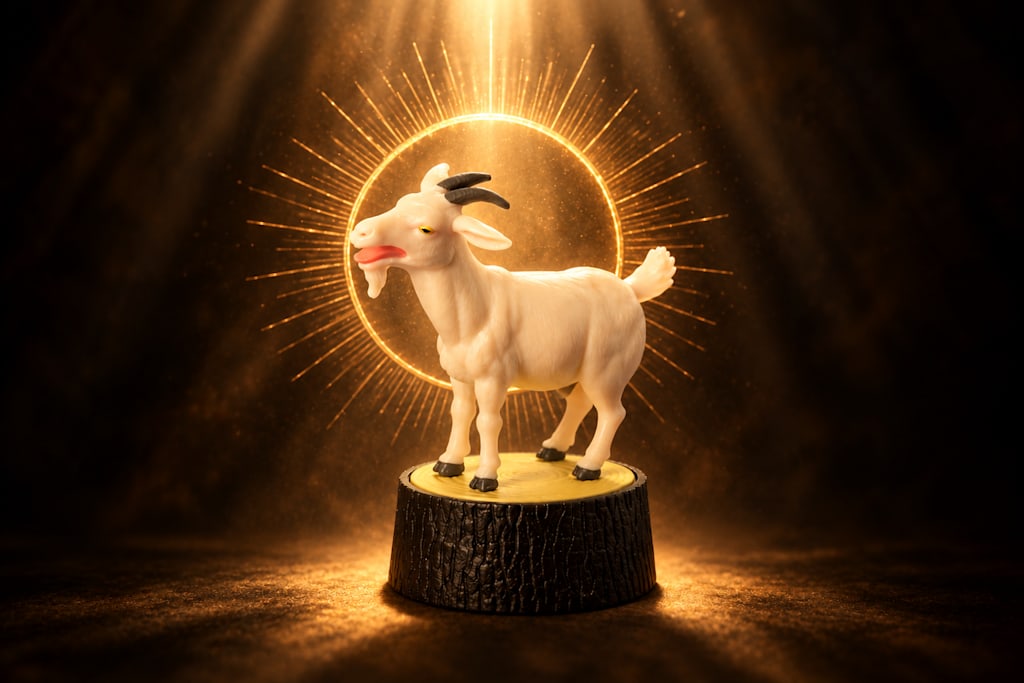
The third was squeeze a tiny plastic goat.
“AAAAAAAAAAAAAAAAAHHHHH!”
My daughter appeared in the doorway.
“Mom. Seriously?”
I squeezed it again.
“AAAAAAAAAAAAAAAAAHHHHH!”
“You’re making it worse.”
“Am I?”
She stared at me with the particular expression teenagers reserve for parents who have failed to evolve beyond single-celled organisms.
“You’re so embarrassing.”
I considered explaining that I was demonstrating a healthy coping mechanism.
Instead, I squeezed the goat.
Again.
The goat had been a gift to myself, purchased during a particularly difficult week when the baby wasn’t sleeping, work was testing the limits of my professionalism, and I had begun fantasizing about moving into a remote cabin where nobody could find me.
It was approximately three inches tall, with an expression of perpetual horror and a button that produced the anguished shriek of a creature witnessing the collapse of civilization.
I loved it immediately.
I kept it on my desk.
Whenever a work email began with Per my last email, the goat screamed.
Whenever someone scheduled a meeting that could have been an email, the goat screamed.
Whenever I discovered that the baby had waited until I put on clean clothes to spit up on me, the goat screamed.
It was considerably cheaper than therapy.
Now, with every smartphone on Earth inexplicably dead, the goat seemed uniquely qualified to express the prevailing mood.
By noon, the news had confirmed that the phenomenon was global.
Every smartphone had ceased functioning simultaneously.
Computers still worked. Televisions worked. Landlines worked, provided anyone still possessed one.
Nobody knew why.
Experts suggested solar activity, coordinated cyberattacks, and several explanations involving electromagnetic fields that the news anchors clearly did not understand.
My daughter stood in the living room holding her phone like a deceased hamster.
“How am I supposed to talk to anyone?”
“With your mouth?”
“Mom.”
“That’s what we did in the olden days.”
“You were born in the nineteen hundreds.”
I pressed the goat.
She left.
The first week was catastrophic.
Not civilization-ending catastrophic, although the television networks seemed determined to make it so.
More like a prolonged family vacation in which everyone had forgotten their luggage, nobody knew where the hotel was, and someone kept asking whether we were there yet.
People couldn’t use mobile payment apps. Rideshare services became complicated. Delivery drivers resorted to paper maps. Restaurants rediscovered the concept of printed menus.
Schools began sending handwritten notices home.
Businesses posted signs explaining that yes, their phones were also dead, and no, yelling at the cashier would not fix them.
I worked from home, so my computer became the center of my increasingly fragile universe.
My employer sent an email reassuring us that operations would continue as usual.
Of course they would.
The apocalypse, apparently, was not an acceptable excuse for missing a deadline.
Meanwhile, my four-month-old son continued to operate according to his own mysterious schedule, which primarily involved screaming whenever I considered sleeping.
I admired his consistency.
By then, I’d started carrying the goat in my purse. Emotional support animals came in all forms.
On Thursday, after a particularly unpleasant morning, I took my son to the grocery store.
The cashier looked as though she’d been awake since the invention of agriculture.
A man in front of me was arguing because the store expected him to pay without his phone.
“But it’s how I’ve always paid!”
“Sir, I understand.”
“Well, what am I supposed to do?”
“Do you have a card?”
He stared at her as though she’d suggested bartering with livestock.
The cashier stared back at him.
I recognized the expression.
It was the expression of a woman considering whether prison might offer better working conditions.
The man eventually left, announcing that he’d never shop there again.
The cashier watched him go.
“Promise?” she whispered.
I laughed.
She looked at me, and for a moment I could see how close she was to crying.
I reached into my purse.
“Here.”
I handed her the goat.
She examined it.
“What is this?”
“Emergency equipment.”
She pressed the button.
“AAAAAAAAAAAAAAAAAHHHHH!”
The woman at the next register jumped.
The cashier stared at the goat.
Then she laughed.
Not a polite little laugh.
A full-bodied, shoulders-shaking, tears-running-down-her-face laugh.
She pressed it again.
“AAAAAAAAAAAAAAAAAHHHHH!”
“Keep it,” I said.
“Seriously?”
“Trust me. You’ll need it.”
I went home without my goat.
It was the first selfless thing I’d done all week that hadn’t involved changing a diaper.
Three days later, I saw another one.
I was standing in line at the pharmacy, where a woman was arguing with the technician about a prescription notification she hadn’t received.
The technician explained that the pharmacy had sent an email.
The woman explained that she didn’t check her email.
The technician explained that this was not something she could personally remedy.
Then, from behind the counter:
“AAAAAAAAAAAAAAAAAHHHHH!”
Everyone froze.
The technician slowly lowered a tiny plastic goat.
“Sorry,” she said.
I stared.
“Where did you get that?”
“My sister gave it to me. Apparently, some woman at her grocery store gave her coworker one, and now they’re all buying them.”
I felt an unexpected surge of pride.
“Really?”
“Yeah. Apparently, you’re supposed to scream when things get ridiculous.”
She looked down at the goat.
“Which is pretty much constantly now.”
I wanted to tell her.
I wanted to announce that I was the original distributor, the woman who had placed the first screaming goat into the hands of an unsuspecting public.
Instead, I nodded solemnly.
“A noble tradition.”
She pressed the button.
I bowed my head.
By the end of the second week, the goats were everywhere.
A local novelty shop began stocking them after someone asked whether they carried “those little screaming things.”
The owner, sensing opportunity, ordered as many as he could through his still-functioning computer.
They sold out in two days.
Soon, people were giving them to coworkers, neighbors, teachers, and anyone who appeared to be one minor inconvenience away from committing a felony.
A handwritten sign appeared in the grocery store.
SCREAMING GOATS ACCEPTED HERE.
Beneath it, someone had added:
Please limit screaming to one per transaction.
A customer crossed out one and wrote three.
The manager crossed out three and wrote ZERO.
Someone drew a goat underneath.
The goat was screaming.
I learned the name of our movement from the newspaper.
Yes, an actual newspaper.
With ink.
And pages.
My daughter brought it home because the headline had caught her attention.
MYSTERIOUS “ORDER OF THE SCREAMING GOAT” SPREADS ACROSS CITY
Beneath it was a photograph of three women standing outside a coffee shop, each holding a miniature goat.
According to the article, the Order had no known founder, no official membership requirements, and no identifiable leadership.
Its members recognized one another through a ritual known as The Call and Response.
One goat screamed.
Another answered.
I read the article twice.
Then I laughed so hard I woke the baby.
My daughter looked over my shoulder.
“Wait. Isn’t that your stupid goat?”
“Excuse me. That’s a sacred artifact.”
“Mom.”
“I believe the proper term is relic.”
She shook her head.
“You’re so weird.”
I folded the newspaper carefully.
For the first time in my life, I was considering framing a local news article.
Things escalated.
A man calling himself the Grand Bleatmaster appeared on television wearing a bathrobe and a pair of plastic horns.
He claimed the Order had existed for centuries.
According to him, the screaming goat was an ancient symbol of humanity’s resistance to oppression.
He had no evidence.
He did, however, have a very impressive beard.
A rival organization emerged almost immediately.
The Silent Sheep.
Their philosophy was apparently that true enlightenment could only be achieved through quiet contemplation.
They communicated by holding up stuffed sheep and nodding meaningfully.
I found them insufferable.
A local radio host invited representatives of both organizations to debate the merits of their respective philosophies.
The Grand Bleatmaster opened with a goat scream.
The Silent Sheep representative responded with thirty seconds of silence.
The host declared it the most productive political discussion of the decade.
My daughter became increasingly concerned about my involvement.
“You’re not actually part of this, are you?”
I looked up from my notebook.
“Part of what?”
“The goat thing.”
“I prefer to think of myself as an early adopter.”
“Please don’t.”
“Technically, I may be the founder.”
She stared at me.
“No.”
“Yes.”
“No.”
“Would you like to hear the sacred origin story?”
She walked away.
I followed her into the kitchen.
“It began in a grocery store—”
“Mom!”
“—when a humble cashier received a gift—”
“I’m begging you.”
“—and thus the first initiate was chosen.”
She opened the refrigerator.
“Do we have any cheese?”
I sighed.
The younger generation had no respect for history.
Later, I noticed she’d left the newspaper open to the article about the Order.
I chose not to comment.
Some conversions required patience.
Despite the absurdity, something peculiar was happening.
People were talking.
Not just about the goats.
At the grocery store, strangers who recognized one another as members of the Order would stop to exchange stories about their days.
At the pharmacy, people began sharing frustrations instead of directing them at the staff.
Someone organized a weekly gathering at the library, where members could bring their goats, drink coffee, and complain about whatever had gone wrong that week.
The first meeting attracted twelve people.
The second attracted forty.
By the third, the library had asked them to relocate because the screaming was disturbing the book club.
The book club, in retaliation, purchased goats of its own.
Nobody was entirely sure whether this constituted an alliance or a declaration of war.
One afternoon, I found myself back at the grocery store.
The cashier I’d given the first goat to was working.
She recognized me immediately.
“Hey! Goat lady!”
I glanced around.
There are worse things to be called, I suppose.
She reached beneath the counter and produced the original goat.
“I still have it.”
“I see that.”
“You have no idea how many times this thing has saved my sanity.”
She smiled.
“People keep asking where I got it. I tell them a woman with a baby gave it to me when I was having a terrible day.”
I felt unexpectedly shy.
“Well, I’m glad it helped.”
She looked at the baby, who was currently attempting to eat his own fist.
“How are you doing?”
It was such an ordinary question.
I almost gave the ordinary answer.
Fine.
Instead, I hesitated.
“Tired,” I admitted.
She nodded.
“Yeah. You looked tired that day, too.”
For a moment, neither of us said anything.
Then she reached across the counter and squeezed the goat.
“AAAAAAAAAAAAAAAAAHHHHH!”
I laughed.
So did she.
And the woman standing behind me in line reached into her purse.
“AAAAAAAAAAAAAAAAAHHHHH!”
We stared at one another.
Then all three of us burst out laughing.
The manager appeared.
“Absolutely not.”
The blackout continued.
Nobody knew when the phones would work again, or whether they ever would.
The world adapted.
People carried paper maps. They bought cameras. They made plans in advance and occasionally arrived at places only to discover that everyone else had misunderstood the time.
There were frustrations, certainly.
There were people who struggled terribly without the technology they’d relied upon.
The goats didn’t fix any of that.
They didn’t replace emergency communication or restore access to lost photographs.
They didn’t make my baby sleep.
They didn’t shorten my fiancé’s work shifts.
They didn’t make the distance between people disappear.
But occasionally, they made that distance feel a little smaller.
One night, the baby refused to sleep.
Again.
I had fed him, changed him, rocked him, walked the hallway, sung to him, and considered negotiating with him as though he were a particularly unreasonable landlord.
Nothing worked.
My fiancé was at work.
My daughter was upstairs.
The house was dark except for the little lamp beside the couch.
I was exhausted.
Not the kind of tired that a good night’s sleep would fix.
The kind that settled somewhere behind my ribs and made everything feel heavier than it should.
I sat down with the baby against my chest.
He cried.
I cried.
For a moment, I wanted my phone.
Not to scroll.
Not to read the news.
Just to tell someone that I was having a hard time.
To send a message into the darkness and hope someone answered.
I thought about the cashier.
The pharmacy technician.
The strangers who had found one another through a ridiculous plastic toy.
Somewhere out there, people were screaming together.
I’d helped give them a way to find one another.
And somehow, I was sitting alone.
The baby finally quieted.
I closed my eyes.
Then I heard footsteps.
My daughter stood in the doorway.
“Mom?”
I looked up.
“Yeah?”
She hesitated.
“You okay?”
I considered lying.
Instead, I shook my head.
“Not really.”
She disappeared.
A moment later, she returned with something hidden behind her back.
“Oh, God,” I said.
She held out a tiny plastic goat.
I stared at it.
“Where did you get that?”
“The bookstore.”
“When?”
“Last week.”
“Why?”
She shrugged.
“I thought it was funny.”
Then she pressed the button.
“AAAAAAAAAAAAAAAAAHHHHH!”
The baby startled.
I startled.
My daughter looked horrified.
Then the baby laughed.
A delighted, breathless little laugh.
We stared at him.
She pressed it again.
“AAAAAAAAAAAAAAAAAHHHHH!”
He laughed harder.
And suddenly I was laughing, too.
Not because anything had changed.
The laundry still needed doing. The dishes were still waiting. My fiancé was still at work.
But my daughter was sitting beside me, holding a screaming goat, and my son was laughing as though he’d just discovered the greatest sound in the universe.
I wiped my eyes.
“You know,” I said, “technically, you’ve just been initiated.”
She groaned.
“Don’t.”
“Membership is for life.”
“Mom.”
“There are no refunds.”
She pressed the goat directly at my face.
“AAAAAAAAAAAAAAAAAHHHHH!”
I bowed my head.
“Welcome to the Order.”
The following morning, I found a handwritten note on the kitchen table.
My daughter had drawn a small goat beneath the words:
RULE NUMBER ONE:
When one of us screams, somebody else answers.
I stared at it for a long moment.
Then I folded it carefully and tucked it into my notebook.
The world had lost its smartphones.
Somehow, we’d found a new way to say:
I hear you.
And it was absolutely ridiculous.
About the Creator
A. Bell
I write about the things we don't always know how to say out loud: grief, love, fear, hope, and all the messy spaces in between.
If something here makes you feel, I'm glad you found me.
Enjoyed the story? Support the Creator.
Subscribe for free to receive all their stories in your feed.
Comments
There are no comments for this story
Be the first to respond and start the conversation.