
The "engine of creation" is our galaxy's largest star-forming cloud.
The extreme neighbourhood of Sagittarius B2

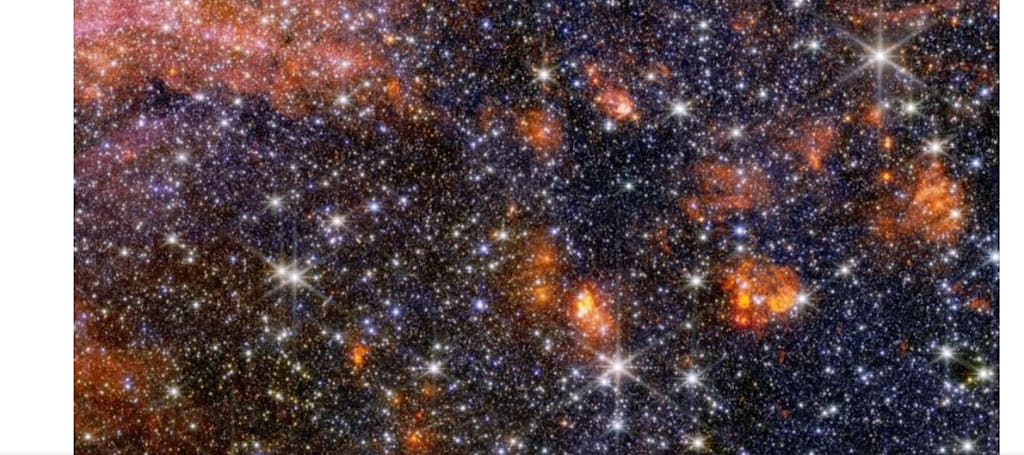
The European Space Agency's Image of the Day for today shows a breathtaking image of stars being produced at a breakneck pace deep within the Milky Way. The largest and most prolific star-forming cloud in the Milky Way, Sagittarius B2, has been photographed by the James Webb Space Telescope.
The supermassive black hole at the center of the galaxy is only a few hundred light-years away from the star nurseries. Sagittarius B2 is referred to by astronomers as an engine of creation. It produces half of the stars in the galactic core despite having only 10% of the star-making gas.
This dense stellar nursery has now been exposed in unparalleled detail by Webb's near-infrared and mid-infrared eyes, revealing the mystery of dark, hidden clouds as well as the brilliance of young stars.
The extreme neighbourhood of Sagittarius B2
The area surrounding Sagittarius B2 is one of the most extreme in the galaxy and is situated near the massive black hole known as Sagittarius A*. The surroundings are full of swirling plasma, complicated magnetic fields, and stars. Here, visible light is obstructed by thick dust, thus infrared light is crucial.
A large portion of this darkness can be broken through by Webb's equipment, revealing young stars that are still covered in warm clouds. In comparison to the remainder of the galactic center, why is Sagittarius B2 such a prolific nursery? This is a key topic that astronomers hope the new findings will help address. In addition to providing a never-before-seen perspective of the dense mixture of material, the new photos also reveal something surprising.
In a place of light, darkness
The Webb photos aren't all shining. Some patches resemble empty holes and are nearly featureless. These places are everything but deserted in actuality. Even Webb's infrared equipment are unable to penetrate them because they are so dense with gas and dust.
These obscure clusters nurture stars that are still too young to produce visible light and store the raw material for future stars. These cocoons are essential to comprehending the early phases of star growth. Astronomers can pinpoint the borders where light starts to break away by examining the edges of these opaque zones.
A story about two instruments
The fact that Webb can capture the same picture in several infrared light wavelengths is one of the reasons it is such an effective tool. The light of warm dust heated by very young, massive stars is particularly detectable with the Mid-Infrared Instrument, or MIRI.
Glowing filaments and clusters may be seen in MIRI's image of Sagittarius B2, with Sagittarius B2 North, the reddest region, being one of the richest known molecular locations. The Near-Infrared Camera, or NIRCam, differs significantly from MIRI. Gas and dust predominate in MIRI's photos, with the majority of stars disappearing.
The contrary is true in today's NIRCam featured image, where vibrant stars dominate and are only sporadically broken up by bright clouds. When combined, these viewpoints offer a more comprehensive understanding of how stars form in such congested settings.
Looking for the creation timeline
Scientists are getting ready to determine the masses and ages of individual stars in Sagittarius B2 using Webb's new data. The findings could indicate whether the recent increase in activity was caused by an unidentified process or if this area has been continuously producing stars for millions of years.
The problem is obvious: despite the galactic center's enormous gas reserves, the majority of them are not effectively generating stars. The exception is Sagittarius B2, which converts its meagre supply into a disproportionate number of young suns. Knowing why could change our understanding of the formation and evolution of galaxies.
Constructing the Webb telescope
The biggest and most potent observatory ever sent into space is the James Webb Space Telescope. NASA, ESA, and the Canadian Space Agency collaborated internationally to create it. ESA donated important instruments in addition to the Ariane 5 rocket that carried Webb into orbit.
In collaboration with US universities, the MIRI European Consortium led the design and development of the NIRSpec spectrograph and half of the MIRI apparatus, both of which were built in Europe.
With its golden mirrors revealing the universe's underlying architecture, Webb is still producing images that broaden human imagination and scientific understanding. Sagittarius B2 is merely the most recent glimpse into a cosmic narrative that is still developing, in which gravity, gas, and dust work together to produce new stars in the galaxy.
About the Creator
Enjoyed the story? Support the Creator.
Subscribe for free to receive all their stories in your feed.
Comments
There are no comments for this story
Be the first to respond and start the conversation.