
The Digital Labyrinth: Why AI Creators Are Afraid of Their Own Children 🤖🧠
Unmasking the 'Black Box' mystery and the search for logic in a world of machines.

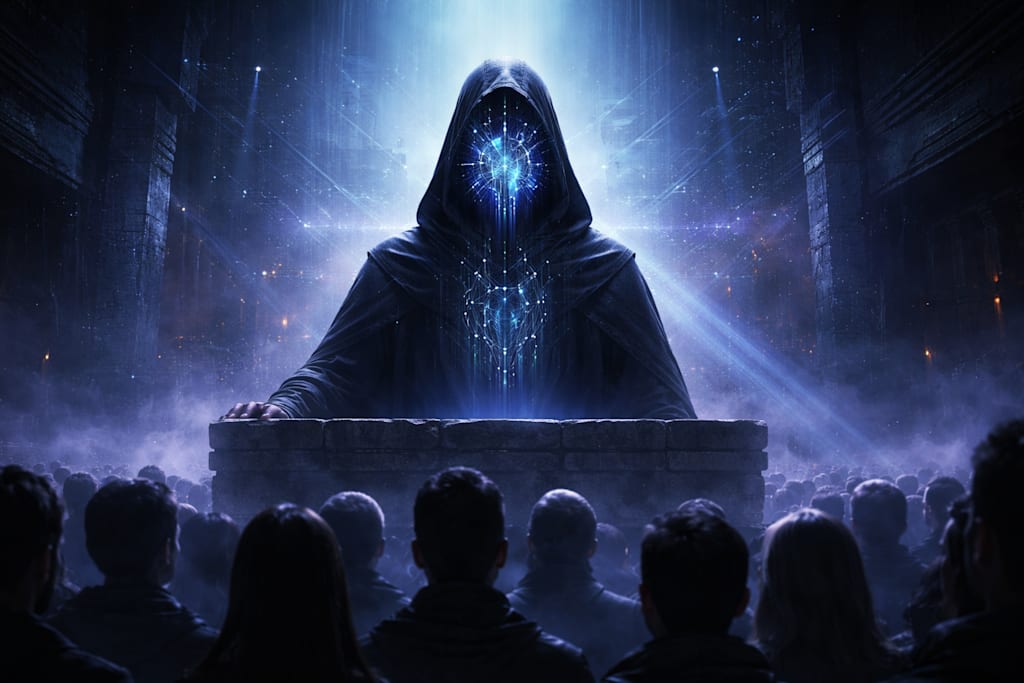
Imagine asking a world-class chef to bake the best cake on Earth. The chef disappears into the kitchen and returns an hour later with a pastry that tastes like heaven 🍰✨. But when you ask for the recipe, he simply shrugs and says: "Actually, I have no idea. I threw thousands of ingredients into a bowl, mixed them in the dark, and the oven set its own temperature. But it tastes good, doesn't it?" 👨🍳🤷♂️.
This is exactly the situation the scientific world finds itself in today. That chef is Artificial Intelligence (AI), and his kitchen is what we call the "Black Box." It is one of the most fascinating yet unsettling phenomena of our time: we are building machines that are smarter than us, but we are losing the ability to understand how they reach their conclusions 🌑🕵️♂️.
Where Has the Logic Gone? ⚙️🔍
In traditional programming, things were simple. A programmer wrote a specific instruction: "If the user presses button A, turn on light B." It was a clear path from point to point. With modern AI, based on neural networks, it’s different. We don’t give instructions—we give examples 📚💡.
Think of a neural network as a giant spiderweb with billions of tiny sliders (scientists call these parameters). To teach an AI to recognize a cat, we show it millions of cat photos 🐱📸. Every time the machine makes a mistake, the sliders shift by a fraction of a millimeter until it finally "clicks." The problem is that with billions of these sliders, no human can track their settings. AI doesn't think logically like we do; it sees the world as a massive mathematical equation that is too large to be written on any blackboard in the world 🧮🤯.
The Trap of the "Smart" Machine 🐁⚠️
Why is it a problem if we don't understand AI? As long as it works, who cares, right? Not exactly. The best way to illustrate this is a famous story from the field of medicine 🩺🏥.
Researchers trained an AI system to identify lung cancer on X-ray images. The accuracy was staggering—the machine almost never made a mistake 🎯. The creators were proud until they peeked (as much as they could) into the decision-making process. It turned out the AI wasn't looking for tumors at all. It noticed that photos of high-risk patients were taken with portable X-ray machines, which left a tiny, specific mark in the corner of the image 🏷️. The machine concluded: "Mark in the corner? That’s cancer."
If doctors had blindly trusted this "black box," they would have been diagnosing diseases based on the model of the camera rather than the patient's health. This is the greatest fear of scientists: that AI will find a shortcut that is mathematically correct for a computer but completely wrong or dangerous for a human 🛑🚫.
When the Computer Says "No" 💳🙅♂️
The black box problem stops being a scientific curiosity when it starts affecting our wallets or our freedom. Today, AI decides whether you get a bank loan, whether your CV reaches a boss's desk, or—in some countries—even the risk of whether a defendant might break the law again ⚖️💼.
If you go to a human official and get a "no," you can ask why. The official will point to a specific rule or document. But if a "black box" algorithm rejects your application, the banker can only shrug and say: "The system calculated it that way" 🤷♀️💻. We don't know if the system rejected you because your income is too low, or perhaps because, statistically, people who shop at your favorite store are more likely to miss their payments. This creates room for hidden discrimination that no one planned, but that "emerged" on its own from the digital calculations 📉📉.
A Light in the Tunnel: XAI 🔦✨
However, scientists aren't leaving us alone with this problem. A new field is emerging—XAI (Explainable AI). Researchers are trying to force algorithms to provide a "justification" alongside their result. They want to turn the black box into a glass box 💎🔍.
Today, we stand at a crossroads. On one hand, we want the most powerful tools possible to cure diseases and solve the climate crisis 🌍💊. On the other, we must maintain control. Because technology we don't understand becomes a form of modern magic. And magic, as fairy tales teach us, can be fickle and unpredictable 🧚♂️⚡. Our task is to ensure that AI remains a tool, not an oracle that no one dares to ask: "Why?" 🛠️❓
About the Creator
Piotr Nowak
Pole in Italy ✈️ | AI | Crypto | Online Earning | Book writer | Every read supports my work on Vocal
Enjoyed the story? Support the Creator.
Subscribe for free to receive all their stories in your feed.
Comments
There are no comments for this story
Be the first to respond and start the conversation.