
The Code of Reality: How Quantum Entanglement May Be “Stitching Together” the Hologram of the Universe
Space

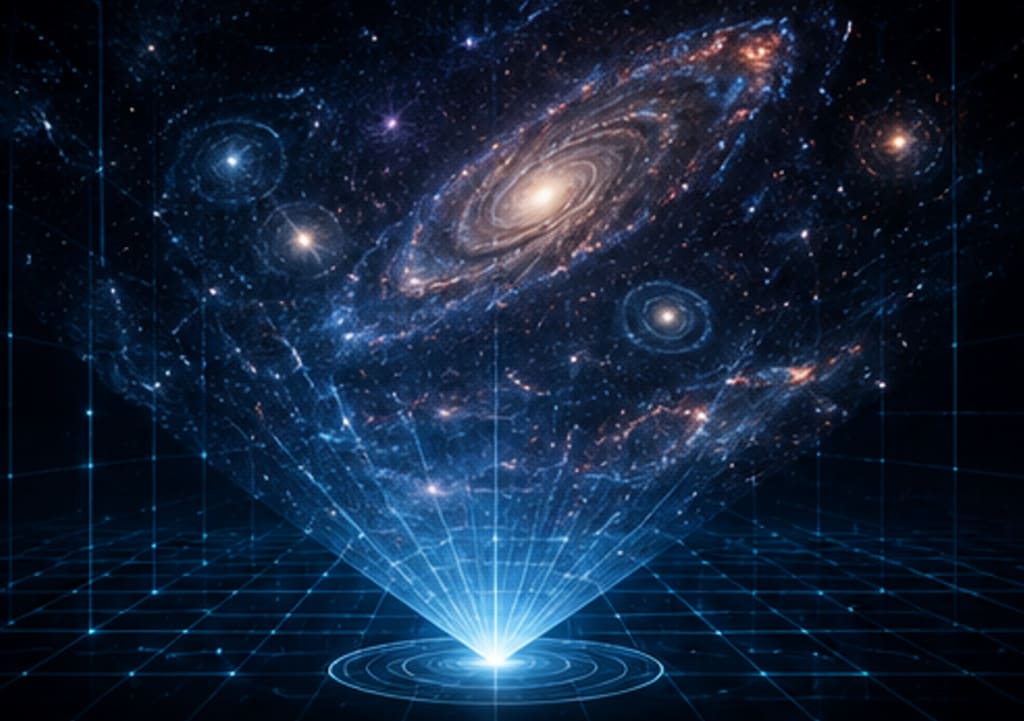
Not so long ago, the idea that our universe might be a giant hologram sounded like something pulled straight from science fiction. Today, however, it is taken seriously by some of the world’s leading theoretical physicists. Over the past few decades, this once-bold idea has grown into one of the most unusual and fascinating directions in modern science.
In a previous article, I wrote about the holographic principle — the idea that all the information contained in a three-dimensional world could, in theory, be encoded on a two-dimensional surface. This concept gained powerful mathematical support through the work of Juan Maldacena, who proposed the famous AdS/CFT correspondence.

But there was one major problem.
Maldacena’s model described an idealized universe with a very specific kind of space-time geometry — one that is quite different from our own expanding universe.
For a long time, this seemed like the biggest obstacle. The holographic principle appeared to work beautifully on paper, but it was unclear whether it could say anything meaningful about the real universe we live in.
In recent years, however, that picture has started to change. New mathematical approaches have appeared, and research into what is known as celestial holography is slowly bringing scientists closer to understanding how these ideas might apply to our own cosmos.
If Space Is Not Fundamental

The most intriguing question is surprisingly simple:
If the universe really is something like a hologram, then how does a flat “data set” turn into the three-dimensional world we experience?
One of the most interesting possible answers has to do with quantum entanglement — a strange phenomenon in quantum mechanics where particles remain connected even when they are separated by enormous distances.
Today, many physicists suspect that the structure of these quantum connections may lie at the very foundation of space-time itself.
In other words, space may not be a fundamental stage on which events happen. It may be the result of something deeper.
If this idea is correct, then distance and geometry — the things we usually take for granted — emerge from the way quantum information is organized.
Tensor Networks: A Mathematical Blueprint for Space

To explore ideas like these, physicists use specialized mathematical tools known as tensor networks. These frameworks allow researchers to describe incredibly complex quantum systems that would be impossible to analyze using conventional methods.
One of the best-known examples is an architecture called MERA (Multiscale Entanglement Renormalization Ansatz). The name may sound intimidating, but the basic concept is surprisingly intuitive.
Information is arranged in multiple layers, with each higher level representing larger and more complex structures. This hierarchical organization is why many researchers draw comparisons between MERA and modern deep neural networks. They are not the same thing, but both rely on layered representations to uncover patterns that would otherwise remain hidden.
Some theoretical models reveal a remarkable relationship: the stronger the quantum entanglement between two regions of a system, the closer those regions appear in the geometry that emerges from the mathematics.
As the amount of entanglement decreases, the effective distance between them grows.
This doesn't prove that space is literally "woven together" by quantum entanglement. But results like these have encouraged physicists to seriously consider the possibility that geometry is not a fundamental property of the universe. Instead, it may emerge naturally from the underlying structure of quantum information.
If that turns out to be true, it would dramatically change the way we think about gravity.
Rather than treating gravity as one of nature's fundamental forces, some modern theories suggest it could be an emergent phenomenon—a large-scale effect arising from deeper informational processes. These ideas are still under active investigation, but they are quickly becoming one of the most exciting frontiers in theoretical physics.
Celestial Holography: Bringing the Theory Closer to Reality

One of the fastest-growing areas of research in recent years is celestial holography. Its goal is to solve one of the biggest limitations of the original holographic principle.
Instead of describing the highly idealized Anti-de Sitter (AdS) universe used in Maldacena's work, researchers are trying to develop a similar mathematical framework for a space-time that more closely resembles our own expanding universe.
To do this, they use a concept known as the celestial sphere—an imaginary sphere located at an infinite distance, where the light from every event in the universe ultimately appears to arrive.
An unexpected discovery emerged from this approach.
Scientists found that the scattering of massless particles—such as photons and gravitons—can be described on this celestial sphere in a completely different mathematical language than in ordinary four-dimensional space-time.
This opens the possibility of constructing a new kind of holographic correspondence that may apply not to an idealized universe, but to the one we actually inhabit.
The work is still far from complete. Many mathematical challenges remain unsolved, and no unified theory has emerged yet.
Even so, the progress made over the past few years has been significant. Today, celestial holography is widely regarded as one of the most promising research directions in modern theoretical physics.
Why This Idea Is Gaining So Much Attention
If space truly emerges from quantum information, many familiar aspects of physics begin to look very different.
Geometry would no longer be the foundation of reality. Instead, it would become the consequence of something deeper.
At the moment, this remains a hypothesis. No experiment has yet demonstrated that the universe actually works this way.
However, what makes the idea so compelling is that independent mathematical approaches continue to point toward the same conclusion: information, quantum entanglement, and the geometry of space appear to be deeply connected.
That repeated convergence has made many physicists take the idea far more seriously than they did just a decade ago.
It may even provide the missing piece needed to unite the two greatest theories in modern physics—quantum mechanics and general relativity—which have remained fundamentally incompatible for more than a century.
What Could This Mean for the Future of Physics?
If the holographic universe hypothesis turns out to be even partly correct, its implications would be difficult to overstate. It wouldn't just introduce another theory—it would fundamentally change the way we think about reality itself.
For centuries, physics treated space as the stage on which everything in the universe takes place. Then Einstein showed us that this stage isn't fixed at all. Space and time can bend, stretch, and warp under the influence of mass and energy.
Modern research takes that idea one step further.
It suggests that the stage itself may not be fundamental.
Instead, space could emerge from something much deeper—laws governing information and quantum states.
If we imagine the universe as an enormous information-processing system, then the geometry we experience isn't the starting point. It's the final result of how information is organized.
This doesn't mean we live inside a computer simulation.
Rather, it suggests that information itself may be just as fundamental as space, time, and matter were once believed to be.
That is one of the reasons why concepts from quantum information theory are becoming increasingly important in fundamental physics. Just twenty years ago, they belonged mostly to computer science. Today, they are gradually becoming part of the language physicists use to describe the universe itself.
The Biggest Challenge: Testing the Idea

As elegant as these theories are, they face one unavoidable obstacle.
In science, a theory must do more than explain existing observations—it must make predictions that can be tested.
And this is exactly where the holographic principle faces its greatest challenge.
Most of the predicted effects would occur at the Planck scale, around 10⁻³⁵ meters. To put that into perspective, that's roughly one hundred billion billion times smaller than the diameter of an atomic nucleus.
No particle accelerator on Earth comes anywhere close to probing such tiny distances.
As a result, physicists have to look for indirect evidence instead.
They investigate whether traces of the early universe, the behavior of black holes, or subtle patterns in quantum entanglement might leave observable signatures that today's instruments could detect.
So far, no direct evidence has been found.
But the absence of proof doesn't necessarily mean the idea is wrong.
History has repeatedly shown that groundbreaking theories often appear decades before technology becomes capable of testing them. Einstein predicted gravitational waves in 1916, yet they weren't detected until a century later. It's entirely possible that the holographic principle is following a similar path.
Where Should We Look for Answers?
If physicists were trying to test the holographic principle today, there are two research areas that stand out as especially promising.
The first involves the rapid development of quantum computers and quantum simulators.
These machines can recreate highly complex quantum systems that are simply beyond the reach of even the world's most powerful supercomputers. Some research groups are already using them to study quantum entanglement and to test mathematical models that describe how the geometry of space might emerge.
Of course, this doesn't mean a tiny universe is being created inside a quantum processor.
What these experiments do provide is a way to explore whether the mathematical mechanisms behind these theories actually behave as expected. They allow scientists to test ideas that would otherwise remain purely theoretical.
The second promising direction is artificial intelligence.
Modern AI systems have already transformed the way scientists analyze enormous amounts of data. They help astronomers discover exoplanets, detect gravitational waves, classify galaxies, and identify patterns that would be nearly impossible for humans to spot on their own.
In the future, similar machine-learning techniques may be used to analyze the cosmic microwave background—the oldest light in the universe, carrying information from just a few hundred thousand years after the Big Bang.
If extremely subtle signatures of the universe's underlying space-time structure are hidden within that ancient light, AI could become one of the most powerful tools for finding them.
At the moment, this is only one possible path forward.
But only a few decades ago, very few people imagined that artificial intelligence would become an essential tool in modern astronomy.
Why the Holographic Principle Refuses to Go Away

A reasonable question naturally follows:
If there is still no direct experimental evidence, why does the holographic principle continue to attract so much attention?
The answer is surprisingly simple.
This idea connects several seemingly unrelated areas of physics in an elegant and unexpected way.
It offers new insights into the thermodynamics of black holes, provides a fresh perspective on the origin of space-time, and has inspired mathematical techniques that are already proving useful in the study of quantum systems.
Even if the universe ultimately turns out not to be a hologram in the literal sense, many of the concepts developed through holographic research have already found valuable applications in other branches of physics.
That's often how science moves forward.
Sometimes the journey itself is just as important as the destination.
Final Thoughts
A few decades from now, we may look back on today's debates the same way we now look back on the early arguments over quantum mechanics or Einstein's theory of relativity. At the time, those ideas also seemed too strange—even impossible—to take seriously.
Today, no one knows whether space truly emerges from quantum entanglement or whether the holographic principle will ultimately prove to be nothing more than a beautiful mathematical framework.
What is already becoming clear, however, is that modern physics is beginning to view information not merely as a way of describing reality, but as one of its most fundamental ingredients.
If this line of research eventually leads to a unified theory that brings together quantum mechanics and gravity, the greatest scientific breakthrough of the 21st century may not be the discovery of a new particle or another spectacular space mission.
It may be something far more profound.
We may discover that space and time themselves are not fundamental features of reality, but emergent properties of a deeper informational structure that we are only beginning to understand.
Whether that vision ultimately proves to be correct remains an open question. But the search itself is already reshaping how physicists think about the universe—and perhaps about reality itself.
After all, some of the most revolutionary ideas in science began as questions that seemed almost impossible to answer. The holographic principle may or may not survive future experiments, but it has already changed the conversation.
And sometimes, changing the questions we ask is the first step toward changing everything we know.
About the Creator
Holianyk Ihor
Exploring the cosmos and seeking answers to universal questions. Astrophotographer capturing planets and deep sky wonders. Let’s look at the stars together.
Enjoyed the story? Support the Creator.
Subscribe for free to receive all their stories in your feed.
Comments
There are no comments for this story
Be the first to respond and start the conversation.