travel
The best science fiction locations to visit around the United States and the globe.
Why Satguru Cargo Is the Top Freight Forwarder in 2025
When it comes to shipping goods across the world, finding the right freight forwarder makes a huge difference. You need someone who’s reliable, fast, and easy to work with. That’s exactly why more and more businesses and individuals are choosing Satguru Cargo in 2025.
By Satgurucargoabout a year ago in Futurism
Back to 2020
I woke up in 2020. Sweat-soaked, mouth dry, and the smell of burnt Eggo waffles lingering in the air. It wasn’t a dream, even though my phone was still charging on a cracked nightstand, and the world outside buzzed with early-pandemic paranoia. No masks in sight just yet—but the anxiety had already RSVPed.
By The Kind Quillabout a year ago in Futurism
Advantages Of Air Cargo In UAE: Revolutionizing The Logistics Industry
Air Cargo in UAE has become an essential part of the global logistic network, facilitating swift and efficient transportation of goods across borders. Thanks to its strategic geographical location, first-rate infrastructure, and advanced technology innovations, air cargo in the UAE has grown to be one of the leading players in the field of operations. In this blog, we will learn the advantages of air cargo in the UAE.
By Satgurucargoabout a year ago in Futurism
How to Type Bengali on Android in 2025 – Translate English Voice to Bangla Using Voice Typing in Bengali Keyboard App
Want to Type in Bengali on Your Android Phone? Here's the Easiest Way in 2025! Do you want to type in Bengali but don't know how? Or maybe you speak English and want it to turn into Bengali? In 2025, you don’t need to learn hard tricks or use big tools. Just try the Bangla Keyboard: Type Bengali app. It’s super easy, and you can speak or type in English and it changes to Bengali right away!
By MUHAMMAD ZAFARabout a year ago in Futurism
Tomorrow’s Memory
Day One – April 5, 2041 When Elias Varrick opened his eyes, he knew it was tomorrow. Not figuratively—literally. Each morning, his mind woke with memories from the next day. A full 24-hour leap ahead in consciousness, replaying the events of a future he hadn’t yet lived. The phenomenon started a year ago, after an experimental neural-AI project Elias led collapsed in a feedback loop of quantum code. He’d survived, but something changed inside him. Doctors called it “Temporal Retrograde Cognition.” The military called it a “liability.” Elias just called it a curse. Every night, his memories reset. Every morning, he knew what would happen next—but not what came before. -------------------------------------- Day Four – April 8, 2041 The vision came in fragments. A mall. Smoke. Screaming. A girl with a red balloon. Elias woke sweating, heart pounding. He grabbed his notebook and scribbled: “Mall—3:45 PM—explosion—food court.” He remembered the girl just staring at the ceiling as it collapsed above her. It wasn’t a dream. It was tomorrow. Which meant… he still had time. He’d done this before. A woman he warned not to take the 9:12 train later thanked him. The news reported a brake failure. But every time he altered the future, the memory vanished, swallowed into a reality he never experienced. Each success left him with nothing but a blank page—and a gut feeling he’d done something important. ------------------------------------- Day Five – April 9, 2041 Elias lingered at the mall’s food court at 3:40 PM, eyes scanning for danger. Then he saw the girl. Red balloon. Alone. He moved without thinking, shouting for everyone to evacuate. Security tried to stop him. A scuffle broke out. And then the explosion. Not in the food court—but a trash bin ten feet away. Controlled. Directed. Minimal casualties—thanks to his distraction. The girl lived. But he wouldn’t remember her face tomorrow. ------------------------------------- Day Six – April 10, 2041 Patterns were emerging. The bombing wasn’t random. It was part of something larger—four coordinated attacks on former HelixNet sites. Elias recognized the name instantly. He had exposed them a year ago for experimenting with neural-AI fusion. The fallout destroyed careers. His included. Now, someone was cleaning up loose ends. And he was next. He flipped through his notes and found a name circled repeatedly: Dr. Lira Sen. A neural engineer. Supposedly killed in the original HelixNet lab meltdown—the same one that cursed Elias with his fractured timeline. But his tomorrow-memory said otherwise. She was alive. And hiding. ---------------------------------------- Day Seven – April 11, 2041 The warehouse smelled of ozone and oil. Lira stepped from the shadows. She was older, thinner, but unmistakable. “I hoped you’d find me,” she said. “Or at least, that you’d remember.” “I only remember tomorrow,” Elias replied. She pointed to a humming device in the corner—a circular machine framed with copper coils and flickering blue light. “That machine split your perception. You don’t move through time, Elias. Your consciousness does. Every night when you sleep, your awareness leaps forward a day. But your body stays in sequence.” “So I never live today,” he muttered. “Only the consequences,” she said. Elias looked at the machine. “Can it be reversed?” She hesitated. “If you do, you’ll lose everything. The ability to remember the future. Your only advantage.” “But if I don’t,” he replied, “I’ll keep watching the world burn a day before I can stop it.” She nodded. “Then we try something different. A hard reset. We anchor your mind in the present… at the cost of everything you've changed.” “And if it doesn’t work?” “You’ll wake up,” she said, “and won’t remember any of this.” ---------------------------------------- Day Eight – April 12, 2041 Elias woke in his bed. The memories of bombs, of the girl, of Lira—all gone. But he felt different. Rested. Whole. He found a sealed envelope on his desk, addressed in his own handwriting. Inside was a note: > “You stopped them. You saved lives. But memory is the price of change. —E.” Below it, a headline blinked across his tablet screen: > “Coordinated Terror Plot Foiled Across City—Anonymous Tip Saves Hundreds” He stared for a long time. Then smiled faintly. He didn’t know how or why. But somehow, he knew the cost had been worth it. --------------------------------------- Day Nine – April 13, 2041 At breakfast, he wrote in a new notebook. Not to remember. But to remind himself who he still was. Just in case.Start writing...
By TheSilentPenabout a year ago in Futurism
Can human Ever Leave the milky way Galaxy The wormholes Explained By Shah saab
Can Humans Ever Leave the Milky Way? Wormholes Explained Humanity has always gazed at the stars with curiosity, dreaming of traveling across the universe. As our understanding of space has grown, so has our ambition. But while we’ve sent probes to the edges of our solar system, the idea of leaving our galaxy—the Milky Way—raises profound scientific, technological, and philosophical questions. Can humans ever truly leave the Milky Way? Could wormholes be the key to this escape? --- The Vastness of the Milky Way The Milky Way galaxy is a sprawling disk of stars, gas, and dark matter, approximately 100,000–200,000 light-years across. Our solar system orbits about 25,000 light-years from the galactic center. To escape the galaxy, humans would have to travel not just between stars, but across a gravitationally bound system of over 100 billion stars. To put that in perspective: the fastest spacecraft ever built, NASA’s Parker Solar Probe, travels at about 700,000 km/h. At that speed, it would take more than 2 billion years to reach the edge of the Milky Way. Clearly, with current propulsion technology, intergalactic travel is far beyond our reach. --- Galactic Escape Velocity Just as a spacecraft must reach escape velocity to break free from Earth’s gravity, it must do the same to leave the Milky Way. The galactic escape velocity near our solar system is estimated at roughly 525 km/s—more than 1,800,000 km/h. No human-made object has come close to this speed. Voyager 1, launched in 1977, is traveling at about 17 km/s and will never escape the galaxy. The enormous speeds required mean we need radical breakthroughs in propulsion—technologies that don’t yet exist or are purely theoretical. --- The Concept of Wormholes One of the most intriguing ideas in theoretical physics is the wormhole, a speculative tunnel through space-time that could connect distant points in the universe instantly. First proposed in 1935 by Albert Einstein and Nathan Rosen (thus also called Einstein-Rosen bridges), wormholes arise naturally from the equations of general relativity. If wormholes exist—and if they can be stabilized—they might allow instantaneous travel between galaxies or even across the universe. This would solve the problem of immense travel times and distances. However, there’s a catch: stabilizing a wormhole likely requires “exotic matter” with negative energy density, a substance we have never observed in nature. Some theories, such as those involving quantum entanglement and spacetime foam, suggest that wormholes could exist on quantum scales. But even if they do, scaling them up to a size usable by humans—or keeping them open long enough for travel—remains a massive scientific and engineering challenge. --- Scientific Research into Wormholes Physicists have explored several potential ways wormholes might exist or be detected. Some theories suggest that a wormhole might produce gravitational lensing—warping light from background stars in a unique way. Others suggest tiny wormholes could be remnants of the early universe, though we’ve never observed one directly. Recent work in quantum gravity and string theory suggests possible links between entangled particles and microscopic wormholes, but these connections are still speculative. In 2022, researchers at Caltech claimed to simulate a wormhole using quantum processors, although this was more of a mathematical analogy than an actual wormhole. Still, it shows growing interest in bringing this science-fiction idea closer to science fact. --- Alternative Propulsion Ideas Aside from wormholes, several advanced propulsion concepts have been proposed to one day enable galactic or intergalactic travel: Alcubierre Drive: A theoretical warp drive that contracts space in front of a spacecraft and expands it behind. It doesn’t move the ship faster than light locally, but space itself could move faster than light. Like wormholes, it requires exotic matter. Antimatter Engines: Antimatter reactions release enormous energy, much more efficient than chemical rockets. But creating and storing antimatter safely is a challenge. Laser Sailcraft: Tiny spacecraft pushed by high-powered lasers could potentially reach nearby stars in decades. Projects like Breakthrough Starshot aim to use this concept. Even the most optimistic timelines place these technologies far in the future. Human travel beyond the Milky Way would likely require generations of development—or entirely new physics. --- Could Nature Do It for Us? In rare events, stars can be ejected from galaxies at incredible speeds. These "hypervelocity stars" are flung out by interactions with supermassive black holes or galactic collisions. In theory, a spacecraft hitching a ride with such momentum could escape the galaxy, but directing and surviving such a journey is beyond our current capability. --- Conclusion Leaving the Milky Way is an awe-inspiring but extremely distant goal. The vast scale of space, the limitations of our current technology, and the speculative nature of wormholes and exotic physics mean that, for now, humanity is firmly rooted in our galaxy. However, as with so many once-impossible dreams—flight, the Moon landing, exploring Mars—our imagination often precedes our capabilities. Whether through wormholes, warp drives, or unknown breakthroughs, the dream of intergalactic travel continues to inspire science and science fiction alike.
By Shah saab ITabout a year ago in Futurism
EgyptAir: A Journey Through Time With Africa’s Pioneering Airline. AI-Generated.
EgyptAir, the national flag carrier of Egypt, is more than just an airline—it’s a symbol of resilience, innovation, and national pride. Founded in 1932, EgyptAir is the first airline in the Middle East and Africa and the seventh globally. With over nine decades of aviation experience, the airline has earned its place as one of the most respected carriers in the region, connecting Egypt to the world and embracing a legacy deeply rooted in history.
By sayedfadelabout a year ago in Futurism
The Rise of AI and the Fall of Traditional Photography
A Legacy of Light, Shadow, and Skill Photography has always been a profession based on precision, patience, and acquired knowledge. Photographers learned their craft through years of experience, understanding the interplay of light and shadow, the art of composition, and the subtle power of emotion captured in a still image. Mastering manual focus, choosing the right aperture, or manipulating natural light weren't just technical decisions; they were the artist's artistic touches.
By Sayed Zewayedabout a year ago in Futurism
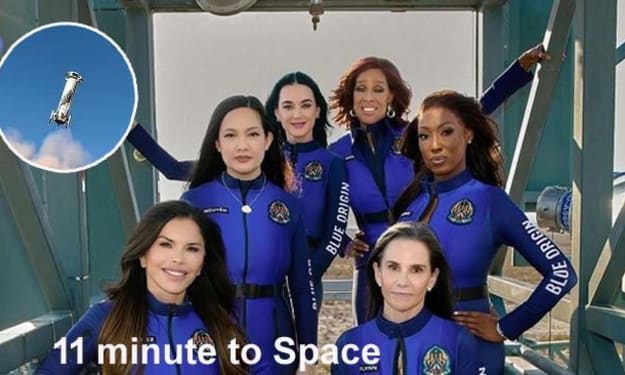
Why Katy Perry Got So Emotional After 11 Minutes to Space Adventure?
Not Everyone get chance to travel space, Those who go went to space, they show mixed and overwhelming emotions, Pop Star Katy Perry to Space along with 5 other female celebrities, When she returned she was soo emotional.
By Nav k Aidanabout a year ago in Futurism