travel
The best science fiction locations to visit around the United States and the globe.
Can human Ever Leave the milky way Galaxy The wormholes Explained By Shah saab
Can Humans Ever Leave the Milky Way? Wormholes Explained Humanity has always gazed at the stars with curiosity, dreaming of traveling across the universe. As our understanding of space has grown, so has our ambition. But while we’ve sent probes to the edges of our solar system, the idea of leaving our galaxy—the Milky Way—raises profound scientific, technological, and philosophical questions. Can humans ever truly leave the Milky Way? Could wormholes be the key to this escape? --- The Vastness of the Milky Way The Milky Way galaxy is a sprawling disk of stars, gas, and dark matter, approximately 100,000–200,000 light-years across. Our solar system orbits about 25,000 light-years from the galactic center. To escape the galaxy, humans would have to travel not just between stars, but across a gravitationally bound system of over 100 billion stars. To put that in perspective: the fastest spacecraft ever built, NASA’s Parker Solar Probe, travels at about 700,000 km/h. At that speed, it would take more than 2 billion years to reach the edge of the Milky Way. Clearly, with current propulsion technology, intergalactic travel is far beyond our reach. --- Galactic Escape Velocity Just as a spacecraft must reach escape velocity to break free from Earth’s gravity, it must do the same to leave the Milky Way. The galactic escape velocity near our solar system is estimated at roughly 525 km/s—more than 1,800,000 km/h. No human-made object has come close to this speed. Voyager 1, launched in 1977, is traveling at about 17 km/s and will never escape the galaxy. The enormous speeds required mean we need radical breakthroughs in propulsion—technologies that don’t yet exist or are purely theoretical. --- The Concept of Wormholes One of the most intriguing ideas in theoretical physics is the wormhole, a speculative tunnel through space-time that could connect distant points in the universe instantly. First proposed in 1935 by Albert Einstein and Nathan Rosen (thus also called Einstein-Rosen bridges), wormholes arise naturally from the equations of general relativity. If wormholes exist—and if they can be stabilized—they might allow instantaneous travel between galaxies or even across the universe. This would solve the problem of immense travel times and distances. However, there’s a catch: stabilizing a wormhole likely requires “exotic matter” with negative energy density, a substance we have never observed in nature. Some theories, such as those involving quantum entanglement and spacetime foam, suggest that wormholes could exist on quantum scales. But even if they do, scaling them up to a size usable by humans—or keeping them open long enough for travel—remains a massive scientific and engineering challenge. --- Scientific Research into Wormholes Physicists have explored several potential ways wormholes might exist or be detected. Some theories suggest that a wormhole might produce gravitational lensing—warping light from background stars in a unique way. Others suggest tiny wormholes could be remnants of the early universe, though we’ve never observed one directly. Recent work in quantum gravity and string theory suggests possible links between entangled particles and microscopic wormholes, but these connections are still speculative. In 2022, researchers at Caltech claimed to simulate a wormhole using quantum processors, although this was more of a mathematical analogy than an actual wormhole. Still, it shows growing interest in bringing this science-fiction idea closer to science fact. --- Alternative Propulsion Ideas Aside from wormholes, several advanced propulsion concepts have been proposed to one day enable galactic or intergalactic travel: Alcubierre Drive: A theoretical warp drive that contracts space in front of a spacecraft and expands it behind. It doesn’t move the ship faster than light locally, but space itself could move faster than light. Like wormholes, it requires exotic matter. Antimatter Engines: Antimatter reactions release enormous energy, much more efficient than chemical rockets. But creating and storing antimatter safely is a challenge. Laser Sailcraft: Tiny spacecraft pushed by high-powered lasers could potentially reach nearby stars in decades. Projects like Breakthrough Starshot aim to use this concept. Even the most optimistic timelines place these technologies far in the future. Human travel beyond the Milky Way would likely require generations of development—or entirely new physics. --- Could Nature Do It for Us? In rare events, stars can be ejected from galaxies at incredible speeds. These "hypervelocity stars" are flung out by interactions with supermassive black holes or galactic collisions. In theory, a spacecraft hitching a ride with such momentum could escape the galaxy, but directing and surviving such a journey is beyond our current capability. --- Conclusion Leaving the Milky Way is an awe-inspiring but extremely distant goal. The vast scale of space, the limitations of our current technology, and the speculative nature of wormholes and exotic physics mean that, for now, humanity is firmly rooted in our galaxy. However, as with so many once-impossible dreams—flight, the Moon landing, exploring Mars—our imagination often precedes our capabilities. Whether through wormholes, warp drives, or unknown breakthroughs, the dream of intergalactic travel continues to inspire science and science fiction alike.
By Shah saab IT2 years ago in Futurism
EgyptAir: A Journey Through Time With Africa’s Pioneering Airline. AI-Generated.
EgyptAir, the national flag carrier of Egypt, is more than just an airline—it’s a symbol of resilience, innovation, and national pride. Founded in 1932, EgyptAir is the first airline in the Middle East and Africa and the seventh globally. With over nine decades of aviation experience, the airline has earned its place as one of the most respected carriers in the region, connecting Egypt to the world and embracing a legacy deeply rooted in history.
By sayedfadel2 years ago in Futurism
The Rise of AI and the Fall of Traditional Photography
A Legacy of Light, Shadow, and Skill Photography has always been a profession based on precision, patience, and acquired knowledge. Photographers learned their craft through years of experience, understanding the interplay of light and shadow, the art of composition, and the subtle power of emotion captured in a still image. Mastering manual focus, choosing the right aperture, or manipulating natural light weren't just technical decisions; they were the artist's artistic touches.
By Sayed Zewayed2 years ago in Futurism
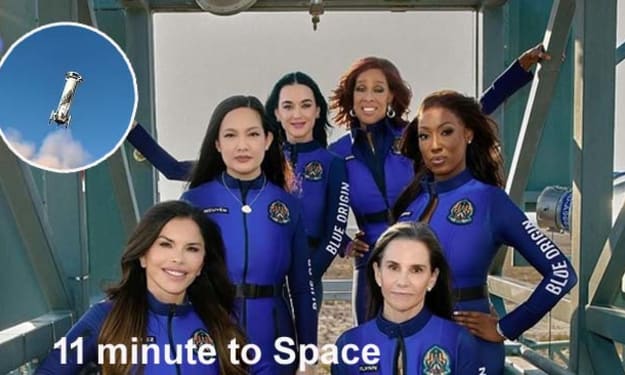
Why Katy Perry Got So Emotional After 11 Minutes to Space Adventure?
Not Everyone get chance to travel space, Those who go went to space, they show mixed and overwhelming emotions, Pop Star Katy Perry to Space along with 5 other female celebrities, When she returned she was soo emotional.
By Nav k Aidan2 years ago in Futurism
How an asteroid might have brought the essential components for life on Earth "blew us away"
Billions of years ago, a wet, salty world circled our sun. It then collided with a catastrophic conflict, with another object, falling apart. One of these lumps has now become Astide Benne. The mineral recently returned to Earth from the US robotic probe Osiris Rex and now contains a wide range of complex chemicals that are extremely important for the existence of life.
By Francis Dami2 years ago in Futurism
Slate Auto's Transformer EV Truck Breaks Cover as Tesla Battles Financial and Innovation Challenges
The electric vehicle (EV) world is buzzing with innovation and disruption, and the past week has been no exception. Two major stories are dominating EV industry news: the impressive debut of Slate Auto’s "Transformer" electric truck and Tesla’s complex battle between groundbreaking advancements and mounting financial challenges. Let’s dive into the details shaping the future of electric vehicles in 2025. Slate Auto Unveils the Transformer EV Truck: A Bold New Vision for Electric Trucks in 2025 In Long Beach, California, a new player on the EV stage has officially made its debut. Slate Auto, a startup backed by none other than Jeff Bezos, introduced its highly anticipated electric truck to the world. Dubbed internally as the "Transformer," this EV is designed to disrupt the current market dominated by futuristic minimalism. Unlike Tesla’s Cybertruck, which boasts a stark, futuristic aesthetic, Slate Auto’s Transformer EV Truck takes a rugged, analog-inspired approach. The Transformer is purpose-built for users who want the benefits of electric mobility without sacrificing the tactile, mechanical feel traditional truck lovers crave. Analog buttons, durable materials, and a robust design philosophy set it apart from competitors that emphasize sleek, touch-screen-heavy interfaces. This strategy taps into an underserved market—drivers who appreciate a more familiar, hands-on driving experience but still want to embrace the future of EVs. The Transformer doesn’t just look tough; it is engineered for real-world utility, making it one of the most exciting electric trucks of 2025. Federal Crash Reporting Changes Could Impact Autonomous Vehicle Transparency Meanwhile, significant regulatory shifts are happening on the federal level that could influence how we view EV safety and autonomous technology. The U.S. Department of Transportation has introduced a new Automated Vehicle Framework that revises the crash reporting requirements for vehicles equipped with Level 2 advanced driver-assistance systems (ADAS). Previously, any crash involving a Level 2 system had to be reported within 24 hours. Now, companies are granted a five-day window to report incidents. Additionally, the scope of mandatory reporting has been dramatically narrowed. Accidents that don’t involve fatalities, injuries requiring hospitalization, airbag deployments, or collisions with vulnerable road users (like pedestrians and cyclists) no longer require a federal report. While automakers might welcome the reduced administrative burden, safety advocates are raising red flags. Organizations like Consumer Reports argue that this change could lead to a lack of transparency, making it harder to track the true safety record of autonomous and semi-autonomous vehicles. Comprehensive data is crucial for public trust and regulatory oversight, and these new rules could hinder both. Tesla’s Dueling Realities: Innovation Meets Financial Struggles At the same time, Tesla continues to be a paradox of groundbreaking ambition and financial instability. One of the most exciting developments in Tesla’s 2025 roadmap is its plan to roll out a robotaxi fleet. Starting with 10 to 20 vehicles in Austin, Tesla intends to rapidly scale its self-driving service. This move places Tesla at the forefront of autonomous vehicle innovation, turning years of promises about robotaxis into a tangible reality. However, Tesla’s financial health paints a more complicated picture. The EV giant reported a staggering 71% year-over-year drop in profits for the first quarter of 2025, landing at $409 million. This sharp decline was driven by weaker vehicle sales and significant price cuts implemented to stay competitive amid rising market pressure. Perhaps even more concerning is the role of regulatory credits in Tesla’s earnings. The company brought in $595 million from selling these credits—meaning without them, Tesla would have actually posted a loss. This dependency signals vulnerabilities in Tesla’s business model that could become more pronounced if regulatory credit markets tighten. As Tesla grapples with shrinking margins and increased competition, its future hinges on successfully scaling new technologies like the Tesla Robotaxi, while also restoring confidence in its core vehicle sales. The Bigger Picture: EV Industry at a Crossroads Taken together, these developments paint a vivid picture of where the EV industry stands today. New players like Slate Auto are innovating rapidly, offering alternatives that blend traditional driving experiences with cutting-edge electric technology. Meanwhile, legacy disruptors like Tesla are being forced to adapt quickly to financial and competitive pressures. Federal regulatory changes could also reshape how consumers perceive the safety and reliability of EVs, especially as autonomous technology becomes more prevalent. Whether these shifts bolster innovation or create new risks remains to be seen. For consumers and investors alike, 2025 promises to be a transformative year for electric vehicles. Brands that can balance bold new ideas with financial sustainability and regulatory transparency will define the next chapter of this dynamic industry. Stay tuned for more EV industry news and updates as the electric revolution continues to accelerate!
By NextGen Mobile Tech2 years ago in Futurism