travel
The best science fiction locations to visit around the United States and the globe.
Love in Retrograde: Do Astrological Transits Really Affect Your Relationships?
Introduction Astrology has fascinated humanity for millennia, its symbols and planetary movements woven into the cultural and spiritual fabric of societies across the globe. Among these cosmic phenomena, astrological transits—and retrograde motions in particular—are often viewed as powerful influences on our lives. "Love in Retrograde" invites us to explore whether these celestial shifts might have a tangible impact on our relationships and romantic destinies. Can the observed movements of planets truly cast their influence over human emotions, or is it our own interpretation of these cosmic patterns that shapes our romantic narratives?
By Mysteries with Professor Jahani2 years ago in Futurism
Blockchain and Beyond: The Rise of Decentralized Online Income
Blockchain technology has rapidly evolved from being the backbone of cryptocurrencies to a transformative force disrupting traditional financial systems and digital marketplaces. As decentralized networks gain traction, new pathways for generating income online are emerging. This article explores the revolutionary impact of blockchain on online earnings by diving deep into decentralized finance (DeFi), the innovative role of non-fungible tokens (NFTs) as revenue streams, and the rise of crypto-based marketplaces.
By Mysteries with Professor Jahani2 years ago in Futurism
The Untold Story of Afghanistan’s Forgotten Inventors and Innovators
When the world thinks of Afghanistan, it’s usually through the lens of war, politics, or humanitarian crises. Lost in the noise are the quieter, forgotten voices of the past—brilliant minds who once pushed the boundaries of innovation, science, and creativity in ways that shaped not only Afghanistan but, at times, the broader region.
By Mysteries with Professor Jahani2 years ago in Futurism
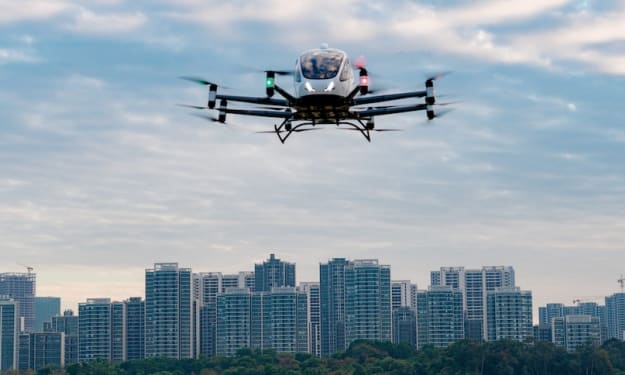
China Launches World's First Autonomous Flying Taxi Reaches 81 MPH in Urban Skies.
China Launches World's First Autonomous Flying Taxi Reaches 81 MPH in Urban Skies. In a groundbreaking leap toward the future of transportation China is preparing to launch the world’s first fleet of autonomous flying taxis capable of reaching speeds up to 81 miles per hour. These electric vertical take off and landing (eVTOL) vehicles are set to redefine urban mobility, significantly cutting travel times and offering a futuristic alternative to ground transport.
By Adnan Rasheed2 years ago in Futurism
How Jeff Bezos’ Amazon Is Secretly Building a Satellite Network to Beat Elon Musk’s Starlink
How Jeff Bezos’ Amazon Is Secretly Building a Satellite Network to Beat Elon Musk’s Starlink In the ever intensifying space race between billionaires Amazon founder Jeff Bezos has quietly taken a major step forward in challenging Elon Musk’s dominance in space through SpaceX. While Musk has long enjoyed the spotlight with groundbreaking missions and Starlink’s growing internet dominance, Bezos' space company Blue Origin and Amazon have now launched a stealthy but serious plan to rival Musk’s achievements and perhaps even dethrone him. At the heart of this ambitious effort lies Amazon’s Project Kuiper, a massive satellite internet constellation initiative aiming to deliver high speed internet globally. Much like Elon Musk’s Starlink Kuiper seeks to provide reliable internet access to underserved and remote areas by deploying thousands of satellites into low Earth orbit (LEO). The implications of this move go far beyond internet services it’s a direct shot at Musk’s most commercially successful space venture.
By Adnan Rasheed2 years ago in Futurism
Time Travel: The Mystery of Andrew Carlssin and the Science Behind It. AI-Generated.
### Travel to the Future and Past: The Story of Andrew Carlssin and Scientific Reality #### The Fascinating Story of Andrew Carlssin In 2003, newspapers shared an astonishing story about Andrew Carlssin, a 44-year-old man who turned $800 into $350 million in just two weeks. His incredible success in the stock market caught the attention of the FBI, who suspected him of insider trading. When questioned, Carlssin claimed he was a time traveler from 250 years in the future. He said he knew which stocks would perform well because of his knowledge from the future, leading to his extraordinary results. The FBI dug deeper and found no record of Carlssin before December 2002, which was surprising. Even more shocking, on April 3, 2003, he was supposed to appear in court for his bail hearing but vanished, never to be seen again. At first, this story sounds thrilling, but research revealed it was a fictional tale published by *Weekly World News*, a tabloid known for its wild, made-up stories. Still, it makes us wonder: could someone really travel through time? #### The Scientific Basis of Time Travel Scientists have taken time travel seriously, especially because of Albert Einstein’s theories. His theory of special relativity says that if you travel very fast—close to the speed of light—time slows down for you. For example, astronaut Scott Kelly aged slightly less than his twin brother on Earth after spending a year in space (*Space.com*). This is called "time dilation." Einstein’s general relativity theory adds that gravity can also affect time; near a black hole, time moves slower. Traveling to the future is simple—we’re all doing it right now, one second at a time. But going to the past is trickier. Scientists talk about wormholes (tunnels in space-time) or black holes as possible ways, but these are just ideas, not reality yet. No one has built a time machine so far. #### H.G. Wells and the Start of Time Travel The idea of time travel began with fiction, especially in 1895 when H.G. Wells wrote his famous novel *The Time Machine*. He imagined a machine that could take you to the past or future, making the term "time machine" popular. Though it was a science fiction story, it inspired philosophers, physicists, and filmmakers. After that, many movies and research papers explored the idea, like *Back to the Future* and *12 Monkeys*. #### Types of Time Travel: Lessons from Sci-Fi Movies Science fiction films have shown time travel in different ways, and we can split them into three types: - **Immutable Timelines:** You can’t change the past; everything is fixed. In *12 Monkeys*, Bruce Willis tries to stop a virus, but it’s already set in stone. - **Mutable Timelines:** You can change the past, and it alters the future. In *Back to the Future*, Marty McFly fixes his parents’ meeting, changing his family’s future. - **Alternate Histories:** Every choice creates a new universe. In *Everything Everywhere All at Once*, Evelyn jumps between different versions of her life. These movies help us understand time travel in a fun way and make us wonder if we’ll ever do it for real. --- ### Detailed Look: The Reality and Fiction of Time Travel #### Background of Andrew Carlssin’s Story In 2003, a jaw-dropping story hit the news: Andrew Carlssin, a 44-year-old man, turned $800 into $350 million in two weeks—an unheard-of feat in stock market history. The FBI arrested him, suspecting insider trading. When asked, he claimed he was a time traveler from 250 years in the future, using his knowledge to pick winning stocks. The FBI found no trace of him before December 2002, which was odd. Stranger still, he disappeared before his court date on April 3, 2003, and was never found. It sounds like a movie plot, but it turned out to be fake—a story cooked up by *Weekly World News*, a tabloid famous for crazy tales (*Snopes.com*). Even so, it sparks curiosity about time travel, a topic loved by both science and fiction fans. #### Scientific Theories Behind Time Travel Time travel isn’t just a wild dream—science has some answers, thanks to Albert Einstein. His special relativity theory says that moving near light speed slows time for you. Astronaut Scott Kelly, for instance, came back from space a tiny bit younger than his twin because time moved slower for him (*Space.com*). General relativity says gravity bends time too; near a black hole, time crawls. Going forward in time is doable, but backward? That’s tough. Scientists suggest wormholes—tunnels through space-time—or black holes might work, but it’s all theoretical. There’s also the "grandfather paradox": if you went back and stopped your grandpa from meeting your grandma, would you still exist? It’s a puzzle science hasn’t solved yet. #### H.G. Wells and Time Travel’s Cultural Rise The time travel craze kicked off with H.G. Wells’ 1895 novel *The Time Machine*. He dreamed up a device to zip through time, and it stuck in people’s minds. It was fiction, but it lit a spark. Soon, philosophers and scientists wrote papers, and movies like *Back to the Future* (1985), *12 Monkeys* (1995), and *Everything Everywhere All at Once* (2022) brought it to life. These ideas make time travel exciting. In *12 Monkeys*, the past is unchangeable. In *Back to the Future*, Marty’s tweaks make his dad a success. And in *Everything Everywhere*, every choice spins a new reality—like being a movie star in one life and a shopkeeper in another. #### Conclusion: Real or Just a Story? Andrew Carlssin’s tale was fake but fun, pushing us to think about time travel. Science says moving to the future is possible with speed or gravity, but the past is still a mystery. Maybe one day we’ll build a time machine, or maybe it’ll stay in books and films like H.G. Wells imagined. If you had a time machine, would you fix a mistake in the past or peek at the future? It’s a question that keeps us dreaming. ---
By Muhammad Waseem khan2 years ago in Futurism
Scientists Find Evidence That Our Entire Universe Might Be Inside a Black Hole
Are We Living Inside a Black Hole? Scientists Find Evidence That Could Change Everything For centuries, humanity has sought to understand the true nature of our universe. From the ancient philosophers who gazed at the night sky to the modern physicists unlocking the secrets of quantum mechanics, we have continuously pushed the boundaries of our knowledge. But what if everything we thought we knew about the universe was wrong? What if our entire cosmos—galaxies, stars, planets, and even time itself—is actually inside a black hole?
By JONATAN DAVID VEGA2 years ago in Futurism
Shipping Containers Cost: Save Money With These 5 Tips!
Shipping containers are now vital for innovative projects, construction, and storage in addition to international trade and business. Whether your use of a shipping container is for storage, transit, or a creative building project, knowing shipping containers costs will enable you to make wise decisions and save money. From cost-cutting advice to knowledge of aspects influencing their price, this blog will provide you with all you require when navigating the container market.
By Satgurucargo2 years ago in Futurism