star wars
Star Wars is a science fiction franchise set in a universe far far away.
Astronomers Discover a Massive Glowing Hydrogen Cloud Only 300 Light-Years from Earth
In a groundbreaking astronomical discovery, scientists have uncovered a massive, glowing cloud of molecular hydrogen astonishingly close to our solar system. Known as the Eos Cloud, this extraordinary structure challenges long-held assumptions about the interstellar medium near Earth and could revolutionize our understanding of star formation. This discovery, led by astrophysicists from Rutgers University, marks the first time a molecular cloud has been identified not by dust or radio emissions, but by its ultraviolet glow—a method never before used in this context. The implications of this are immense, offering scientists a new tool for mapping the cosmos and shedding light—literally—on regions previously hidden from view. What Is the Eos Cloud? The Eos Cloud is a vast crescent-shaped formation made primarily of molecular hydrogen, the most basic building block of the universe and the essential raw material for star formation. Located a mere 300 light-years from Earth, this cloud is now considered one of the closest molecular clouds to our solar system. Given its proximity and size, it is remarkable that it went undetected for so long. Stretching across a region of the sky equivalent to the size of 40 full moon, the Eos Cloud contains approximately 3,400 times the mass of the Sun in hydrogen gas. Its scale and mass make it a significant player in the local galactic environment. It exists on the periphery of the Local Bubble, a hot, low-density cavity in the interstellar medium that encompasses our solar system and several nearby star systems. The Groundbreaking Discovery Method The team, led by Rutgers astrophysicist Blakesley Burkhart, used data from NASA’s Galaxy Evolution Explorer (GALEX), a space-based observatory that specializes in detecting ultraviolet light. Far-ultraviolet radiation excites molecular hydrogen, causing it to emit a faint glow that can only be observed from space, since Earth's atmosphere blocks ultraviolet radiation. This emission is not visible to the naked eye, but when detected with the right instruments, it creates a luminous outline of the molecular hydrogen cloud. It was this glow in the dark that first revealed the presence of Eos. Traditionally, molecular clouds have been detected using infrared or radio waves, focusing on dust and cold gas. Eos’ detection through its ultraviolet fluorescence marks a significant shift in how we detect these elusive structures in space. The innovative approach not only unveils Eos but also holds the promise of finding other molecular clouds that were previously hidden from astronomers. Why Eos Matters for Star Formation Molecular clouds like Eos are critical to the life cycle of stars. They serve as stellar nurseries, where hydrogen gas condenses and compresses under gravity to form protostars—young stars still in their formative stages. These protostars can eventually evolve into fully-fledged stars, much like our Sun. Eos presents a unique opportunity to study star formation from a perspective closer to our solar system. Studying such a molecular cloud could provide vital insights into the conditions necessary for star birth and the subsequent development of planetary systems. The study of these clouds also informs our understanding of how galaxies evolve. By analyzing the chemical composition and structural dynamics of Eos, astronomers can piece together the broader processes that govern star formation across the universe. The Local Bubble and Its Impact on Eos To understand the significance of Eos, it’s important to consider the environment surrounding it. The Local Bubble is a cavity in the interstellar medium—a vast expanse of low-density, hot gas that stretches about 1,000 light-years across. Thought to have been formed by ancient supernova explosions, the Local Bubble’s high temperature and low density make it an inhospitable environment for star formation. In contrast, the Eos Cloud is positioned at the very edge of this bubble, where the conditions are somewhat more conducive to star formation. The cloud is a contrastive entity in a vast region of space that would otherwise not foster new stars. Its location at the edge of the Local Bubble suggests a dynamic interaction between these two galactic structures, which could offer crucial clues to how stars evolve in different environments. Future Observations and the Search for More Hidden Clouds The discovery of the Eos Cloud has already sparked plans for follow-up studies. With its relative proximity, Eos can be studied in greater detail using telescopes like the Hubble Space Telescope and the James Webb Space Telescope, which are capable of probing deeper into its structure and composition. Scientists hope to learn more about: The internal structure and density of the Eos Cloud. Whether stars are actively forming within it. How its position near the Local Bubble affects its stability and evolution. If Eos is found to contain protostars or young stellar objects, it would further cement its status as an active star-forming region—an exciting prospect for astronomers studying how stars and planetary systems like our own come to be. The Bigger Picture: Implications for Astronomy The discovery of the Eos Cloud is a stunning reminder that the universe still holds surprises, even in regions we thought we understood well. This vast, glowing hydrogen cloud—hidden just a few hundred light-years away—has suddenly brought the drama of cosmic star birth to our galactic doorstep. More importantly, the breakthrough detection method used to find Eos could dramatically expand our ability to map and understand the hidden architecture of our galaxy. With new tools in hand and a renewed sense of cosmic curiosity, scientists are poised to uncover even more secrets from the darkness of space. As new discoveries continue to unfold, Eos stands as a luminous beacon—not just of hydrogen, but of the endless wonder of exploration. Eos Cloud discovery
By Tech Horizons2 years ago in Futurism
SpaceX Rocket Debris Crashes in Europe Top Polish Space Officials Fired
SpaceX Rocket Debris Crashes in Europe Top Polish Space Officials Fired In a dramatic turn of events debris from a SpaceX Falcon 9 rocket re-entered Earth's atmosphere and crashed in western Poland in February 2025 leading to the dismissal of several top officials at the Polish Space Agency (POLSA). The incident has raised serious questions about space debris management and highlighted communication failures within Poland’s governmental system. On February 1, 2025 SpaceX launched its Falcon 9 rocket from Vandenberg Space Force Base in California as part of the Starlink 11-4 mission tasked with deploying 22 internet satellites into low Earth orbit. Normally the upper stage of the rocket would perform a controlled deorbit and burn up over the ocean. However a propellant leak prevented the maneuver causing the stage to make an uncontrolled re-entry into the Earth's atmosphere. On February 19 residents across western Poland were startled by spectacular fireballs lighting up the sky. Many reported hearing sonic booms while others captured footage of the bright streaks overhead. Shortly afterward authorities confirmed that pieces of the Falcon 9 rocket had survived re-entry and landed on Polish territory. Several significant fragments were found: one on the grounds of an electrical warehouse in Komorniki, another in the forests near Wiry and a few more scattered across rural areas near Poznań. Fortunately no injuries were reported but the discovery of rocket parts so close to populated areas immediately triggered investigations.
By Adnan Rasheed2 years ago in Futurism
From Silent Machines to Emotional Beings: The Evolution of Robots and the Pursuit of Feelings.
Introduction Throughout history, humans have dreamt of creating mechanical beings that could mirror not just their actions, but also their emotions. The journey from simple automata to sophisticated robots capable of emotional interaction is a saga spanning centuries, filled with ambitious experiments, groundbreaking theories, and tantalizing glimpses into the future of technology and consciousness.The Dawn of Robotic Dreams
By Sayed Zewayed2 years ago in Futurism
When Dreams Become Cities: The Dawn of Neural Urbanization
When we think of cities, we imagine towering skyscrapers, bustling streets, and the constant hum of life flowing like a river. Cities have always been built by our hands — brick by brick, steel beam by steel beam. But what if, in the not-so-distant future, cities could be dreamed into existence?
By Nuhan Habib2 years ago in Futurism
US Army Students’ Hypersonic Rocket Smashes Altitude Record with 93 Mile Flight
US Army Students’ Hypersonic Rocket Smashes Altitude Record with 93 Mile Flight In a historic achievement that combines education innovation and cutting edge technology a group of U.S. Army students from West Point has set a new world record in amateur rocketry. The cadet led team successfully launched a hypersonic rocket to an altitude of 93 miles approximately 149.5 kilometers surpassing the previous amateur record and crossing the Kármán line the internationally recognized boundary of space. The rocket designed and built by the West Point Hypersonic Research Team known as SPEAR Space Engineering and Applied Research was launched on January 11, 2025 at Black Rock Desert in Nevada. The site famous for its open terrain and use in high altitude experimental launches provided the ideal location for this monumental flight.
By Adnan Rasheed2 years ago in Futurism
Musk says Tesla's Optimus humanoid robots affected by China's export curbs on rare earths
Musk says Tesla's Optimus humanoid robots affected by China's export curbs on rare earths Tesla’s Ambitious Robot Project Faces Setbacks as China’s Rare Earth Export Curbs Disrupt Supply Chains
By Adnan Rasheed2 years ago in Futurism
SpaceX Bandwagon-3 Mission Successfully Launches from Florida. AI-Generated.
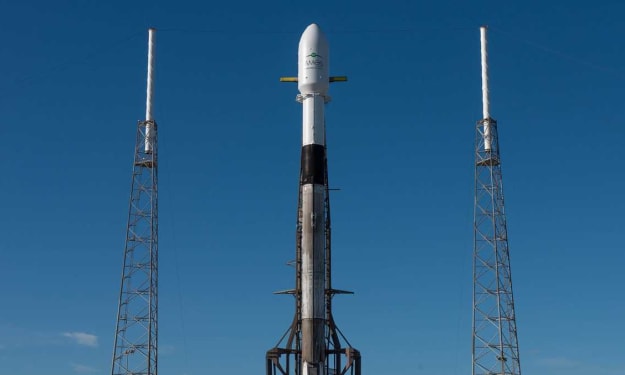
SpaceX Bandwagon-3 Mission Successfully Launches from Florida "SpaceX's latest rideshare mission marks a major milestone with international payloads reusable rocket success and a bold leap forward in space accessibility."
By Adnan Rasheed2 years ago in Futurism
China Begins Mass Production of Humanoid Robots AgiBot and Unitree Lead the Future of AI Robotic
China Begins Mass Production of Humanoid Robots AgiBot and Unitree Lead the Future of AI Robotic From futuristic concepts to factory floors Chinese tech giants AgiBot and Unitree are transforming humanoid robots into real world AI-powered workers through large scale production.
By Adnan Rasheed2 years ago in Futurism