space
Space: The Final Frontier. Exploring space developments and theorizing about how humans fit into the universe.
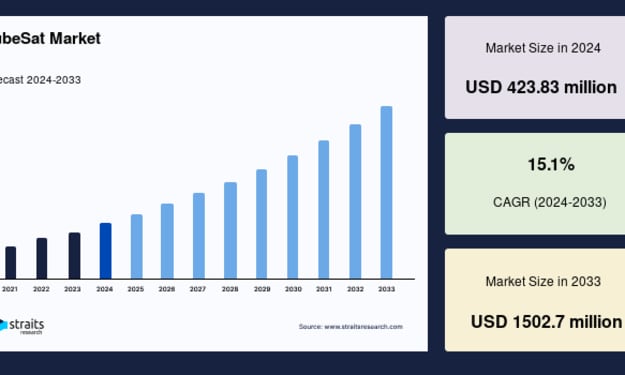
CubeSat Market Size to Reach USD 1.5 Billion by 2033 | Forecast 2025–2033
Introduction Miniature satellites known as CubeSats are much simpler to create, develop, and launch than traditional satellites. By combining different units, CubeSats can be created as single units (1U), double units (2U), or four units (4U), among other configurations. For more than a decade, CubeSats have simplified launching satellites into orbit. Researchers and business people from all over the world use CubeSats extensively in space exploration. Due to their small size and lightweight, CubeSats are an excellent and reasonably priced entity for exploring new technologies and concepts. They are also well suited for quick manufacturing and testing. Additionally, CubeSats can be produced relatively quickly due to these qualities.
By Industrial News Hubabout a year ago in Futurism
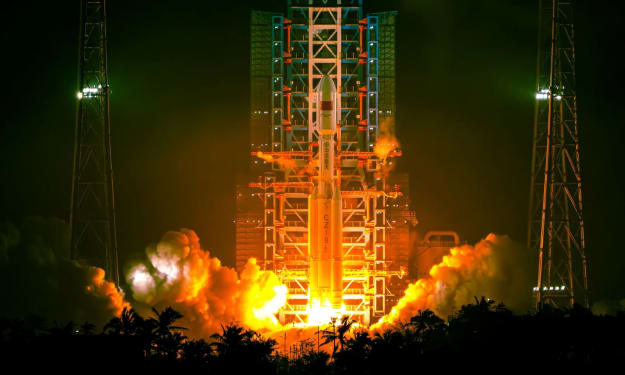
China’s Effort to Build a Competitor to Starlink Is Off to a Bumpy Start
China’s Effort to Build a Competitor to Starlink Is Off to a Bumpy Start In a world increasingly driven by data connectivity, and satellite technology China’s ambitious attempt to rival Elon Musk’s Starlink satellite internet network is both a strategic necessity and a national prestige project. However as with many grand visions the road to execution has proven to be far from smooth. China’s twin satellite internet initiatives Guowang (also called SatNet or Xingwang) and Qianfan (also known as Spacesail) are part of a state driven effort to create a low Earth orbit LEO satellite constellation that could provide global broadband coverage enhance military communication and establish China as a major space power. While these projects symbolize China’s desire to assert technological independence and global influence their rollout so far has been marred by technical logistical and regulatory challenges.
By Adnan Rasheedabout a year ago in Futurism
The Galactic Federation Is Closing In: Awakening From the Matrix and the Call to Heal Ourselves and the Planet
They Are Watching. And Waiting. There is a rising hum beneath the surface of the world. You can feel it in the air, in the earth, in the strange coincidences that seem too perfect to be accidents. People are waking up in the middle of the night, feeling watched yet comforted. There is a growing whisper among mystics, ex-military personnel, visionaries, and everyday people alike: We are not alone. We have never been alone.
By The Secret History Of The Worldabout a year ago in Futurism
NASA’s Perseverance Rover Captures First Visible-Light Auroras on Mars: A New Frontier in Martian Exploration.
Mars has long fascinated scientists and space enthusiasts alike, with its rusty red landscape and the possibility that life once existed on the planet. Now, NASA’s Perseverance rover has added an incredible new chapter to Mars exploration by capturing the first-ever visible-light auroras on the Red Planet. This remarkable discovery, made on March 18, 2024, after a powerful solar storm, sheds light on the dynamic interactions between Mars’ atmosphere and the Sun’s activity. It opens exciting new opportunities for understanding the Martian environment and preparing for future human missions. What Are Auroras and Why Are They Important? Auroras are natural light displays typically seen near the poles of Earth, often called the Northern or Southern Lights. These dazzling lights occur when charged particles emitted by the Sun collide with a planet’s atmosphere and magnetic field, causing the atmosphere to glow. On Earth, auroras are guided by our planet’s global magnetic field toward the polar regions, creating spectacular and structured light shows. However, Mars is very different. The Red Planet lacks a global magnetic field, having lost it billions of years ago. Instead, it has patches of localized magnetic fields scattered across its crust. As a result, auroras on Mars tend to be more chaotic, diffuse, and widespread. Previously, scientists had only detected Martian auroras in ultraviolet light from orbiting spacecraft, which are invisible to the human eye. The recent observations from Perseverance are the first to reveal auroras in visible light directly from the surface, a historic milestone. The Solar Storm That Made It Possible On March 18, 2024, the Sun unleashed a massive solar storm, sending a coronal mass ejection (CME) — a powerful burst of charged particles — hurtling through space. When this CME reached Mars, the charged particles interacted with its thin atmosphere, igniting a faint green glow in the sky. Perseverance’s cameras were perfectly positioned to capture this rare event. Solar storms like CMEs are common, but their effects on Mars differ from Earth due to its thin atmosphere and lack of a strong magnetic field. This interaction can lead to atmospheric loss and impacts on the planet’s climate and habitability. Studying these events helps scientists better understand how solar activity influences Mars and how it may affect future explorers. Perseverance’s Cutting-Edge Instruments The Perseverance rover, which landed on Mars in February 2021, is equipped with advanced instruments designed for geology, atmospheric studies, and even searching for signs of past life. Among these instruments, Mastcam-Z and SuperCam played a critical role in capturing the visible-light aurora. Mastcam-Z is a sophisticated camera system capable of high-resolution, color imaging and zooming capabilities, while SuperCam can analyze the composition of rocks and the atmosphere using laser and spectrometry techniques. During the solar storm, scientists directed these instruments to look toward the Martian sky, hoping to detect any auroral activity. After several attempts, Perseverance successfully photographed the faint green aurora, confirming predictions made by NASA’s space weather models. Why This Discovery Matters for Future Mars Missions Visible-light auroras on Mars are not just a fascinating spectacle — they have practical implications for upcoming human missions to the planet. Understanding how solar particles interact with Mars’ atmosphere helps scientists assess radiation risks that astronauts may face on the surface. Solar storms can expose explorers and equipment to harmful radiation, making accurate forecasting essential for mission safety. Moreover, these auroras offer a unique window into the planet’s atmospheric composition and dynamics. Monitoring auroral activity could help researchers track changes in Mars’ atmosphere over time and study how solar events influence atmospheric loss. This knowledge is crucial for developing strategies to protect future habitats, electronics, and astronauts on Mars. What Experts Are Saying Dr. John Clarke, a leading space physicist involved in the study, explains, “This is a landmark moment in Mars exploration. Seeing visible auroras from the surface confirms that the Martian atmosphere is more dynamic than we imagined. It also means astronauts will be able to witness these stunning light displays in person during intense solar events.” NASA’s Mars exploration team views this discovery as a stepping stone toward understanding Mars as a complex, evolving world. Each new insight into the planet’s atmosphere brings humanity closer to the goal of establishing a sustainable presence there. The Bigger Picture: Mars, Solar Activity, and Space Weather Mars serves as a natural laboratory for studying space weather — the varying conditions in space caused by the Sun’s activity. Since Mars lacks Earth’s protective magnetic shield, it offers scientists a unique perspective on how solar storms impact planetary atmospheres and surfaces. These insights not only benefit Mars missions but also improve our understanding of how solar activity affects other planets, including Earth. By studying Mars’ auroras and atmospheric responses, scientists gain valuable data for predicting and mitigating space weather hazards in the broader solar system. Conclusion: A Bright Future for Mars Exploration NASA’s Perseverance rover’s capture of the first visible-light auroras on Mars marks a monumental achievement in planetary science. This discovery illuminates the complex interactions between the Sun and Mars, providing essential knowledge for future exploration and colonization efforts. As we prepare to send humans to Mars, understanding phenomena like auroras will help ensure the safety and success of those missions. Beyond the scientific implications, the thought of astronauts witnessing glowing lights dancing across the Martian sky adds a poetic touch to humanity’s quest for discovery. With each new finding, Mars becomes less a distant world and more a place we can someday call home.
By Tech Horizonsabout a year ago in Futurism
🧠Quantum Breakthrough at Room Temperature: The Dawn of Practical Quantum Networks
In a discovery that may very well become one of the defining scientific achievements of the decade, researchers from the University of Tokyo and the Delft University of Technology in the Netherlands have successfully demonstrated quantum entanglement at room temperature using diamond-based qubits. This astonishing feat removes one of the largest barriers to real-world quantum computing and communication: the need for prohibitively cold environments. While the phrase "quantum entanglement" might conjure up images of science fiction or highly abstract theory, this new development has immediate and far-reaching consequences. It could mark the beginning of a new era in secure communication, global information transfer, and the development of powerful quantum computers that operate in everyday conditions.
By History Seekerabout a year ago in Futurism
Why Satellites Don't Crash Despite Earth's Strong Gravity
Satellites are one of the greatest wonders of modern science, and they have revolutionized our lives. They constantly revolve around the Earth in a specific orbit—one we cannot see with the naked eye—helping us navigate, forecast the weather, connect with others, and even explore the universe. But have you ever wondered: why do satellites stay up there? If you think gravity doesn’t work in space, you're holding onto a common misconception. In reality, gravity extends far beyond our atmosphere. It’s the very reason satellites remain in orbit instead of drifting away or crashing back down to Earth. So, how exactly does this invisible force keep satellites circling the planet? The answer lies in a delicate balance between gravity and speed.
By ABID HASANabout a year ago in Futurism
That’s a Hat Trick! Varda Successfully Returns 3rd Space Capsule from Orbit. AI-Generated.
That’s a Hat Trick! Varda Successfully Returns 3rd Space Capsule from Orbit In a major milestone for private space technology, Varda Space Industries has successfully returned its third orbital capsule from space, marking three consecutive successful missions. The achievement reinforces Varda’s role as a key player in the emerging space manufacturing industry and highlights the growing maturity of commercial re-entry capabilities.
By Adnan Rasheedabout a year ago in Futurism
The Aethereal Nexus
Words possess an unmatched power: they carry the potential to shape reality, sculpt consciousness, and align our minds with deeper truths. Yet, even among words, certain ones vibrate uniquely, resonating not only through intellect but through subtle intuition and primal recognition. Two such words are "Aethereal" and "Nexus."
By Bruno Cerqueiraabout a year ago in Futurism
China Launches First Satellites to Build World's First Orbital Supercomputer. AI-Generated.
China Launches First Satellites to Build World's First Orbital Supercomputer With the launch of 12 advanced satellites, China begins constructing the world’s first space-based supercomputer, aiming to revolutionize real-time data processing and assert dominance in the new era of orbital technology.
By Adnan Rasheedabout a year ago in Futurism
"How China Became a Tech Superpower"
How China Became a Tech Superpower In just a few decades, China has transformed from a largely agrarian society into one of the most technologically advanced nations on Earth. Once known for cheap manufacturing and imitation products, China now leads in fields such as artificial intelligence, 5G, quantum computing, and electric vehicles. The question many around the world are asking is: How did China become a tech superpower so quickly? A Strategic Vision from the Top China’s rise in technology wasn’t an accident—it was the result of deliberate, long-term planning by its government. The Chinese Communist Party (CCP) has consistently placed science and technology at the core of its national development strategy. As early as 2006, China launched its Medium- to Long-Term Plan for the Development of Science and Technology, which aimed to reduce reliance on foreign innovation. This was followed by the Made in China 2025 initiative in 2015, targeting global leadership in 10 high-tech sectors including robotics, aerospace, and new energy vehicles. Unlike Western governments that often shift priorities with each election cycle, China’s centralized governance allows it to focus on long-term technological goals with consistency and massive resource backing. Government Investment and Support China pours billions into research and development. In 2023, China’s R&D spending reached over $445 billion—second only to the United States. This includes generous subsidies for tech startups, tax breaks for innovation-focused companies, and funding for public-private partnerships in cutting-edge fields. Moreover, state-owned banks provide favorable loans to tech companies, while government policy shields them from foreign competition during their early stages. This strategic support has helped companies like Huawei, Tencent, and BYD become global giants. Tech Giants Driving Innovation China is home to some of the world’s most influential tech companies. Alibaba revolutionized e-commerce, Tencent transformed mobile communication and gaming, and ByteDance (owner of TikTok) reshaped global social media. These companies aren’t just copying Western models—they’re innovating. For example, WeChat (by Tencent) is far more than a messaging app; it combines social networking, payments, news, and government services in one platform, becoming an essential tool in everyday Chinese life. In the AI space, China is rapidly catching up with the U.S., thanks to huge data sets, government support, and a vast pool of engineering talent. Chinese facial recognition firms like SenseTime and Megvii are now global leaders. A Massive Market and Data Advantage China’s population of over 1.4 billion provides a huge domestic market for testing and scaling new technologies. With millions of users adopting new apps and gadgets rapidly, Chinese companies can collect vast amounts of data—fueling advances in artificial intelligence, e-commerce personalization, and smart city systems. Moreover, in China, fewer regulations around data privacy (compared to countries like those in the EU) have enabled faster development and testing of surveillance tech and other data-heavy technologies. Education and Talent Development China has made enormous investments in education, especially in STEM (Science, Technology, Engineering, Mathematics) fields. Each year, Chinese universities produce millions of graduates with engineering and computer science degrees. Many Chinese students also study abroad in top global universities, bringing back skills and ideas. China is also nurturing home-grown talent with tech-focused schools, innovation zones, and "tech cities" like Shenzhen—known as the Silicon Valley of China. Infrastructure and 5G Leadership China has built some of the most advanced digital and physical infrastructure in the world. It leads in 5G deployment, with more 5G base stations than the rest of the world combined. High-speed rail, smart cities, and widespread mobile payment systems make everyday life in urban China more tech-driven than in many Western nations. This infrastructure allows Chinese companies and citizens to adopt and adapt new technologies quickly, giving them a competitive edge. Military-Civil Fusion and National Security China’s tech growth is also closely tied to its national security interests. Through a policy known as “military-civil fusion,” the Chinese government encourages collaboration between the private sector and the military to accelerate technological development in areas such as cybersecurity, quantum technology, and space exploration. This strategy blurs the line between civilian and military innovation, helping China advance in defense technologies and compete with the U.S. for global influence. Challenges Ahead Despite its successes, China faces major challenges. U.S. sanctions have targeted key tech sectors—most notably Huawei and the semiconductor industry. China still relies heavily on foreign-made advanced microchips, particularly those produced by Taiwan’s TSMC and U.S. firms. Additionally, concerns about censorship, surveillance, and lack of political freedom could limit global collaboration and innovation in the long run. Conclusion China’s rise as a tech superpower is the result of a unique mix of government planning, massive investment, ambitious entrepreneurs, and a vast domestic market. While challenges remain, the pace and scale of China’s technological advancement are reshaping global power dynamics. Whether admired or feared, China’s transformation from a developing country to a tech titan is one of the most remarkable stories of the 21st century.
By World politics about a year ago in Futurism