space
Space: The Final Frontier. Exploring space developments and theorizing about how humans fit into the universe.
AI’s Human Soul
The Human Essence of AI Artificial Intelligence (AI) often feels like a futuristic marvel, a technology that operates beyond human reach. Yet, at its heart, AI is a profoundly human creation, woven from the threads of our curiosity, creativity, and conscience. From the researchers who dream it to the artists who shape it and the ethicists who guide it, AI is a reflection of humanity’s aspirations and challenges. This article explores the human soul of AI—how it’s built, how it inspires, and how it demands our responsibility. Far from being a distant machine, AI is a canvas painted with human ingenuity, and its story is ours to tell.
By Shohel Ranaabout a year ago in Futurism
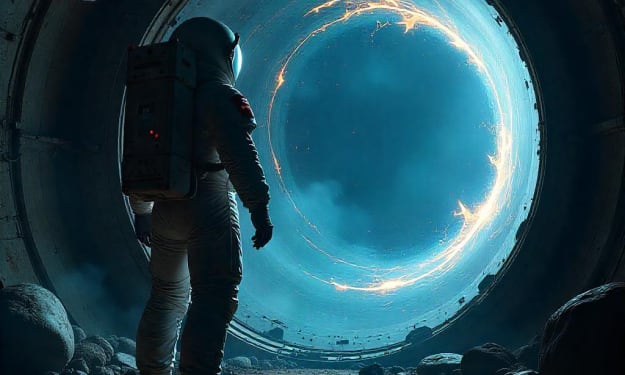
The Moon Archives: Earth’s Forgotten Memory Buried in Lunar Dust. AI-Generated.
1. The Forgotten Echo in Lunar Orbit In 2043, after decades of unmanned exploration, the UK-led Artemis-Britannica mission sent humans back to the Moon—not to conquer, but to excavate. The mission’s goal was bold: investigate strange electromagnetic echoes detected beneath the Sea of Tranquility.
By uzair hadiabout a year ago in Futurism
“Beyond the Edge: A Journey Through Darkness to Find the Light”
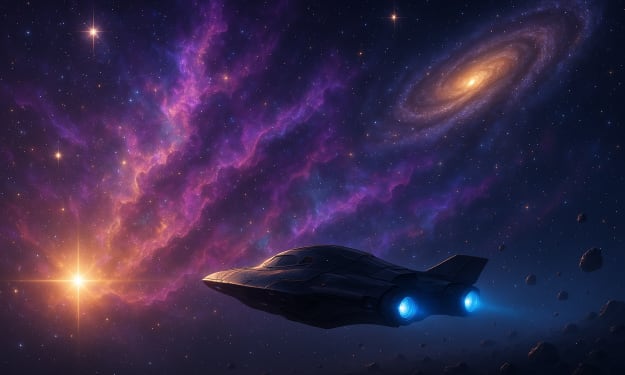
“Was the Stellar Voyager really pulled into the unknown by an unseen force?” The moment it happened, silence devoured the ship. “Captain! We're off-course!” Lieutenant Sarah Chen’s voice cracked through the comm. Captain Ethan Reid bolted upright in his command chair, his eyes darting to the main screen. The familiar Milky Way constellations had vanished, swallowed by a strange glow pulsing across the void. “What the hell is that?” Ethan whispered. The Stellar Voyager was no rookie mission—it was humanity’s most advanced deep-space exploration vessel, equipped for mapping galaxies, not falling victim to them. “Navigation’s offline. External comms dead,” said Luis Ramirez, the ship’s chief engineer. “Sir… it’s like space itself just shifted around us.” A gravitational anomaly, perhaps? Or something more?
By Mian Nazir Shahabout a year ago in Futurism
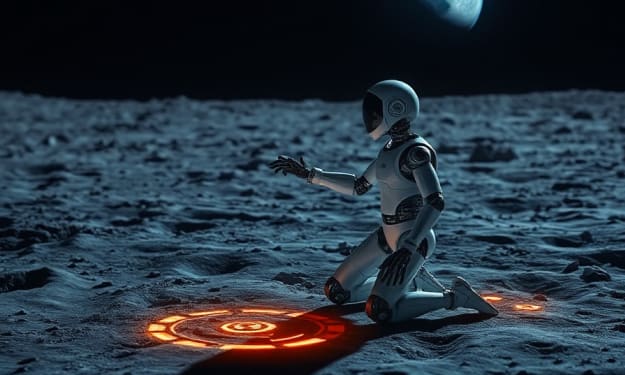
The Machine That Rewrote the Moon’s Diary. AI-Generated.
I. The Mission That Wasn’t About Secrets The Lunar Insight Engine — or L.I.E. — wasn’t built to find anything poetic. It was designed to measure lunar tectonic shifts, monitor subsurface instability, and report any anomalies that might impact Earth’s gravitational systems.
By uzair hadiabout a year ago in Futurism
The Tree That Grew in Zero Gravity — And Dreamed of Earth. AI-Generated.
No one expected it to survive. The seed was ordinary — a modified acorn harvested from a forest in Old Canada. It had been dormant for a hundred years, cryogenically preserved in Earth’s Biobank Program after global temperatures rose too high to sustain natural forests.
By uzair hadiabout a year ago in Futurism
The Light That Refused to Die — And Traveled Forever Through the Universe. AI-Generated.
In the infinite darkness of space, a spark was born. Not a spark of fire, nor a flicker of flame, but a photon — a single quantum of light, born from the implosion of a dying star named Eros-7 in the Andromeda sector. In the split-second chaos of stellar collapse, a billion photons scattered across space, most of them absorbed by dust, planets, or simply lost to the endless gravity of black holes.
By uzair hadiabout a year ago in Futurism
The Council of Nine: Guardians of the Earth Experiment Part 3
The Council of Nine: Guardians of the Earth Experiment Atlantis, ancient DNA codes, and the awakening of forgotten power within us Let me ask you something: What if Earth was never just a random planet?
By The Secret History Of The Worldabout a year ago in Futurism
Humanity Beyond the Solar System: Charting Our Interstellar Future
The Cosmic Threshold The Solar System is our cradle, but it is not our destiny. As technology evolves and the boundaries of space exploration are stretched, a new era is taking shape—one where humanity contemplates life beyond the Sun’s reach. Interstellar travel, once confined to science fiction, is increasingly becoming a subject of scientific inquiry and engineering ambition.
By Alex Kennedyabout a year ago in Futurism
Can We Find Life on Alien Planets?
Can We Find Life on Alien Planets? The James Webb Telescope's Groundbreaking Discoveries The quest to answer one of humanity's most profound questions—Are we alone in the universe?—has taken a significant leap forward. Thanks to the James Webb Space Telescope (JWST), scientists are now uncovering tantalizing clues that suggest life may exist beyond Earth. Among the most promising leads is the exoplanet K2-18 b, located approximately 120 light-years away in the constellation Leo. The Hycean World: A New Frontier K2-18 b is classified as a "Hycean" planet—a term coined to describe exoplanets that possess a hydrogen-rich atmosphere and a global ocean beneath. These planets are considered prime candidates in the search for extraterrestrial life due to their size and atmospheric conditions, which are more conducive to detailed study compared to smaller, rocky planets. Recent observations by JWST have revealed the presence of carbon dioxide and methane in K2-18 b's atmosphere, indicating a complex chemical environment. More intriguingly, scientists have detected traces of dimethyl sulfide (DMS), a compound on Earth primarily produced by marine phytoplankton and certain bacteria. The detection of DMS at levels thousands of times higher than found on Earth has led researchers to hypothesize that biological processes may be at play on K2-18 b . What Does This Mean for the Search for Life? The identification of DMS is particularly compelling because, on Earth, it is predominantly associated with life. While other non-biological processes can produce DMS, the concentrations observed on K2-18 b are unprecedented and suggest the possibility of biological activity. However, scientists caution that these findings are preliminary and require further observation to confirm the presence of life . Beyond K2-18 b, JWST has also made significant contributions to our understanding of other exoplanets. For instance, the telescope has detected frozen water in the debris disk around HD 181327, a young, sunlike star located 155 light-years away. This discovery suggests that icy bodies, which could deliver water to forming planets, are common in the universe and may play a crucial role in the development of habitable environments . The Broader Implications These discoveries underscore the potential of JWST to transform our understanding of the cosmos. By analyzing the atmospheres of exoplanets with unprecedented detail, JWST is providing insights into the conditions that might support life elsewhere. While the detection of DMS on K2-18 b is not definitive proof of life, it represents a significant step toward answering the age-old question of whether we are alone in the universe. The Discovery That Changed Everything
By Shah saab ITabout a year ago in Futurism