social media
Trending science fiction, technology, and scientific developments on social media.
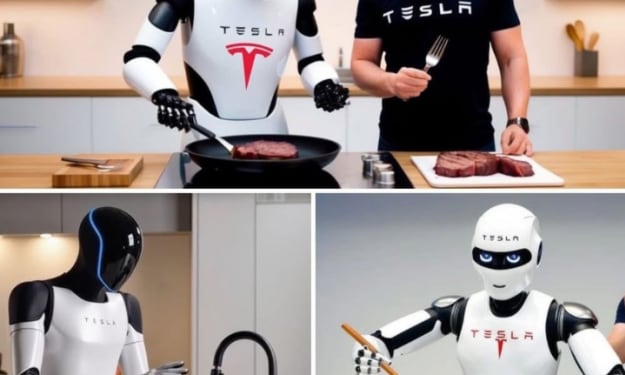
Elon Musk’s $5,000 Robot "Culina" – A Culinary Revolution or a Threat to Chefs?
Elon Musk’s $5,000 Robot "Culina" – A Culinary Revolution or a Threat to Chefs? Elon Musk has once again shocked the world with an innovation that could redefine the future of cooking. His latest creation, Culina, is a state-of-the-art robotic chef developed by Tesla’s food technology division. This AI-powered cooking assistant is designed to prepare gourmet meals with precision, efficiency, and taste that rival the world’s best chefs.
By Adnan Rasheedabout a year ago in Futurism
AI-Driven Robotics in India's Border Security A Revolutionary Step.
AI-Driven Robotics in India's Border Security A Revolutionary Step Defense technology is advancing rapidly worldwide and India is also moving towards modernizing its border security using artificial intelligence (AI) and robotics. Border surveillance is a complex and challenging task especially for countries that share multiple international borders. India which borders China Pakistan Bangladesh Nepal and Myanmar is working on introducing AI driven robotic guards to enhance its defense strategy.
By Adnan Rasheedabout a year ago in Futurism
India’s Smart Home Revolution in 2025: Are You Ready ?
When I had first installed a smart bulb in my small Mumbai apartment last month, I did not anticipate that it would be like entering the future. A mere "Alexa, turn off the lights" and I was addicted. It is March 2025, and smart homes are no longer the preserve of sci-fi fantasy—they're appearing all over India, from the high-rises of Delhi to Tier-2 cities like Indore. But what is propelling this technology wave, and are we actually prepared? Let's get in. The Smart Home Frenzy Sweeps India Step into any electronics shop these days, and you'll notice shelves filled with smart speakers, Wi-Fi thermostats, and even doorbells that double as security cameras. As per new talk on X, Indian smartphone sales increased 40% just this year because of budget choices by Xiaomi, boAt and other brands. It's not limited to cities and the super-rich—my Bhopal cousin recently paid ₹999 to get a smart plug so that he can monitor his geyser from his phone. That madness is just spreading rapidly. Why now? Firstly, the internet is faster than ever now—5G is being deployed, and small towns even have decent Wi-Fi. And, the cost is reducing. An intelligent speaker worth ₹10,000 in 2020 costs less than ₹3,000 now. Let's also throw in the local fondness for ease of living—think saying to your AC, "I'll be coming home from the office; let the room chill before I return.". Posts on X are buzzing with people sharing their “smart home hacks,” like using voice assistants to play Bollywood playlists during chai time. It’s tech meeting tradition, and India’s loving it. How These Gadgets Actually Work So, how does this magic happen? It’s simpler than you’d think. Most smart devices connect to your phone via an app and run on your home Wi-Fi. Use my smart bulb—it's connected to an app where I can switch colors or create a "movie night" atmosphere. Voice assistants such as Alexa or Google Home serve as the brain, connecting everything. You tell it, "Turn on the fan," and voilà, it's on.But it's not all about flash lights. Smart locks enable you to see if your door is locked from anywhere—ideal for paranoid people like me. Energy-saving devices, such as smart plugs, monitor power consumption, which is a biggie with increasing electricity bills. My friend in Bangalore informed me that his smart thermostat reduced his AC bill by 20%. In 2025, the devices are smarter than ever—some even learn your routine, such as switching off lights when you exit the room. It's like having a considerate roommate who never complains. What's Next for Indian Homes? The future's looking wild. By December 2025, X experts estimate 50% of Indian city dwellers will own at least one smart gadget. Firms are already hyping AI features—such as more Hinglish-savvy assistants or recipes based on the contents of your fridge. Envision you asking, "Bhai, AC thanda kar do," and it actually hearing you. But there is a flip side. Are we prepared for the glitches? My smart bulb used to flicker like a disco light during a blackout—stable electricity is something smart tech requires, which isn't so universal here in India yet. Privacy's another concern—those incessant mics always on make one question who all are listening. Yet, the convenience proves too much to resist. I read a tweet recently: "Smart homes are the new joint family—always there when you need them."So, are you ready? Whether it's a ₹500 smart plug or an entire connected home, India's smart home revolution is upon us. It's not only luxury—it's a way of life. Perhaps it's time to throw out the old switches and get partying. What's your first smart move going to be?
By Nayan Jonaki Boraabout a year ago in Futurism
The Evolution of Furniture Manufacturing: A Look at Sustainable Practices
The furniture manufacturing industry has undergone a dramatic transformation in recent years, largely driven by the growing environmental concerns of consumers and businesses alike. As climate change becomes an increasingly urgent issue, many industries are rethinking their practices, and the furniture sector is no exception. Traditionally, furniture manufacturing involved the use of natural resources like wood and chemicals that had significant environmental impacts. However, in response to the rising demand for more sustainable products, companies have turned their focus toward creating environmentally friendly furniture. Today, sustainable practices such as the use of eco-conscious materials, energy-efficient production processes, and safer finishes are becoming the standard rather than the exception.
By OPAA LIVING2 years ago in Futurism
UFOs Over New Jersey: The Government Knows, But They’re Not Telling Us the Truth
UFOs Over New Jersey: The Government Knows, But They’re Not Telling Us the Truth For decades, whispers of extraterrestrial activity have circulated throughout the United States. But lately, something strange has been happening over New Jersey’s skies, and the government doesn’t want you to know about it.
By JONATAN DAVID VEGA2 years ago in Futurism
From Classroom Consumer to Campus Creator
There’s a silent epidemic on college campuses: Students are drowning in information but starving for impact. We attend lectures, highlight textbooks, and cram for exams, yet rarely apply what we learn beyond the classroom. I know this because I was the queen of “academic osmosis”—someone who treated education like a spectator sport. But after two years of passive learning, I hit a wall. Despite straight A’s, I couldn’t answer one critical question: What am I building with this knowledge? This is how I shifted from being a consumer of education to a creator of value—and how you can too, without sacrificing your GPA or social life. The Student Consumer Trap: Why Good Grades Aren’t Enough My wake-up call came during a internship interview. The hiring manager glanced at my 3.8 GPA and said, “Impressive. Now, show me a project where you solved a real problem.” I froze. My resume was a laundry list of coursework and part-time retail jobs—zero proof I could do anything. Sound familiar? The university system often trains us to: Memorize, not apply: We regurgitate textbook theories but rarely test them in the real world. Chase grades, not growth: We stress over A’s but skip opportunities to lead clubs, launch initiatives, or create. Hoard knowledge, not share it: We treat ideas like secret treasures rather than tools to help others. I realized I’d become a professional student—great at absorbing, terrible at executing. The Myths Keeping Students Stuck Myth 1: “I’ll Start Creating After Graduation” The lie: “I’m too busy with classes to build anything now.” The truth: I spent 4 hours daily scrolling TikTok, rewatching Friends, and stressing about deadlines I’d procrastinated. Student Example: Problem: Maya, a computer science major, dreamed of building apps but “waited for free time.” Solution: She repurposed class projects. For a databases course, she created a roommate-matching app for her dorm. It went viral on campus, landed her a summer internship, and became her senior thesis. Myth 2: “I Need Permission to Create” The lie: “I’m not qualified—I’m just a student.” The truth: Your fresh perspective is an asset. Companies crave students who innovate, not just recite textbooks. Student Example: Problem: Jake, a marketing student, felt unqualified to start a podcast. Solution: He interviewed local businesses about their pandemic pivots for a class assignment. His professor shared it with the Chamber of Commerce, and Jake now hosts workshops for small biz owners. Myth 3: “Creation Requires Money” The lie: “I can’t afford software, equipment, or a team.” Use free tools: Canva for design, Google Workspace for collaboration, Anchor for podcasts. Tap campus resources: 3D printers, recording studios, and mentorship programs. Student Example: Problem: Aisha, an engineering student, wanted to prototype a sustainable water filter but had no budget. Solution: She used her department’s lab, partnered with environmental science classmates, and won a $5k sustainability grant. The Student Creator’s Playbook: 4 Steps to Start Now 1. Turn Classwork Into Portfolio Gold Don’t just submit assignments—repurpose them. Example: A sociology essay on gentrification? Expand it into a blog series or documentary short film. My Story: For a statistics course, I analyzed campus dining hall waste. I turned it into an infographic shared by the university’s sustainability office, which led to a paid role in redesigning their recycling program. 2. Leverage Campus Resources Universities are creating playgrounds—most students just don’t realize it. Free software: Adobe Creative Cloud, MATLAB, LinkedIn Learning. Clubs: Join (or start) a TEDx team, consulting group, or hackathon squad. Grants: Pitch ideas to your department. I funded a mental health podcast through a $1k student wellness grant. 3. Build in Public Share your process, not just polished results. Example: Livestream your study sessions on Twitch while preparing for finals. Teach others your note-taking method. My Story: I documented my journey writing a research paper on Instagram—from messy drafts to professor feedback. A startup founder saw it and hired me to write their whitepapers. 4. Partner with Peers Collaboration > competition. Example: Team up with an art student to illustrate your economics thesis. Partner with a coding club to automate a campus process (e.g., laundry room alerts). My Story: I co-founded a newsletter with a biology major (she wrote health tips; I covered productivity). We monetized it through local cafe ads and split the profits. The Results: Why Creating Beats Consuming After 18 months of intentional creating: My LinkedIn exploded from 200 to 5,000+ followers (employers DM me now). I’ve earned $12k+ from freelance writing, campus workshops, and mini-courses. My grades improved because applying knowledge cemented my understanding. But the biggest win? I stopped defining myself by exams. I became someone who solves problems, not just studies them. Your Assignment (Yes, Right Now) Audit Your Time Track your screen time for 48 hours. Replace just 30 minutes of scrolling with creating. Pilot a Micro-Project Turn a class presentation into a YouTube video. Design a study guide and sell it for $2 on Etsy. Organize a “Skill Swap” event (you teach essay writing; someone teaches Python basics). Fail Forward My first YouTube video got 27 views. My first blog post had 12 typos. My first workshop had 3 attendees. Keep going.
By Pure Crown2 years ago in Futurism
From Passive Learner to Active Creator
We live in a world saturated with information. Every day, we’re bombarded with podcasts, articles, online courses, and social media posts promising to teach us how to succeed. For years, I devoured this content, convinced that accumulating knowledge was the key to unlocking my potential. But despite filling my brain with strategies, hacks, and inspirational quotes, my life remained stagnant. The truth hit me hard: Consuming without creating is like stocking a library but never writing a book.
By Pure Crown2 years ago in Futurism
From Knowledge Hoarder to Action Taker
We live in an age of endless information. Want to learn how to start a business? There’s a YouTube tutorial for that. Need motivation? Plug into a podcast. Craving self-improvement? The internet is a buffet of e-books, courses, and “life hacks.” But here’s the uncomfortable truth: Most of us are addicted to consuming—not creating. We mistake scrolling for strategizing, liking for learning, and bookmarking for building. I know this because I was the ultimate consumer—a “professional learner” who confused motion with progress. For years, I drowned in information but starved for results. This is my story of breaking free from the consumer trap and discovering the transformative power of action. The Illusion of Productivity: When Learning Becomes Procrastination My journey began with noble intentions. I wanted to build a life of freedom, creativity, and financial independence. So, I did what any ambitious person would do: I consumed knowledge like it was oxygen. I devoured books: Atomic Habits, The 4-Hour Workweek, Rich Dad Poor Dad—highlighted, dog-eared, and stacked neatly on my shelf. I binge-watched tutorials: From dropshipping to digital marketing, I knew every “secret” to a six-figure income… except how to actually earn it. I curated inspiration: My notes app overflowed with business ideas, and my Pinterest boards looked like a vision board for Elon Musk. But here’s the kicker: I never shipped anything. I was like a chef who collected every cookbook, memorized every recipe, but never cooked a meal. My kitchen? Pristine. My guests? Hungry. My excuse? “I’m still learning.” The reality? I was terrified. Consuming content felt productive—it gave me a dopamine hit of “progress” without the risk of failure. But deep down, I knew the truth: I was hiding. The Lies We Tell Ourselves (And How to Smash Them) When you’re stuck in the consumer cycle, your brain becomes a factory of excuses. Here are the three big ones I battled—and how I finally dismantled them: 1. “I Don’t Have Enough Time” ⌛ My delusion: “I’ll start my side hustle when things calm down.” The truth: I spent 4 hours daily scrolling TikTok, rewatching The Office, and doomscrolling newsfeeds. The fix: I audited my screen time and reclaimed just 1 hour a day. Within a month, I’d drafted an ebook, launched a newsletter, and filmed my first YouTube video. Time isn’t the issue—priorities are. 2. “I Need More Resources” 💸 My delusion: “I’ll launch my business once I save $10k.” The truth: My first profitable project cost $12: a Canva Pro subscription and a domain name. The fix: I embraced constraints. No budget for a website? I built a LinkedIn audience instead. No money for ads? I traded skills with other creators. Scarcity fuels creativity—start small, but start. 3. “I’m Not Ready Yet” 🎓 My delusion: “I need one more course to feel qualified.” The truth: I’d taken 11 courses on copywriting… but had never written a sales page for a client. The fix: I adopted the “70% Rule.” If I felt 70% ready, I launched. My first YouTube video had terrible lighting. My first blog post was riddled with typos. But guess what? No one noticed—they just cared that I showed up. The Pivot: How I Became a Producer (and Why You Can Too) The shift didn’t happen overnight. It started with a brutal moment of self-awareness: I was intellectualizing my inertia. Knowledge wasn’t the problem—my relationship with it was. So, I made three radical changes: 1. I Swapped Consumption for Creation For every hour I spent watching a tutorial, I spent two hours applying it. Watched a video on SEO? I optimized 10 blog posts. Read a chapter on habit-building? I designed a 30-day challenge for myself. 2. I Embraced “Public Learning” Instead of hoarding ideas, I started sharing them—even half-baked ones. I posted daily LinkedIn insights, hosted free Zoom workshops, and turned my messy journey into content. Not only did this hold me accountable, but it also attracted opportunities I never expected. 3. I Redefined “Success” I stopped chasing viral moments and focused on consistency. My mantra: 1% better daily. Some days, that meant writing 200 words. Others, it meant editing a single reel. Small wins compounded faster than I imagined. The Results: Why Action Beats Theory Every Time Within six months of flipping the script, my life transformed: My “side hustle” became a full-time coaching business. My LinkedIn audience grew from 200 to 20,000+ followers. I went from $0 to $10k/month by selling digital guides and templates. But the biggest win? I stopped feeling like a fraud. For the first time, my outer reality matched my inner ambitions. Your Turn: Stop Collecting Recipes—Start Cooking The world doesn’t need more information hoarders. It needs doers—people willing to burn their eggs, botch their first draft, and embarrass themselves in the messy, glorious pursuit of progress. Here’s your starter kit: Audit Your Inputs: Reduce passive consumption by 50%. Unfollow “inspo” accounts that make you feel inadequate. Ship Something Small Today: A post, a prototype, a pitch—just get it out of your head. Reframe Failure: Every flop is data. Every cringe moment is a badge of honor. Remember: You don’t need permission, a perfect plan, or a viral moment. You just need to start. The floor is yours. That idea you’ve been overthinking? The project you’ve been “researching” for months? The life you’ve been fantasizing about? It’s time to build it. The universe rewards action, not intention. 🔥 What’s your first tiny step? Drop it below—and let’s make it real. 🚀
By Pure Crown2 years ago in Futurism