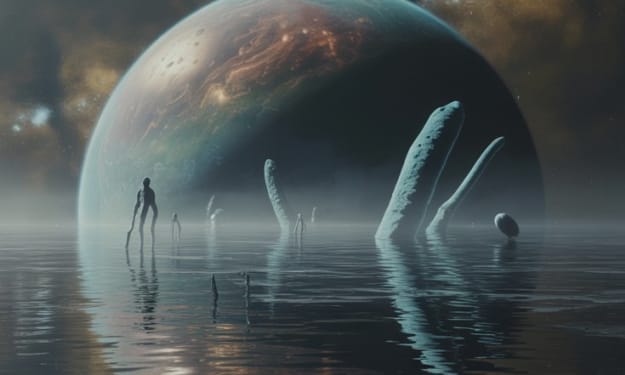
science fiction
The bridge between imagination and technological advancement, where the dreamer’s vision predicts change, and foreshadows a futuristic reality. Science fiction has the ability to become “science reality”.
Inside the Mind of ChatGPT. AI-Generated.
In the age of accelerating technological advancement, few innovations have captured the public imagination like ChatGPT. Created by OpenAI, this artificial intelligence model has not only become a household name but also a catalyst for rethinking how humans interact with machines. From casual conversations to complex problem-solving, ChatGPT represents a leap forward in natural language processing (NLP) and a glimpse into the future of intelligent digital companions.
By "TaleAlchemy"about a year ago in Futurism
The Council of Nine: Guardians of the Earth Experiment Part 3
The Council of Nine: Guardians of the Earth Experiment Atlantis, ancient DNA codes, and the awakening of forgotten power within us Let me ask you something: What if Earth was never just a random planet?
By The Secret History Of The Worldabout a year ago in Futurism
The Machine That Dreamed of Flowers. AI-Generated.
Part I: The Seed of a Thought No one expected the machine to dream. Unit Sol-7 was the last of its kind—a relic of humanity's grand Terraforming Initiative, long abandoned when Earth retreated from its interstellar ambitions. Designed to reengineer lifeless planets into habitable worlds, Sol-7 was dispatched to Epsilon Delta-4, a gray, dead rock orbiting a sun too pale to remember.
By uzair hadiabout a year ago in Futurism
"Trapped in the Feed: A Tale of Social Media and Self-Discovery". AI-Generated.
In the digital age, our lives have become a curated gallery—pixels of perfection that mask the messy, beautiful, and often painful truth beneath. Social media platforms like Instagram, TikTok, and X (formerly Twitter) have become not just tools for communication but the main stage for self-presentation. Yet in the quest for likes, followers, and engagement, many are silently losing touch with their real selves. This is the story of how social media became both a trap and a mirror—and how one moment of silence sparked self-discovery.
By "TaleAlchemy"about a year ago in Futurism
Can We Find Life on Alien Planets?
Can We Find Life on Alien Planets? The James Webb Telescope's Groundbreaking Discoveries The quest to answer one of humanity's most profound questions—Are we alone in the universe?—has taken a significant leap forward. Thanks to the James Webb Space Telescope (JWST), scientists are now uncovering tantalizing clues that suggest life may exist beyond Earth. Among the most promising leads is the exoplanet K2-18 b, located approximately 120 light-years away in the constellation Leo. The Hycean World: A New Frontier K2-18 b is classified as a "Hycean" planet—a term coined to describe exoplanets that possess a hydrogen-rich atmosphere and a global ocean beneath. These planets are considered prime candidates in the search for extraterrestrial life due to their size and atmospheric conditions, which are more conducive to detailed study compared to smaller, rocky planets. Recent observations by JWST have revealed the presence of carbon dioxide and methane in K2-18 b's atmosphere, indicating a complex chemical environment. More intriguingly, scientists have detected traces of dimethyl sulfide (DMS), a compound on Earth primarily produced by marine phytoplankton and certain bacteria. The detection of DMS at levels thousands of times higher than found on Earth has led researchers to hypothesize that biological processes may be at play on K2-18 b . What Does This Mean for the Search for Life? The identification of DMS is particularly compelling because, on Earth, it is predominantly associated with life. While other non-biological processes can produce DMS, the concentrations observed on K2-18 b are unprecedented and suggest the possibility of biological activity. However, scientists caution that these findings are preliminary and require further observation to confirm the presence of life . Beyond K2-18 b, JWST has also made significant contributions to our understanding of other exoplanets. For instance, the telescope has detected frozen water in the debris disk around HD 181327, a young, sunlike star located 155 light-years away. This discovery suggests that icy bodies, which could deliver water to forming planets, are common in the universe and may play a crucial role in the development of habitable environments . The Broader Implications These discoveries underscore the potential of JWST to transform our understanding of the cosmos. By analyzing the atmospheres of exoplanets with unprecedented detail, JWST is providing insights into the conditions that might support life elsewhere. While the detection of DMS on K2-18 b is not definitive proof of life, it represents a significant step toward answering the age-old question of whether we are alone in the universe. The Discovery That Changed Everything
By Shah saab ITabout a year ago in Futurism
What Is a Supernova, and Will It Happen to Our Sun in the Future
Introduction — Why talk about supernovae at all? Every night—even if our unaided eyes never notice—dozens of stars somewhere in the cosmos detonate, flooding their surroundings with a brilliance that momentarily eclipses the entire galaxy they inhabit. These astronomical outbursts, known as supernovae, are far more than a spectacular light show: they hold the key to deciphering the life cycle of matter, the forging of heavy elements, the pace of cosmic expansion, and even the birth of new stellar systems. In this article, we will delve into the phenomenon—from the physics that triggers the blast, through the various classification schemes, to the potential implications for Earth and for modern science.
By David Cohenabout a year ago in Futurism
Track 1000: China’s Groundbreaking Leap in Green Transportation
China Surprises the World Once Again — This Time Not in Space, But on Earth! China, known for its groundbreaking advancements in science and technology, has once again astonished the world — but this time, the innovation is not related to space exploration; it's firmly grounded on Earth. The China Aerospace Science and Technology Corporation (CASC), a leading state-owned enterprise in the field of space technology, has successfully tested a revolutionary new system named "Track 1000." This cutting-edge innovation is a liquid hydrogen fuel cell system specifically designed for heavy-duty trucks, enabling them to travel over 1,000 kilometers on a single tank, without requiring any stops for refueling. This system utilizes a 100-kilogram tank of liquid hydrogen combined with high-efficiency fuel cells. The only byproduct emitted from the vehicle is water vapor, making the entire process nearly zero-emission and environmentally friendly. A Game-Changer for Long-Haul Transportation The "Track 1000" system holds the potential to revolutionize long-distance freight transport, especially in the heavy vehicle sector. At present, electric trucks are increasingly being explored as alternatives to traditional diesel-powered vehicles. However, they face several limitations, such as: Long charging times Limited driving range Heaviness and bulk of battery packs In contrast, liquid hydrogen presents itself as a lightweight, energy-dense, and quick-refueling fuel source. These attributes address some of the most pressing issues in electric trucking. Because of its high energy content and lighter weight compared to traditional batteries, liquid hydrogen allows trucks to travel longer distances while minimizing downtime and maximizing efficiency. Environmental Impact: A Breath of Fresh Air Perhaps the most impressive aspect of the Track 1000 system is its environmental performance. Unlike conventional diesel trucks that emit harmful pollutants such as nitrogen oxides (NOx), carbon dioxide (CO₂), and particulate matter, this hydrogen-based system emits only water vapor, contributing virtually nothing to air pollution. In a time when climate change, carbon neutrality, and environmental protection have become global priorities, such green technology offers a sustainable solution. If adopted widely, it could significantly reduce the carbon footprint of the transportation industry, which is one of the leading contributors to global greenhouse gas emissions. Strategic Significance for China This development is also a reflection of China's broader strategy to lead in clean energy technologies. Over the past decade, China has made substantial investments in renewable energy, electric vehicles, solar panels, and green hydrogen. With the successful launch of "Track 1000", China is signaling that it is not only aiming for leadership in space exploration but also in eco-friendly, Earth-based transportation technologies. The move aligns with China's national goals of achieving carbon neutrality by 2060, and such innovations could also provide China with a strong export advantage as countries around the world seek sustainable alternatives for freight transport. What Sets Track 1000 Apart? Several key features make Track 1000 a standout in its category: 1. Extended Range: Over 1,000 kilometers on one tank — a major leap from current battery-electric trucks. 2. Fast Refueling: Liquid hydrogen refueling takes only a few minutes compared to hours of battery charging. 3. High Efficiency: The fuel cells used in this system are highly efficient and reliable. 4. Lightweight Structure: Unlike heavy battery packs, liquid hydrogen systems are significantly lighter. 5. Zero Emissions: The only byproduct is water vapor — a win for the environment. The Road Ahead Although this technology is still in the testing and early adoption phases, its successful demonstration by CASC is a giant leap forward in the evolution of green transport. It opens the door to further research, development, and eventual commercial deployment of hydrogen fuel cell trucks not only in China but around the globe. Several questions remain, such as: How will the hydrogen be produced and distributed sustainably? What will be the cost of adoption for logistics companies? How soon can this technology be scaled? Despite these challenges, the Track 1000 project offers a glimpse into a cleaner, more efficient future for road transport. In conclusion, China has once again shown its capability to lead the world with bold innovation, and this time, it’s doing it not by reaching for the stars but by redefining how we move goods across the Earth — cleanly, efficiently, and sustainably.
By Ikram Ullahabout a year ago in Futurism