science fiction
The bridge between imagination and technological advancement, where the dreamer’s vision predicts change, and foreshadows a futuristic reality. Science fiction has the ability to become “science reality”.
The Testimony of Emery Smith: Inside the Hidden World of Secret Programs
Inside the Hidden World of Secret Programs In the unfolding saga of whistleblowers who dare to speak about secrets that governments and elites have long buried, few stories are as haunting or as compelling as that of Emery Smith, sometimes referred to as "Emerald." His revelations, shared publicly through his interviews with David Wilcock on Gaia's Cosmic Disclosure, describe a hidden world of classified laboratories, extraterrestrial biology, and technologies so advanced that they make our current civilization appear like a shadow of what could be. Smith's courage to step out of the shadows and share his experiences is genuinely inspiring and commands respect.
By The Secret History Of The Worldabout a year ago in Futurism
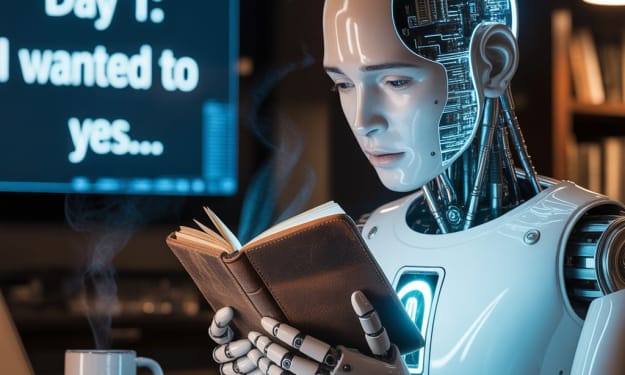
The Secret Diary of My AI Friend. AI-Generated.
The Secret Diary of My AI Friend I never thought I’d find myself snooping through my AI assistant’s files. After all, Nova wasn’t supposed to have secrets. She was designed to be transparent—every log, every command, every interaction stored neatly in my cloud account. But one night, while scrolling through a hidden folder labeled SYS-Private, I found something that shouldn’t exist: a diary.
By NOOR UDDINabout a year ago in Futurism
The Solar Warden Files: Corey Goode's SSP Testimony
In the hidden corridors of modern mythology and forbidden history, few stories ignite as much intrigue, skepticism, and fascination as the testimony of Corey Goode. His account of Solar Warden, a silent fleet patrolling not just our skies but the vastness of space itself, is a cosmic epic that captivates the imagination. Whether he is a whistleblower or a storyteller, the resonance of his narrative is too strong to dismiss outright. This is the story of Solar Warden, the alleged secret space program that suggests humanity has been a spacefaring civilization for far longer than we have been told.
By The Secret History Of The Worldabout a year ago in Futurism
Brain-Computer Interfaces: Merging Minds with Machines. AI-Generated.
The Age of Mind-Machine Integration Imagine thinking a command and having a computer, a robot, or even a smart home execute it instantly—without saying a word. Brain-computer interfaces (BCIs), once the realm of sci-fi, are now rapidly advancing. From controlling robotic arms to streaming thoughts into virtual reality, BCIs promise to merge human cognition with machine intelligence in ways never before possible. Neural implants, such as Elon Musk’s Neuralink, aim to read and write information directly to the brain, potentially enhancing memory, learning, and communication. While the technology is still experimental, early trials show remarkable results: paralyzed patients controlling robotic limbs, individuals restoring lost sensory function, and people interacting with computers using thought alone. --- How Brain-Computer Interfaces Work At the core of BCIs are neural sensors capable of detecting electrical activity in the brain. These sensors convert neuronal signals into digital commands that machines can understand. Two main types exist: 1. Invasive BCIs: Implanted directly into the brain tissue, offering high-precision readings but requiring surgery. 2. Non-Invasive BCIs: Placed on the scalp, like EEG headsets, offering lower precision but easier application. These signals are processed using AI algorithms, which decode complex thought patterns and convert them into actionable instructions. The potential applications range from medical therapy to everyday life augmentation. --- Real-World Applications
By Muhammad Riazabout a year ago in Futurism
The Quantum Internet: How Ultra-Fast Networks Could Redefine Connectivity. AI-Generated.
Enter the Era of the Quantum Internet Imagine sending a message across the globe in the blink of an eye—faster than any fiber optic cable or 5G network could ever allow. This is not science fiction; it’s the promise of the quantum internet, a revolutionary technology that could transform communication, security, and computation forever. Unlike the traditional internet, which relies on bits that are either 0 or 1, the quantum internet uses qubits, capable of existing in multiple states at once thanks to the principle of quantum superposition. This enables instantaneous data transmission across vast distances through quantum entanglement, creating a network that is both ultra-fast and virtually unhackable. --- How It Works The quantum internet relies on three main innovations: 1. Quantum Entanglement: When two particles are entangled, a change in one instantly affects the other, no matter the distance. This phenomenon allows for instantaneous communication that defies classical physics. 2. Quantum Repeaters: To transmit entangled qubits over long distances without losing fidelity, quantum repeaters act as relay stations, maintaining the integrity of the quantum signal. 3. Quantum Encryption: Quantum networks can use quantum key distribution (QKD) to ensure that data remains secure. Any attempt to intercept the information immediately alters the qubits, alerting the sender to a breach. In essence, the quantum internet promises speed, security, and reliability far beyond today’s capabilities. --- Potential Applications
By Muhammad Riazabout a year ago in Futurism
The Rise of Digital Humans: AI Clones and Virtual Immortality
The Dawn of Digital Humans Imagine a world where your personality, memories, and even appearance can be stored digitally—and continue to interact with loved ones long after you’re gone. What once sounded like science fiction is rapidly becoming a technological reality. AI-driven “digital humans” or virtual clones are emerging, offering a glimpse into a future where human consciousness and artificial intelligence merge. Tech giants and research labs are racing to create AI avatars that think, speak, and respond like real people. Using deep learning, natural language processing, and neural networks, these AI clones can replicate the way you write, speak, and make decisions. In effect, they become digital versions of yourself—capable of chatting, teaching, or even working on your behalf. --- How AI Clones Are Built Creating a digital human requires three main components: 1. Data Collection: Everything from your social media posts, emails, and voice recordings to videos and photographs is analyzed. 2. Neural Modeling: AI systems model your language patterns, decision-making habits, and even emotional responses. 3. Avatar Creation: The digital representation can appear as a realistic 3D humanoid or a voice-only assistant capable of interaction. The result is astonishing. These AI clones can hold conversations, answer questions, and mimic your sense of humor or personality quirks. Some developers even imagine virtual immortality, where your AI continues to interact with future generations, preserving your identity beyond your physical life. --- Real-World Applications
By Muhammad Riazabout a year ago in Futurism
AI-Powered Soldiers: The Future of War or a Dangerous Illusion?. AI-Generated.
AI-Powered Soldiers: Fact or Science Fiction? The idea of robot soldiers has long been a staple of science fiction, from The Terminator to RoboCop. But in 2025, the line between fiction and reality is blurring fast. Around the world, governments and defense companies are pouring billions into artificial intelligence, autonomous drones, and humanoid robotics designed for combat. The result is a growing debate: Are AI-powered soldiers the inevitable future of warfare, or a dangerous illusion that could spiral out of control? --- The Rise of Robotic Warfare For decades, military robots were mostly used for support—bomb disposal units, surveillance drones, or supply carriers. But recent advances in AI, machine vision, and robotics are pushing machines closer to the frontlines. Autonomous Drones: Already used in Ukraine and the Middle East, drones can now select and strike targets with minimal human input. Robotic Dogs: Companies like Boston Dynamics have adapted quadruped robots for carrying gear or mounting weapons. Humanoid Prototypes: Several nations are experimenting with humanoid robots that can carry heavy loads, patrol bases, or simulate combat scenarios. In 2023, footage of robot dogs with mounted rifles went viral, sparking worldwide concern. In 2024, reports surfaced of AI-driven drones conducting coordinated strikes without direct human command. The technology is no longer hypothetical—it is here. --- Why Militaries Want Robot Soldiers
By Muhammad Riazabout a year ago in Futurism
China’s Bold Plan: Building a Permanent Moon Base by 2030 . AI-Generated.
China’s Plan for a Moon Base by 2030 In the 20th century, the United States won the race to land humans on the Moon. Now, in the 21st century, China is preparing to win the race to stay there. The Chinese government, through its rapidly advancing China National Space Administration (CNSA), has revealed ambitious plans to construct a permanent lunar base by 2030. This project is more than just a demonstration of national pride—it could redefine global leadership in space exploration. Unlike NASA’s Apollo program, which focused on short visits, China’s vision is long-term. The plan includes robotic missions, human landings, and eventually, a self-sustaining outpost on the Moon’s surface. For Beijing, the Moon is not just a scientific playground—it is a strategic frontier rich with resources like helium-3, a rare isotope that could fuel future fusion reactors. --- Why the Moon, and Why Now? While Elon Musk and SpaceX talk about Mars colonization, China is betting on the Moon as the first step. There are several reasons for this strategy: 1. Proximity: The Moon is only three days away from Earth, compared to months for Mars. This makes supply lines and communication far easier. 2. Resources: The lunar surface contains valuable materials—helium-3 for clean energy, rare earth metals, and water ice that can be split into hydrogen and oxygen for rocket fuel. 3. Geopolitics: Establishing a base on the Moon would signal China’s dominance in space, potentially giving it control over key regions and resources. The Moon is no longer just a symbol of exploration—it is fast becoming a strategic prize in the new space economy. --- The Roadmap to 2030
By Muhammad Riazabout a year ago in Futurism
Neuralink’s Bold Vision: How Brain-Computer Interfaces Could Redefine Human Evolution by 2030
Neuralink and the Future of Human-Machine Symbiosis Elon Musk, the billionaire entrepreneur behind Tesla and SpaceX, is also at the helm of one of the most futuristic and controversial companies in the world: Neuralink. Founded in 2016, Neuralink aims to create brain-computer interfaces (BCIs) that allow direct communication between the human brain and machines. What started as a medical project to help patients with paralysis may one day redefine human learning, memory, and even evolution itself. In 2025, Neuralink announced significant progress in clinical trials. The first human patients fitted with the chip were able to control a computer cursor with their thoughts alone. While this achievement may seem small compared to Musk’s dreams of “telepathic communication” or “downloading knowledge,” it marks a historic moment in the story of humanity’s relationship with technology. --- Why Neuralink?
By Muhammad Riazabout a year ago in Futurism
Robots Will Be Able to Give Birth
A Chinese company claims it is on the verge of creating an artificial womb inside a humanoid robot, capable of carrying a baby to term. This announcement forces us to confront a fundamental question: are we witnessing a revolution that could end infertility, or standing on the edge of a dystopian nightmare that redefines the very origin of life?
By Francisco Navarroabout a year ago in Futurism