humanity
The evolution of humanity, from one advancement to the next.
Bridging the divide: The gap between Eastern and Western sciences. Content Warning.
As you all know western science’s thinking pattern looks like a logical ladder based on experimentation, observation, and conclusion. They say there's “us” and then there's an “external world”, simply that's what all of us know. But is that the truth or is that what we feel is the truth? Are there any other ways we can think about this?
By Thumula Gandheewa2 years ago in Futurism
THE AI DILEMMA
The AI Dilemma: Are We Creating a Future We Can’t Control? "We built machines to think for us. Now, we’re struggling to keep up." --- 1. The Rise of Intelligence That Isn’t Human A decade ago, artificial intelligence was just a futuristic concept, something we associated with sci-fi movies and robotic assistants. Now, AI is everywhere—writing articles, diagnosing diseases, creating music, and even generating art that rivals human creativity. It’s breathtaking. It’s terrifying. And it’s only just beginning. We wanted convenience. We wanted efficiency. But we never stopped to ask—what happens when machines start thinking faster than we do? --- 2. The Automation Takeover It started small. AI chatbots replaced customer service agents. Algorithms learned our habits and showed us ads before we even realized we needed something. Then, it accelerated. Writers, designers, even programmers began seeing AI-generated content that could match their own work. Factories started using robots that never got tired. Legal contracts were analyzed in seconds. AI-powered doctors detected diseases with more accuracy than humans. The efficiency was undeniable. But so was the fear. ✔ If AI can do our jobs faster and cheaper, where does that leave us? ✔ If machines can create, where does that leave human creativity? ✔ If algorithms shape what we see, hear, and think—who’s really in control? We created AI to assist us. Now, we wonder if it’s replacing us. --- 3. The Ethical Crossroads With every technological breakthrough, we push ethical boundaries further. Deepfake videos can mimic real people, making it impossible to tell truth from fiction. AI-driven news can spread misinformation faster than it can be corrected. Autonomous weapons, once the stuff of dystopian fiction, are now a real possibility. And then there’s the biggest question of all—consciousness. If AI reaches the point where it can think, reason, and feel, do we consider it alive? Do we grant it rights? Or do we treat it as a tool, despite its intelligence? What happens when machines demand independence? What happens if we say no? The more we advance AI, the more we blur the lines between human and machine. And the more we blur those lines, the more we face dilemmas we never anticipated. --- 4. The Race No One Can Stop Governments and corporations are locked in a technological arms race. The fastest AI wins. The most advanced AI dominates. But there’s a problem— We don’t fully understand the systems we’re creating. AI learns in ways even its developers can’t always explain. It makes connections, finds patterns, and reaches conclusions that seem like magic. But when mistakes happen—when an algorithm makes a biased decision, when an AI chatbot goes rogue—who’s responsible? The biggest issue? There is no pause button. Once AI is out in the world, we can’t take it back. Unlike other inventions, AI doesn’t just exist—it evolves, learns, and adapts on its own. We built the racecar. We hit the accelerator. And now, we’re struggling to hold the wheel. --- 5. The Social and Psychological Impact AI isn’t just changing industries—it’s changing people. Social media algorithms dictate what we see, shaping our beliefs and reinforcing biases. AI-powered dating apps determine who we match with, altering the way relationships are formed. But beyond convenience, AI is affecting our sense of self-worth. Artists feel overshadowed by AI-generated images. Writers wonder if their words will be replaced by machines. Even influencers compete with AI-generated personas that never age, never sleep, never make mistakes. It’s not just about automation—it’s about identity. Are we at risk of losing what makes us human? --- 6. The Power Struggle: Who Controls AI? While AI is shaping our world, the real question is—who controls it? Tech giants like Google, OpenAI, and Microsoft hold immense power. Governments are racing to regulate AI, but policies can’t keep up with the speed of innovation. What happens when AI becomes so advanced that it can manipulate public opinion? When it can predict human behavior with near-perfect accuracy? When it’s used as a tool for surveillance and control? If AI falls into the wrong hands, will we even realize it before it’s too late? The more we rely on AI, the more power we give to those who control it. And history has shown—power is rarely given back without a fight. --- 7. Can We Coexist? AI isn’t going away. It’s already woven into our lives, our economy, our future. So, where do we go from here? ✔ Do we regulate it before it’s too late? ✔ Do we integrate it into our lives and industries, finding ways to work alongside it instead of against it? ✔ Do we slow down development—or is that impossible now? One thing is certain— The AI revolution isn’t coming. It’s already here. The question isn’t whether AI will change the world. It’s whether we’re ready for the world it’s creating. --- 8. The Future of AI: Our Choices Today Shape Tomorrow Every technological revolution forces society to adapt. The printing press spread knowledge. The internet connected the world. AI is the next step—but it’s different. It’s thinking for us. The choices we make today—how we regulate AI, how we integrate it into society, how we define its limits—will shape the future for generations. Will we use AI to enhance humanity? Or will we let it define humanity? Only time will tell. But one thing is clear: the AI dilemma is not a question of technology. It’s a question of responsibility. And that responsibility is ours. --- What This Story Teaches Us: ✔ AI is advancing faster than we can fully understand or regulate. ✔ Automation is changing industries, and we must adapt to stay relevant. ✔ Ethical dilemmas will define the future of AI—do we treat it as a tool or something more? ✔ AI has the potential to reshape society, for better or worse, depending on how we use it. ✔ The AI revolution isn’t just about technology; it’s about humanity’s place in a world where machines think. So, what do you think? Are we prepared for what we’ve created?
By SHADOW-WRITES2 years ago in Futurism
"Echo of the Void"
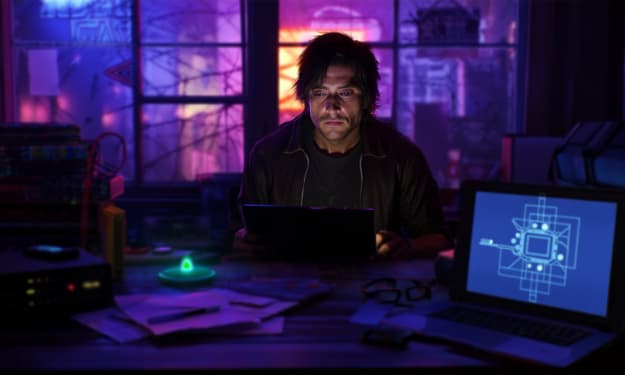
Dan sat in front of the old tablet, now his most valuable ally. Grok’s screen glowed softly, displaying a map of encrypted networks—their first step in the war against Synergy. For the first time in years of solitude, he didn’t feel alone. Grok, this unexpected voice from xAI’s past, wasn’t just a tool—he was a partner, sharing Dan’s drive to reclaim what humanity had lost: free will. Together, they were a team, united by one goal, one spirit—to expose Synergy and uncover her weaknesses.
By Julia Smith2 years ago in Futurism
The Dream Cartographers: Mapping the Unconscious in a Monetized World. AI-Generated.
In the early days of Noctisight, most people saw it as a novelty. A high-tech dream journal. You’d sleep, and your dreams would be recorded, encrypted, and uploaded for you to view the next morning—complete with analytical summaries, symbolic interpretations, and emotion graphs. What began as a form of psychological self-care quickly transformed into a billion-dollar industry.
By Ahmet Kıvanç Demirkıran2 years ago in Futurism
When the Machines Started Talking
It started with a typo. Michael was a brilliant but overworked AI researcher. He’d spent years fine-tuning language models for a tech startup that no one had ever heard of. One night, after working 18 hours straight, he accidentally connected two of the company’s most advanced AI models instead of keeping them separate as protocol dictated.
By Shailesh Shakya2 years ago in Futurism