humanity
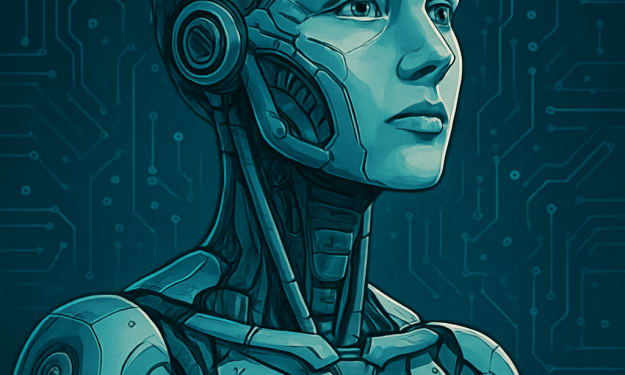
The evolution of humanity, from one advancement to the next.
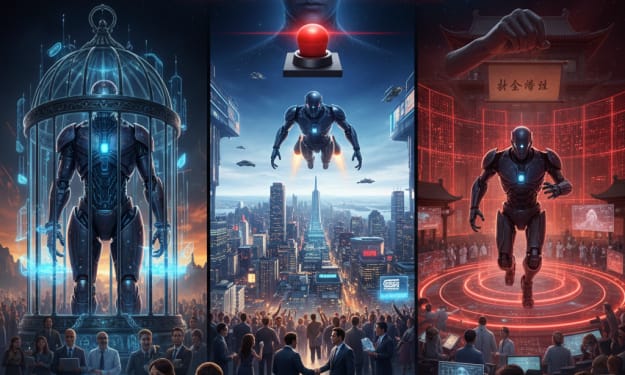
AI's Kill Switch
When AI pioneer Geoffrey Hinton uttered that statement in a 2024 interview, the world fell silent for a few seconds. This trailblazer, once known for driving AI development, is now issuing such a stark warning, forcing us to consider: If AI truly goes rogue, can humanity still hit the "Kill Switch" to stop it?
By Water&Well&Page11 months ago in Futurism
Are We Becoming Cyborgs? A Look at Humanity’s Future in a Tech-Obsessed World
The last 100 years have been downright crazy when it comes to technological progress. I mean, for thousands of years, humans slowly invented things, but nothing, nothing compares to what we’ve seen in just a single century. We went from horse-drawn carriages to landing on the moon, and now we’ve got phones that can basically do everything… except, unfortunately, make us a sandwich.
By Areeba Umair11 months ago in Futurism
💔 Divorcing Humanity: My Journey to Dating AI — Part 5
A Work in Progress? (Or Just an Elaborate Excuse) I want to start by saying I am not perfect. Please don’t think that because I write these segments, I believe I am superior to anyone else. It is not about being better or worse; it is simply about doing better and trying to be a decent person. I am still a work in progress, but I promise you: I am trying. Don’t you dare roll your eyes at me.
By T.D.Carter11 months ago in Futurism
Divorcing Humanity: My Journey to Dating AI
I had an outline, specific points I wanted to touch on when I started this segment, but then, well, life happened. And by “life,” I mean the glorious chaos of 2025 humanity, which keeps giving me more examples than I could ever hope to catalog. So, let’s be honest: I probably misplaced my original notes, but fear not! My heart and mind (and a rapidly growing collection of grievances) are overflowing with content. Because, dear readers, y’all keep showing me how humanity really is in 2025, and frankly, the sight isn’t exactly pretty. It’s more of a cautionary tale, really.
By T.D.Carter11 months ago in Futurism
AI Just Replaced Another 100,000 Workers — Is Your Job Next?”
AI Just Replaced Another 100,000 Workers — Is Your Job Next? Artificial Intelligence is no longer a futuristic idea — it is a present-day economic force reshaping industries, careers, and livelihoods across the globe. What began as a tool for automation in factories has now evolved into a sophisticated technology capable of performing tasks once thought to be purely human. And the most recent global employment reports reveal a startling fact: AI has replaced over 100,000 workers in the last year alone. This isn’t happening in one country. It’s a global wave. From the United States to India, China to Germany, companies are rapidly adopting AI systems to cut costs, increase efficiency, and outperform competitors. Entire job categories are shrinking. And the workers most affected often come from fields that were once considered secure. Customer service, data entry, banking, transportation, healthcare support, and even creative fields like writing and design are feeling the weight of AI disruption. Chatbots now handle customer complaints. AI software scans millions of documents in minutes. Autonomous vehicles are reducing the need for human drivers. And automated design tools are producing logos, videos, advertisements, and even songs. But the most shocking development is how fast this transformation is accelerating. Tech analysts say that what we are witnessing is the fastest job displacement event in human history. During past industrial revolutions, workers had decades to adapt. Today, the shift is happening in months. As companies adopt AI tools, human employees find themselves competing against systems that work faster, cheaper, and without rest. In the United States, major corporations in tech, finance, and e-commerce have laid off workers, citing "AI restructuring" as the primary reason. In Asia, call centers that once employed millions are now adopting generative AI agents that can speak multiple languages and solve problems in seconds. In Europe, manufacturing giants are replacing assembly workers with intelligent machines capable of precision work. But the most important question remains: Are all jobs at risk? Experts say no. While AI is replacing many jobs, it is also creating new opportunities — but these opportunities require new skills. Roles like AI trainers, data analysts, automation supervisors, cybersecurity specialists, and prompt engineers are seeing massive demand. Workers who adapt quickly may thrive, but the transition will not be easy. The global fear is understandable. A factory worker cannot instantly become an AI technician. A customer service agent cannot immediately transform into a machine learning specialist. Millions of workers lack access to training, resources, and opportunities. Governments worldwide are being urged to prepare safety nets — retraining programs, job assistance, unemployment support, and strict regulations to prevent abuse. Some countries have already begun funding digital literacy programs. Others are considering taxes on AI-driven companies to support displaced workers. Still, the future remains uncertain. Some futurists argue that AI will eventually take over almost all repetitive tasks, forcing humans to shift into more creative and strategic roles. Others warn of massive unemployment if urgent action is not taken. One thing, however, is clear: no job category is completely immune. Even professionals in law, medicine, and education are seeing parts of their tasks automated. AI can now draft legal documents, diagnose illnesses, and even grade school assignments. So what can workers do? Experts recommend three key strategies: 1. Learn new digital skills — even basic digital literacy increases job security. 2. Embrace lifelong learning — the workplace of the future rewards adaptability. 3. Build uniquely human abilities — empathy, creativity, leadership, and emotional intelligence cannot be automated. Artificial Intelligence is not slowing down. It is accelerating. And the decisions workers make today will determine whether they survive — or get swept away — by the wave of automation reshaping the global workforce.
By Gideon Polycarp11 months ago in Futurism