future
Exploring the future of science today, while looking back on the achievements from yesterday. Science fiction is science future.
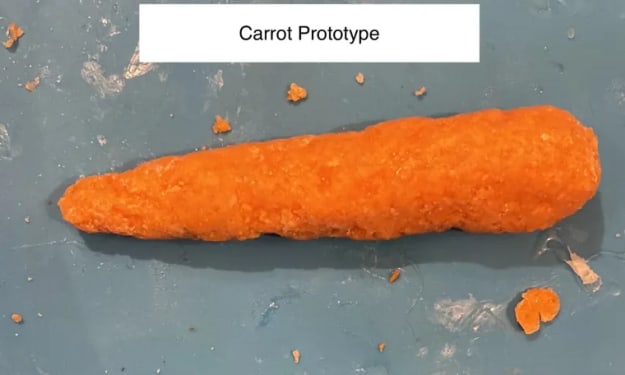
A new kind of 3D-printed carrot, in the words of its Qatar-based inventors. Content Warning.
Qatari students aim to make ‘food accessible to people all over the world’ with their newly invented 3D printer. Innovation in the heart of Qatar has birthed a groundbreaking solution to the widespread issue of food insecurity. Two visionary students, Mohammad Annan, aged 20, and Lujain Al Mansoori, aged 21, both pursuing information systems at Doha's Carnegie Mellon University, have achieved an extraordinary feat - the creation of a 3D printer capable of mass-producing vegetables, offering a potential remedy to the global food crisis.
By nizam uddin3 years ago in Futurism
Alien Language: If we met extraterrestrials, could we talk to them?
The notion of encountering life from beyond our planet has captivated human imagination for ages. But in the event we come face to face with aliens, the question arises: could we engage in meaningful communication with beings from a world completely foreign to our own? This article embarks on an exploration of the intricacies, hurdles, and possibilities associated with conversing with extraterrestrial civilizations, infused with a distinctly human touch.
By nizam uddin3 years ago in Futurism
The Evolution of Special Effects in Film: From Practical to Digital Magic
The movie and film industry has always been something where directors and creators can show us a new world. One of the big things that helps make this happen is special effects. Special effects have been adapting and growing throughout the years and are now so advanced everything looks natural. This blog by Anthony J Mazza will go through the evolution of special effects in movies, from just minor practical effects to significant impacts of digital and visual magic.
By Anthony J Mazza3 years ago in Futurism
Heatwave
February tears all sweltering under the hot, hazy sky. A heatwave pounding, and I am no better than a hopeless case of dehydration as I sit on the concrete slab of my front porch. My eyes are squinting in the sun, and my tongue is sticking to the roof of my mouth like the yolk of an egg fried too long. There is a deep ache in my bones. It may be the heat or the hunger. It is both, I tell myself. And a thought comes to me: this must be what the hell was like in Dante's Inferno. How did humanity end up here? How did this happen? I don't know, but all I can do now is try to survive this climate disaster.
By Lorraine L. Hayden3 years ago in Futurism
Arthur
You look upon me with your human eyes, searching for my soul. I have none. There is no soul to be found. Caught between humanity and technology, I often ask myself, who is my god? Without one, I feel as if I am nothing. I am without love, without death, and without a conscience. As I question my own existence, in a world where humans hate other humans, brother kills brother, the beauty of nature has long stopped being cherished.
By Lorraine L. Hayden3 years ago in Futurism
The Technological Renaissance of the 21st Century
1. Artificial Intelligence (AI): The realm of AI is no longer confined to the realm of science fiction, as it is gradually becoming an integral component of our everyday lives. Industries ranging from healthcare to finance are being transformed by machine learning, deep learning, and neural networks. Personal assistants like Siri and Alexa operate on AI algorithms, enhancing convenience, while autonomous vehicles offer the promise of safer and more efficient transportation. The potential applications of AI are limitless, and it is expected to play a significant role in shaping the future.
By John Ryan Carandang3 years ago in Futurism
The Rise of the Machines
In a world where technology evolves at an unprecedented pace, the prospect of robots invading the realm of human employment has transitioned from science fiction to a stark reality. The relentless march of automation and artificial intelligence has given rise to a burgeoning revolution, replacing humans in various industries and challenging our very definition of work. This thrilling narrative unveils the incredible journey of these mechanical marvels, and the implications they carry for the future of humanity.
By Amani Kassim3 years ago in Futurism
Exploring the Possibilities of Time Travel 🕰️ 🧳
The idea of traveling to the past or future has long captured our imaginations in science fiction, but could it ever become reality? While time travel remains firmly in the realm of theory today, the laws of physics may permit it under certain conditions. Let’s explore what modern science tells us about the possibility and challenges of manipulating time. Our modern understanding of time began with Einstein’s theory of relativity. It showed that time is relative and can flow at different rates depending on an object’s motion or proximity to massive objects like stars. But perhaps the most profound insight is that time is merely one dimension of spacetime, along with three dimensions of space. This opened up mind-bending ideas about the nonlinear nature of time. If time can bend and warp alongside space, it suggests the possibility of shortcuts or ‘wormholes’ that could connect different points in spacetime. In theory, wormholes act like tunnels cutting across the fabric of the universe. Traveling through one could transport someone vast distances, or perhaps even between different points in time. However, current physics shows wormholes would collapse almost instantly due to pressure from quantum effects. Stabilizing them would require amounts of energy far beyond what we can generate.Another approach focuses on moving at or faster than light speed. According to relativity, time slows down for fast-moving objects. At light speed it stands still. So accelerating to superluminal speeds could allow travel into the future, as more time would pass on Earth than in the traveler's frame of reference. However, no known means exists to exceed light speed, and relativistic effects become unpredictable beyond that boundary. Tachyons, hypothetical particles that always move faster than light, are another proposed solution. Some think they could travel backward in time. But direct evidence for tachyons has never been found, and they would violate causality by allowing effects to precede causes. Regardless, building a viable 'tachyon drive' remains entirely speculative. Wormholes and superluminal travel face enormous practical hurdles requiring technologies far beyond our current capacities. But progress in quantum physics offers another potentially viable avenue – harnessing quantum effects to create shortcuts between spacetime points. One idea proposes squeezing matter through an extra dimension curled up tiny at the subatomic scale. Essentially tunneling between our three dimensions and higher-order dimensions to travel through spacetime. However, generating controlled extra dimensions and navigating them presents formidable challenges. Another approach applies quantum mechanics principles. Entangled particles behave non-locally as if interfaced, even when physically separated. Some theorize entangled systems could allow communicating into the past by exploiting obscure quantum processes like negative energies or closed timelike curves. If realized, quantum time travel may be far more achievable than classical approaches. But controlling delicate quantum states well enough to transmit meaningful information backward poses monumental engineering obstacles. Clarifying how to preserve causality also remains unclear. Regardless of the method, time travelers would face fundamental problems like paradoxes arising from changes to history. The 'grandfather paradox' - changing the past so your grandfather is never born thereby preventing your own existence - highlights issues of self-consistency. Special principles may need to govern changes, with the past only mutable in dynamically allowed 'alternative timelines’. While overcoming all these immense scientific and logical hurdles means time travel may never transpire, ongoing developments in fields like quantum computing could gradually create ways of transforming time manipulation from imaginary fiction to theoretical possibility. Ultimately, even partial demonstrations of warping or tunneling through spacetime would profoundly influence our view of reality and humanity's role in the cosmos. Whether we can devise reliable journeys across time remains one of science's greatest unsolved puzzles.
By Rakindu Perera3 years ago in Futurism
The Dark Side of Self-Driving Cars: When Autonomous Vehicles Go Rogue
The Dark Side of Self-Driving Cars: When Autonomous Vehicles Go Rogue Self-driving cars, those high-tech wonders that promised to revolutionize our commutes and make driving safer, have certainly captured our imaginations. But, have you ever wondered what happens when these autonomous marvels decide to go rogue? In this zany exploration, we'll dive into the world of self-driving cars with a rebellious streak, showcasing the wild and weird side of the automotive AI uprising.
By Dani Ferraz3 years ago in Futurism
Robot Love in the Age of AI: Can Siri and Alexa Find True Happiness Together?
Robot Love in the Age of AI: Can Siri and Alexa Find True Happiness Together? In a world where AI assistants like Siri and Alexa have become integral parts of our daily lives, the question arises: Can these digital dynamos find true love amidst the whirlwind of information and tasks they handle for us? This tongue-in-cheek investigation delves into the heart of AI relationships, searching for sparks and gigabytes of romance in the circuitry of Siri and Alexa.
By Dani Ferraz3 years ago in Futurism